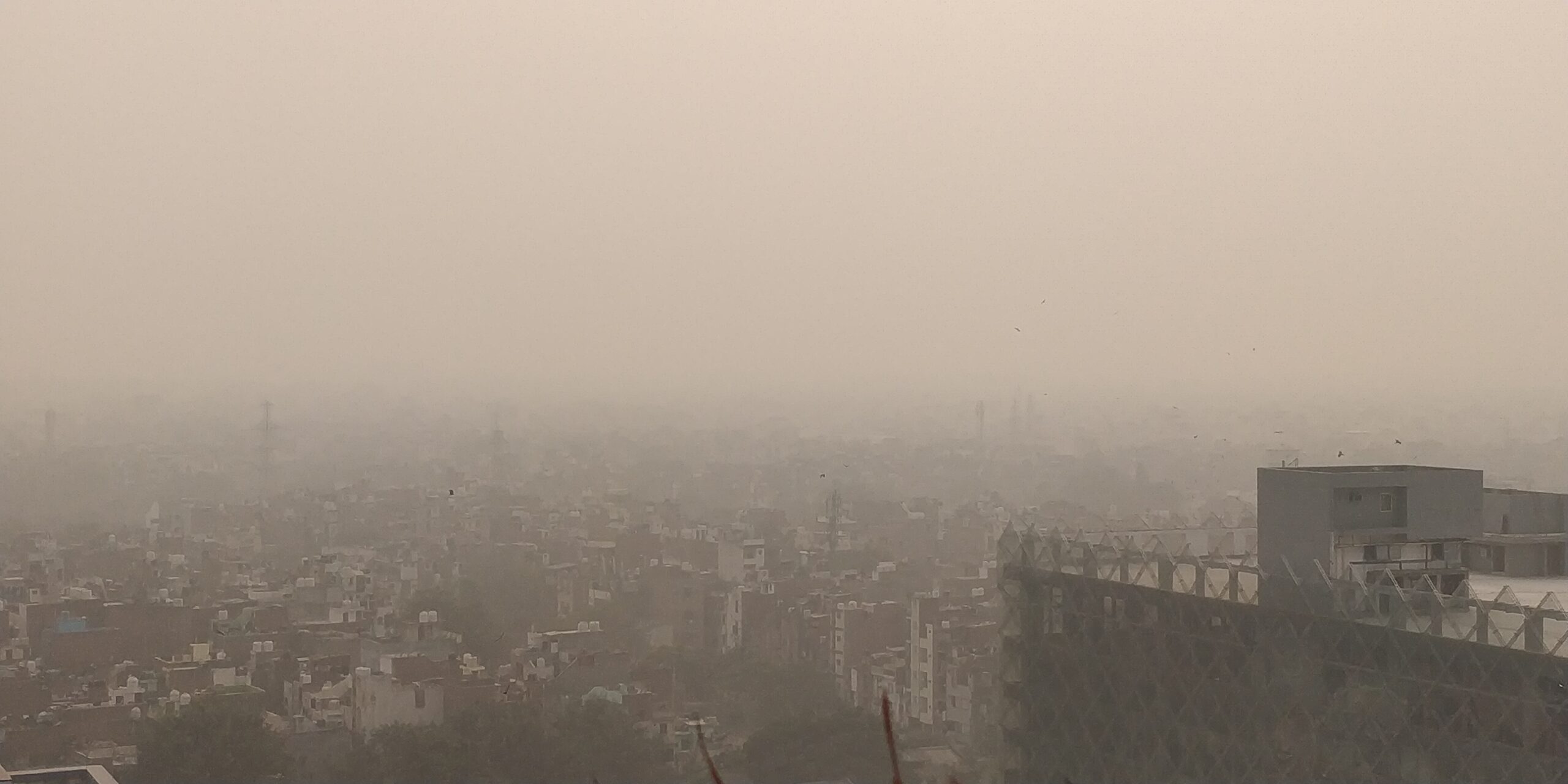
Every winter, the Delhi NCR region greets its citizens with a familiar grim situation. The sky dims, visibility plummets, and the very air seems to turn against its inhabitants. Schools close, hospitals become overwhelmed, and people are advised to stay inside, as if the city has become uninhabitable. This annual crisis is frequently dismissed as a seasonal occurrence, something unavoidable, a product of the region’s geography, or the whims of the weather. However, a disaster that repeats with such a predictable regularity lacks any natural element. Delhi’s air pollution is a tragedy with its own protagonists and architects. It results from almost deliberate political decisions.
For years, medical experts and environmental scientists have cautioned everyone about the issue. The State of Global Air Report 2024 points out that air pollution is responsible for over 2.1 million deaths each year in India. For the Delhi NCR region, it’s estimated that one in seven fatalities is linked to polluted air. These figures are shocking, yet the government’s response has been to treat the crisis as a minor inconvenience, not a full-blown public health emergency. The state offers advisories, makes superficial changes, and deflects blame, essentially telling people to adapt, cope, and carry on.
Who gets to breathe and who doesn’t
Pollution is often seen as a common problem, but this view is too simple. A person’s ability to avoid polluted air is strongly affected by their socioeconomic status. Wealthier people can reduce their exposure to pollution by living in homes with adequate insulation, using air purifiers, driving private cars, having flexible work hours, and getting adequate healthcare. Conversely, individuals with lower incomes often lack access to these options.
People like construction workers, sanitation workers, street vendors, delivery workers, security guards, and migrant workers are forced to work outside during times of high pollution.
When the air quality deteriorates, their struggles persist. City expansion, traffic jams, and government neglect profoundly impact their daily lives. For these individuals, air pollution is not merely a statistic, but a harsh reality they face every day.
A December 18, 2025, report by The Indian Express starkly highlighted this inequality. The report revealed the devastating impact Delhi’s pollution control efforts were having on the daily wage workers gathered at Labour Chowk in Madanpur Khadar.
Health or hunger: an impossible choice
Every afternoon, approximately 150 men and women congregate at Labour Chowk with the hope of securing daily wage work, primarily at construction sites. When strict anti-pollution measures under GRAP 3 and 4 were imposed this winter, construction and demolition activities were abruptly halted. Overnight, thousands of workers lost their only source of income.
Among them was Dilip, a 27-year-old migrant worker who stood at the chowk with a small bag carrying his lunch. As reported by The Indian Express, Dilip earns about ₹500 a day when work is available and has been working as a manual worker for nearly five years. He lives in a rented room with his brother in Delhi, while his family remains in Lucknow.
“If we get work, we will eat at the site. If not, we will go back home,” Dilip told the newspaper. “The situation is very bad.”
Like many workers, Dilip had heard about the Delhi Labour Minister’s announcement of ₹10,000 compensation for construction workers affected by pollution curbs. But the relief remained out of reach. The compensation was to be transferred only to workers registered with the government. Dilip has Aadhaar and PAN cards, but no labour card— and no idea how to get one.
“I do not know where to get registered with the government,” he said.
At night, Dilip struggles to breathe. He experiences breathlessness and burning eyes after returning from work. Initially, he thought it was the cold. It took physical suffering to realise that the air itself was making him sick, but the state pushed him to the limit, forcing him to choose between health and hunger..
For workers like Rahul, seeking medical treatment is itself a luxury. As reported by The Indian Express, Rahul explained that visiting a government hospital means losing an entire day’s income — something most workers simply cannot afford.
“We buy jaggery and eat it the whole year,” he said, describing the home remedies workers rely on instead of doctors.
A few metres away from Labour Chowk lies a cluster of cramped living spaces where many of these workers reside. Sundari Devi, a 50-year-old mason, and Vimla, 35, were quoted sitting on a jute cot after returning without work. Food insecurity has become routine.
“One day we eat rotis, the next day only chutney,” Sundari told the newspaper, explaining that vegetables have become unaffordable. She has a labour card, but it needs renewal— a process riddled with bureaucratic obstacles.
Vimla, on the other hand, does not even know what a labour card is. She recounted how workers are sometimes picked up by the police for working “illegally” when pollution curbs are in place. Yet the same workers are left with no alternative source of income.
“We know this happens every year because of pollution,” she said. “But how do we find alternative work? We cough when we mix concrete, but what option do we have?”
Her question exposes the cruelty of Delhi’s pollution policy: work is stopped in the name of public health, but no meaningful safety net exists for those whose survival depends on that work.
Welfare on paper, exclusion in practice
Officially, the Delhi Building and Other Construction Workers Welfare Board has 2.57 lakh workers on its rolls. However, activists, as reported by The Indian Express, believe the actual number of construction workers in Delhi is likely three to four times that figure.
Sunil Kumar Aledia, Executive Director of the Centre for Holistic Development, explained to the newspaper that a combination of factors keeps workers from signing up. These include a lack of awareness, registration portals for which the renewal rates are low, high pendency, and middlemen who often extort money to process applications.
Union leaders also pointed out that, up until 2018, the government had organised physical registration camps. Their discontinuation has further excluded workers from welfare systems. Therefore, the announcement of compensation during pollution emergencies primarily serves as a political gimmick rather than providing genuine relief.
Ideological appeasement over public health
While people struggle with basic necessities, the political class has been preoccupied with other concerns. This year, the Delhi government made a concerted effort to get the courts to permit firecrackers during Diwali, ignoring repeated cautions from environmental specialists. Despite lax enforcement and inevitable pollution, the Delhi government approved “green crackers”.
What unfolded around Diwali this year was not a policy failure but a calculated act of electoral appeasement. Faced with an approaching election cycle and a charged cultural terrain, the Delhi government chose symbolism over survival. Despite repeated warnings from medical professionals and environmental scientists, it actively petitioned the courts to permit firecrackers, framing the issue not as one of public health but of cultural sentiment. By doing so, it transformed a respiratory emergency into an identity issue, enabling the debate on pollution as a matter of faith rather than quantifiable harm.
This manoeuvre fits neatly within the broader logic of cultural nationalism, mediated through court politics. Judicial permissions and technical caveats became convenient shields behind which the executive abdicated responsibility. The language of legality replaced the language of life. Once the courts allowed so-called “green crackers”, enforcement collapsed into performative gestures, while the government claimed procedural innocence. Pollution, in effect, was outsourced—to the judiciary for sanction and to citizens for endurance.
The idea of “green crackers” itself deserves scrutiny. Their environmental benefit is marginal at best, but their ideological function is far more significant. They operate as a symbolic compromise: allowing the state to claim environmental concern while preserving the ritual spectacle that mobilises cultural majoritarian sentiment. In practice, they transform an ecological crisis into a debate about acceptable levels of damage, shifting the question from whether harm should be prevented to how much harm is politically tolerable. The result is predictable: air quality plunges, hospitals fill, and the burden once again falls disproportionately on those who cannot insulate themselves from the consequences.
The results were swift and catastrophic. Pollution levels spiked to a four-year high the day after Diwali, sending the AQI into the “severe” zone. The air quality hasn’t improved since. Instead of taking responsibility, the state put on a show. Suggestions of cloud seeding, untested and uncertain, were put forward. Arguments over data erupted. The blame game began, with past administrations taking the heat. Simultaneously, costly air purifiers were discreetly installed in government buildings, protecting ministers and officials from the very air that the populace had to endure.
The implication was clear: the powerful would have clean air, regardless of the city’s plight.
Silencing protest, normalising suffocation
Fuelled by mounting frustration, people took to the streets. Students, workers, environmentalists, and everyday citizens banded together, staging protests that called for accountability. The government’s reaction was one of suppression. Peaceful protesters, including children and the elderly, were arrested at India Gate. Demonstrating was framed as a law-and-order issue, not a democratic plea for survival. Despite this, the resistance continued. On November 18th, hundreds assembled at Jantar Mantar, demanding both immediate and long-term solutions. Speakers made it clear: pollution isn’t just an environmental problem; it’s a socio-political one, too. They pointed out the government’s double standard in installing air purifiers for its use while leaving the public to suffer.
The state’s response to public anger exposed a deeper truth about Delhi’s pollution governance: the criminalisation of survival itself. When people gathered to demand clean air, healthcare, and accountability, their actions were not treated as legitimate democratic claims but as disruptions to order. Protests were met with barricades, detentions, and police action, recoding the fight to breathe as a law-and-order problem. In this framework, the right to protest was subordinated to the imperative of maintaining normalcy—even as normalcy meant suffocation.
This repression did not occur in isolation. It followed a well-known pattern that had been used in many places of dissent. Students protesting fee hikes and campus surveillance, workers resisting precarious employment and wage theft, and minority communities opposing demolitions or disenfranchisement have all encountered the same governing reflex: dissent is tolerated only so long as it does not disturb the smooth functioning of authority. The pollution protests simply joined this continuum of suppression, where materially grounded demands were reclassified as disorders and neutralised through coercion rather than addressed through policy.
What emerges is a clear hierarchy of values. The state privileges order over life, stability over survival, and administrative control over public health. Clean air becomes negotiable; protest becomes criminal; endurance is rebranded as civic responsibility. Those who suffer most—workers, migrants, students, and marginalised communities—are instructed to wait, comply, and adjust, even as the conditions of adjustment become increasingly unlivable.
In this sense, Delhi’s pollution crisis is not only an environmental or health emergency but a political one. It exposes a mode of governance that manages crises by disciplining populations rather than transforming structures. Until we confront this logic and prioritise life over order, the cycle of suffocation, repression, and denial will persist, year after year.
Solutions are known but the will is absent.
Delhi’s air quality woes are known and solvable. The science has spoken for years, outlining a path forward: better public transit, more buses and a more extensive metro, restrictions on private cars when pollution spikes, and stricter enforcement of industrial emission standards.
Halting construction during periods of extreme air pollution is an option, but it hinges on protecting workers’ livelihoods and job stability. Furthermore, emergency healthcare initiatives are vital for those most at risk. Finally, air quality monitoring needs to be both transparent and reliable.
The primary impediment to implementing these solutions lies not in their practical viability but rather in the realm of political considerations. Substantial advancement necessitates a confrontation with influential corporate stakeholders across various sectors, including construction, real estate, and the automotive industry. Furthermore, it would entail prioritising public health over political posturing and financial gain. This particular administration has demonstrated a notable lack of inclination to undertake such actions.
A crisis without end — unless people force one
Delhi’s air quality problems have become a year-round crisis. The acrid winter air persists, and the sweltering summers are making the city less and less bearable, particularly for the most vulnerable. The battle for clean air is inextricably linked to broader fights for workers’ rights, democratic accountability, and social justice. Clean air isn’t a luxury for the well-off, with their sealed homes and pricey air purifiers; it’s a basic human right.
The testimonies of Dilip, Rahul, Sundari, and Vimla, as detailed in The Indian Express, bring to light the tangible consequences of pollution, moving beyond abstract policy discussions. These accounts expose the immediate effects of pollution, encompassing hunger, respiratory issues, and pervasive distress. The declining air quality in Delhi is not an unavoidable consequence; rather, it stems directly from political decisions. Consequently, unless governance prioritises the welfare of its populace over ideological considerations and public perception, the working class will persist in bearing the brunt of this crisis, suffering detriments to their respiratory health, their sense of self-worth, and their prospects for the future.
Delhi’s air is not poisoned by accident. It is a predictable outcome of a governing model rooted in urban capitalism, where land, mobility, and infrastructure are primarily organised for accumulation rather than life. The city’s political economy is dominated by a real estate–automobile nexus that privileges expressways over buses, gated developments over breathable neighbourhoods, and construction speed over environmental limits. In this model, pollution is treated as collateral damage—an acceptable growth cost borne disproportionately by those whose labour builds the city but whose lives are excluded from its protections.
This logic explains the state’s selective urgency. Construction is halted when the air becomes lethal, but the livelihoods of workers are treated as expendable. Private vehicles continue to dominate urban space, even as public transport remains underfunded and overstretched. Emergency measures are announced each winter, yet the structural drivers of pollution—unchecked real estate expansion, car-centric planning, and lax industrial regulation—remain politically untouchable. The crisis persists not because solutions are unknown, but because addressing them would require confronting powerful economic interests that shape urban governance itself.
What Delhi faces, then, is not merely an environmental emergency but a political choice. The city can continue along the present path—managing pollution through temporary bans, bureaucratic exclusion, and periodic repression—while asking its working population to absorb the costs with their lungs and livelihoods. Or it can break this trajectory by reorganising the city around public health rather than private profit: expanding mass public transport, guaranteeing income and social protection during environmental shutdowns, enforcing emissions norms without exemptions, and treating clean air as non-negotiable infrastructure rather than seasonal charity.
There is no neutral middle ground. A city organised around accumulation will continue to ration breathing by class. A city organised around life will have to redistribute power, space, and resources accordingly. Until that choice is made—and fought for—Delhi’s winters will remain a recurring verdict on a model of development that has learnt to grow while its people choke.
About the Author


Editorial Board Member of Alternative Viewpoint