Urbanization has become a primary site of capital accumulation. — David Harvey
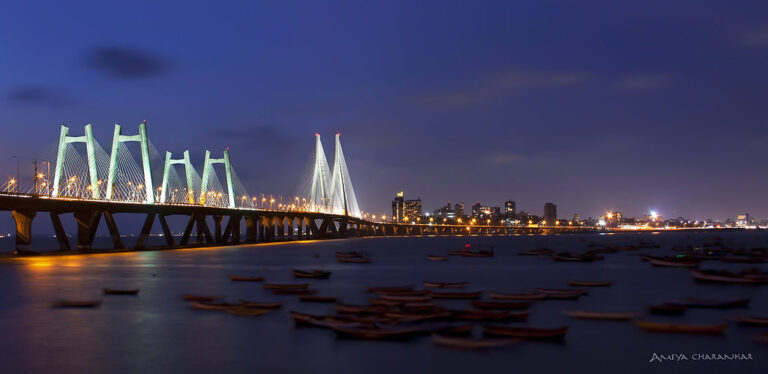
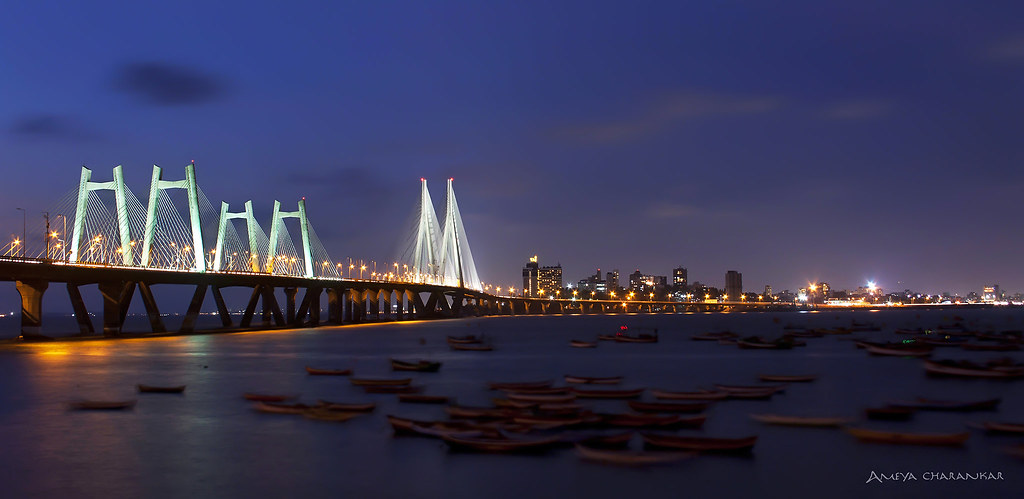
In the decades following economic liberalisation, Mumbai has undergone a sustained infrastructural transformation. The Bandra–Worli Sea Link, the Coastal Road, successive metro corridors, the Trans Harbour Link and the proposed redevelopment of Dharavi are typically presented as technical responses to congestion or housing pressures. Viewed together, however, they signal a broader reorganisation of metropolitan space. Infrastructure has become a central instrument for aligning the city with financial integration and land-centred accumulation.
This development builds on an earlier shift. Through much of the twentieth century, textile mills and port activity structured Mumbai’s economy and urban form. Liberalisation in the early 1990s accelerated deindustrialisation and expanded finance and services, releasing centrally located land for redevelopment. The remaking of former mill districts and the rise of the Bandra Kurla Complex marked the consolidation of a finance-oriented urban formation.
Since the early 2000s, infrastructure has moved to the forefront of this trajectory. Large projects consolidate high-value corridors, draw investment toward selected axes and reshape surrounding land markets. The state remains deeply involved, assembling land, structuring finance and advancing projects intended to enhance metropolitan competitiveness. The Sea Link and the Coastal Road exemplify this pattern: framed as congestion remedies, they reinforce a coastal corridor linking affluent residential zones with major financial districts.
Within this expanding axis, centrally located settlements such as Dharavi acquire new significance. Their redevelopment forms part of a wider restructuring in which urban land is revalued and reorganised rather than simply upgraded.
Mumbai thus offers a revealing case of a broader shift visible across major cities in the Global South. As industrial production recedes as the anchor of metropolitan growth, infrastructure-led territorial restructuring emerges as a principal strategy of accumulation. The state does not withdraw; it repositions itself as an active broker of land, finance and speculative urban futures.
Mumbai’s recent experience draws these strands together while pushing them further. Infrastructure appears not merely as an instrument of competitiveness or a secondary effect of financial expansion, but as a central mechanism through which land is revalued and territorial hierarchies are actively reorganised. Corridor consolidation, infrastructural finance and the redevelopment of informal settlements form part of a single accumulation regime structured around revaluation.
From Industrial Metropolis to Financial Platform
For much of the twentieth century, industrial production shaped Mumbai’s urban form. Across Parel, Lalbaug and Byculla, textile mills structured everyday life. Workers lived near factory compounds, unions organised locally and neighbourhood identities grew around industrial employment. Port activity reinforced the city’s labour-intensive character. Urban land derived its value primarily from production and worker concentration rather than speculative exchange.
This configuration began to unravel in the 1980s and shifted decisively after economic liberalisation in 1991. Mill closures and the outward movement of manufacturing released extensive tracts of centrally located land. Finance and service sectors expanded in parallel, and profits increasingly flowed from redevelopment and commercial property rather than industrial output. Central urban land acquired renewed strategic significance.
The transformation became visible in areas such as Lower Parel and Worli, where former mill compounds were replaced by office towers, luxury housing and retail complexes. What had anchored working-class employment was reorganised as high-yield real estate. The shift was not only architectural; the mechanisms of accumulation themselves changed as property development and finance displaced industrial production.
The emergence of the Bandra Kurla Complex consolidated this transition. Through land assembly and public investment in infrastructure, state agencies created a new business district designed for finance capital. As firms clustered there, BKC began to rival South Mumbai’s historic commercial core and signalled the city’s outward turn toward global financial networks.
Finance expanded, yet informal production persisted. Corporate districts and dense production settlements came to occupy adjacent urban spaces. As factory employment declined, small-scale manufacturing and service work proliferated in areas such as Dharavi, sustaining metropolitan labour markets while occupying increasingly strategic land.
By the early 2000s, land had become the primary terrain of value extraction. Infrastructure moved to the centre of policy, not only to address congestion but to reshape the city’s spatial profile in line with financial ambition. The subsequent wave of mega-projects extended this trajectory, consolidating territorial restructuring as a central engine of metropolitan growth.
The Entrepreneurial Infrastructure State
The transition from an industrial to a finance-oriented metropolis required institutional reorganisation. In Mumbai, the state did not withdraw from urban development; it recalibrated its role. Rather than focusing primarily on incremental service provision, it assembles land, structures financing arrangements and advances large-scale projects intended to enhance the city’s competitive position.
Mega-infrastructure has become central to this strategy. Projects such as the Bandra–Worli Sea Link, the Coastal Road, the Trans Harbour Link and successive metro corridors are framed as mobility improvements, yet their implications extend further. They concentrate resources in highly visible corridors linked to business districts and higher-income residential areas, reinforcing selected axes of growth rather than diffusing development across the metropolis.
Institutionally, this shift has involved special-purpose vehicles, public–private partnerships and long-term concession models. In practice, a significant portion of financial risk returns to the state. Governments provide guarantees, bridge funding gaps and absorb cost overruns, while revenue mechanisms—tolls, development rights and land monetisation—are structured around extended return horizons. Public authority thus stabilises large capital investments while facilitating land reassembly and project momentum.
The Sea Link marked an early moment in this transition. Opened in 2009 after cost escalations, the toll-operated bridge reduced travel time between the western suburbs and South Mumbai but limited access to particular categories of vehicles. In a city where suburban rail remains the backbone of mobility, the project primarily served car-based circulation while tightening a coastal axis already associated with high land values.
The Coastal Road extends this trajectory. Its first phase, opened in 2024 at a cost above initial projections, lengthens the same coastal corridor. Environmental groups and fishing communities raised concerns about marine ecosystems, tidal flows and access to traditional routes. Modifications were introduced, yet construction continued and the road remains configured for uninterrupted vehicular movement. Together, these projects consolidate a continuous high-speed stretch along the western seaboard.
The implications are not confined to traffic. Announced corridors influence land acquisition and redevelopment planning well before completion. Developers secure parcels along projected routes in anticipation of improved access, and nearby property markets adjust accordingly. As connectivity increases, previously marginal areas gain renewed speculative appeal.
Infrastructure in this context operates both as construction and as a catalyst for land revaluation. Financing blends public expenditure with borrowing and private participation, treating major transport works as long-term assets expected to generate indirect returns through rising land values and expanded commercial activity. Even where toll revenues are insufficient, anticipated gains in property appreciation and business concentration sustain the rationale.
The distributive consequences are uneven. High-speed coastal routes primarily benefit car-owning commuters, while suburban rail—despite carrying the bulk of daily commuters—receives only incremental upgrades relative to road spending. Reclamation and embankment works have also altered tidal patterns and raised concerns about flood exposure in low-lying areas. Environmental clearances accompany construction, yet mitigation is folded into project continuation rather than functioning as a decisive constraint.
Through this combination of corridor consolidation and infrastructure finance, centrally located land whose current use yields modest financial returns becomes newly attractive for redevelopment. Dharavi lies within precisely such a zone.
Dharavi as Accumulation Frontier
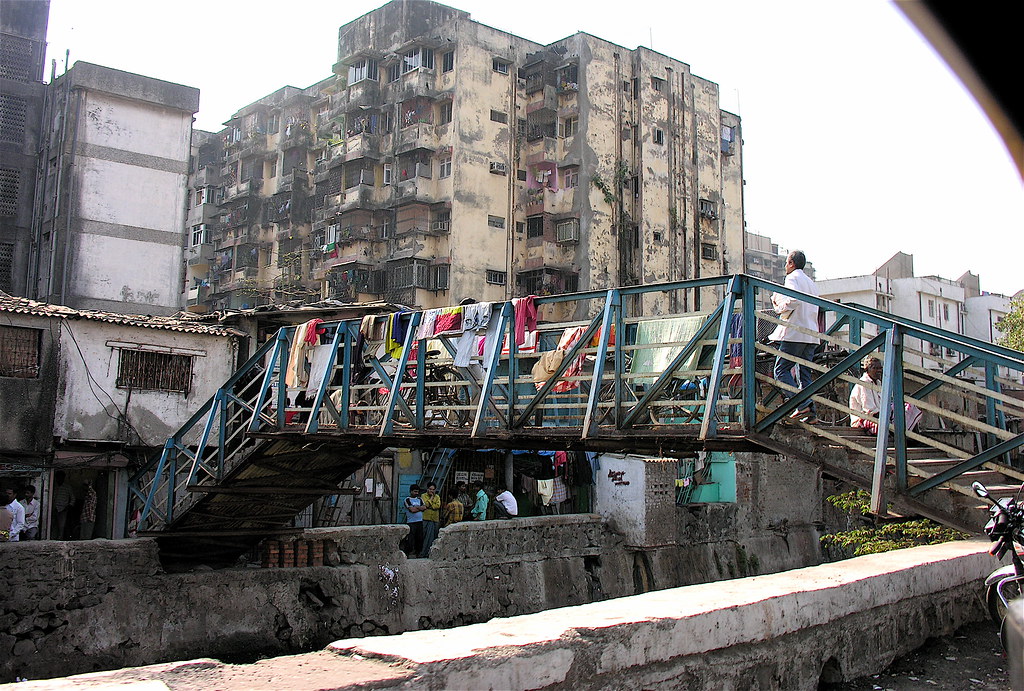
Dharavi occupies a strategic position within Mumbai’s reconfigured metropolitan landscape. Spread across roughly 645 acres near the Bandra Kurla Complex and within the arc of consolidated transport corridors, it lies on some of the most centrally located land remaining in the city.
Often described as one of Asia’s largest informal settlements, Dharavi is better understood as a dense economic ecosystem. Thousands of small manufacturing and service units—leather goods, garments, recycling, food production and metalwork—operate within closely interwoven networks of production and residence. These activities feed into regional and national supply chains and generate substantial annual turnover. Social infrastructure—credit arrangements, skill transmission and labour circulation—anchors this economy locally. Dharavi is not merely a housing cluster but a complex site of social reproduction.
Yet this embedded economy exists on land whose exchange potential has risen sharply. Improved connectivity and proximity to the Bandra Kurla Complex intensify redevelopment pressure. What may appear underutilised in financial terms is, in fact, densely inhabited and economically active space organised around use rather than speculative yield.
The current redevelopment proposal crystallises this tension. A consortium led by the Adani Group is advancing the project under the Slum Rehabilitation framework. Eligible households are to receive 300-square-foot units, while others face relocation to peripheral sites. Significant portions of the land are reserved for commercial and higher-end residential development. Presented as upgrading, the plan also redirects the area toward intensified real estate extraction.
The consequences extend beyond demolition. Relocation risks separating homes from workplaces and weakening the proximity on which informal production depends. Many enterprises rely on shared services, low operating costs and dense labour networks. Dispersal or vertical rehousing could disrupt these arrangements, undermining an entire mode of economic organisation tied to central urban space.
Redevelopment proceeds through administrative differentiation rather than abrupt eviction. Eligibility criteria and compensation rules determine who remains and who moves, fragmenting collective claims while enabling large-scale land reassembly. In political-economic terms, Dharavi becomes an accumulation frontier produced by earlier infrastructural investments. Corridor consolidation has raised surrounding land values; infrastructure finance has reinforced the treatment of territory as an asset. Redevelopment captures the widening gap between existing use and projected exchange value.
Where mill-land transformation once marked the city’s shift from industrial production to property-led growth, Dharavi signals the extension of that trajectory into the heart of informal urbanism.
Uneven Development as Structural Outcome
Viewed sequentially, Mumbai’s recent mega-projects reveal a consistent spatial pattern. Investment concentrates along selected corridors, particularly the western coastline, where high-speed transport reinforces existing financial districts and affluent residential zones. Centrally located informal settlements face mounting redevelopment pressure, while lower-income households are displaced toward the metropolitan periphery. The result is not episodic imbalance but a structured geography of uneven development.
Allocation priorities reinforce this differentiation. Coastal expressways and signature corridors command substantial capital outlays, while mass transport receives meagre incremental upgrades. This hierarchy reflects strategic emphasis: projects that intensify land values and metropolitan visibility take precedence over those that primarily stabilise working-class circulation.
Displacement follows a similar logic. Earlier transport schemes relocated large numbers of households to peripheral sites. More recent projects rely less on overt eviction and more on indirect pressures. Rising land values, redevelopment initiatives and ecological transformation narrow the conditions under which low-income residents can remain in central areas. Coastal construction has also reshaped tidal patterns and access to marine livelihoods, redistributing environmental risk toward vulnerable communities.
Dharavi concentrates these dynamics. Its redevelopment would convert centrally located, socially productive land into higher-value real estate. Eligibility rules incorporate some residents into formal housing while relocating others beyond the urban core. Economic networks organised around proximity are fragmented as exchange value takes precedence over embedded use.
This trajectory should not be understood as administrative failure. It reflects a governing orientation that prioritises competitiveness, land appreciation and financial integration. Planning instruments are calibrated to unlock exchange value, and public authority is mobilised to stabilise investment conditions. Redistribution becomes secondary to valuation.
The resulting urban form is increasingly polarised: accelerated corridors and financial enclaves coexist with precarious peripheries. Informal labour continues to underpin metropolitan life, yet its spatial centrality diminishes as high-value districts consolidate.
Mumbai’s experience mirrors a broader shift visible across major cities in the Global South. As industrial production recedes as the anchor of urban growth, infrastructure-led territorial restructuring becomes a principal accumulation strategy. Uneven development is not a by-product of this model but one of its constitutive outcomes.
The question, then, is not whether megaprojects modernise the city, but how that modernisation is structured—who benefits, how risk is distributed and which forms of social reproduction are rendered expendable.
Infrastructure and the Remaking of the Megacity
Mumbai’s recent mega-projects are frequently justified as technical solutions to congestion or housing deficits. Considered together, they reveal something more fundamental: the restructuring of metropolitan space in the service of land valorisation and financial integration.
The earlier shift from industrial production to property-led accumulation released centrally located land and reoriented the city toward finance. The current infrastructural phase consolidates that transition. Bridges, corridors and redevelopment schemes do not simply accompany economic change; they actively reorganise territory to facilitate capital circulation. Connectivity becomes a mechanism of revaluation. Land becomes the primary medium of accumulation.
The state plays a decisive role in this process as it assembles land, underwrites financial risks, and guarantees project continuity. Public authority absorbs uncertainty while private actors capture appreciation. Infrastructure is thus not a neutral public good but a strategic instrument through which capital secures spatial advantage. The distributional outcomes are not incidental. They follow from the governing logic itself.
High-value corridors intensify while working-class districts are subjected to redevelopment pressure. Informal settlements are incorporated selectively or displaced outward. Ecological risk is unevenly distributed. What appears as upgrading is, at the level of political economy, a reordering of class relations in space. Land organised around use and social reproduction is subordinate to exchange value and speculative yield.
Dharavi crystallises this transformation. Its remaking would not merely improve housing conditions; it would convert a dense working landscape into real estate calibrated for higher returns. Administrative sorting replaces overt eviction, but the underlying movement is clear: the capture of urban ground rent through state-facilitated revaluation.
Mumbai’s trajectory reflects a broader pattern across the Global South. As industrial expansion recedes, territorial restructuring through infrastructure emerges as a substitute strategy for sustaining accumulation. In this configuration, uneven development is not a failure of planning but an outcome of class-oriented spatial strategy. The megacity becomes an arena in which capital reorganises territory, and the state acts as its institutional mediator.
The central question, therefore, is not whether infrastructure modernises the city. It is about how modernisation is organised, in whose interest territory is restructured, and which social groups bear the cost of valorisation. In contemporary Mumbai, infrastructural urbanism reveals the consolidation of a pro-capital spatial order in which land, connectivity and finance converge to reorder the city’s class geography.
References
Aalbers, Manuel B. The Financialization of Housing: A Political Economy Approach. London: Routledge, 2016.
Banerjee-Guha, Swapna (ed.). Accumulation by Dispossession: Transformative Cities in the New Global Order. New Delhi: Sage, 2010.
Brenner, Neil, and Nik Theodore. “Cities and the Geographies of ‘Actually Existing Neoliberalism’.” Antipode 34, no. 3 (2002): 349–379.
Harvey, David. “From Managerialism to Entrepreneurialism: The Transformation in Urban Governance in Late Capitalism.” Geografiska Annaler B 71, no. 1 (1989): 3–17.
Harvey, David. The Urbanization of Capital. Baltimore: Johns Hopkins University Press, 1985.
Harvey, David. The New Imperialism. Oxford: Oxford University Press, 2003.
Smith, Neil. “Toward a Theory of Gentrification: A Back to the City Movement by Capital, Not People.” Journal of the American Planning Association 45, no. 4 (1979): 538–548.
Smith, Neil. Uneven Development: Nature, Capital and the Production of Space. Oxford: Blackwell, 1984.
Weinstein, Liza. The Durable Slum: Dharavi and the Right to Stay Put in Globalizing Mumbai. Minneapolis: University of Minnesota Press, 2014.
About the Author


Shweta Damle
Founder-Director, Habitat and Livelihood Welfare Association, and member of the Working Committee, Working People's Coalition (WPC).