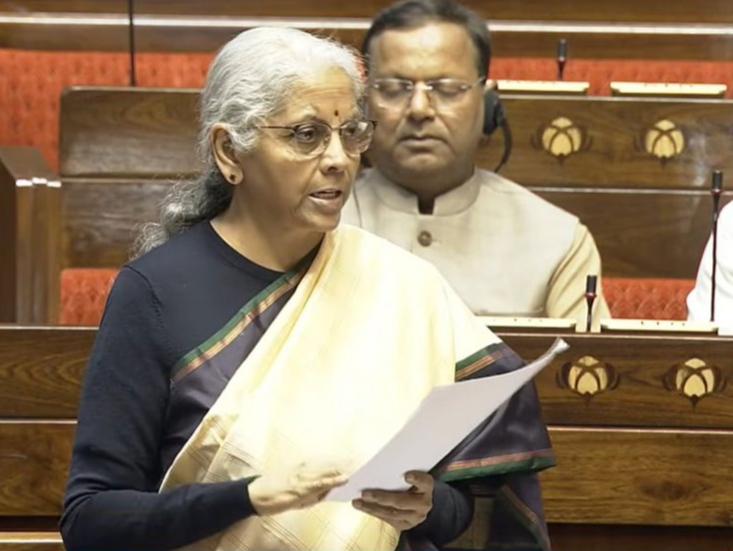
The 13th budget of the BJP government and the ninth presented by the current finance minister, Nirmala Sitharaman, mark not merely another fiscal exercise but the consolidation of a capital-led growth model anchored in infrastructure expansion, centralised decision-making, and investor confidence. While electoral welfare schemes persist, the policy’s deeper direction increasingly focuses on reassuring capital and accelerating large-scale investment.
This shift is inseparable from the government’s political consolidation. Success in recent state elections has reduced the immediate need for broad-based appeasement. The budget reflects that confidence. Mega infrastructure projects, institutional expansion, and capital expenditure are prioritised as symbols of state capacity and modernisation. At the same time, fiscal and policy choices signal a narrowing of redistributive ambition and a growing distance from the material insecurities of workers, small farmers, and informal producers.
The model rests on two reinforcing pillars, i.e., centralisation and liberalisation. While decision-making powers increasingly accumulate at the Union level, states merely are required to contribute financially without commensurate control over design and implementation. Capex-linked transfers, scheme-tied assistance, and conditional borrowing frameworks redefine federal relations in favour of central oversight. The result is not merely administrative coordination but a restructuring of fiscal federalism.
Since 2014, this direction has been institutionalised through major structural reforms—GST, expanded FDI regimes (including 100% FDI in insurance), the opening of nuclear power generation to private players, and the consolidation of 29 labour laws into four labour codes. Environmental regulations have been diluted in the name of easing investment. These measures share a common premise: that private capital, once freed from regulatory and fiscal constraints, will drive growth and employment. Yet private investment has remained uneven, raising questions about the social costs of these concessions.
Growth, in this framework, is measured primarily through its contribution to GDP and aggregate output, producing an image of development that obscures widening inequality and precarious employment. Over the past decade, policy restructuring has increasingly favoured capital-intensive sectors and global integration, even as large sections of the working population face insecurity in agriculture, informal urban employment, and platform jobs. We need to avoid reading the budget in isolation but instead situate it within the context of a broader trajectory of centralised, capital-oriented transformation that reshapes both federalism and labour relations.
A Jobless Growth
The Budget’s story about jobs is based on a statistical trick. The government says that falling unemployment rates and more people working are signs of success, but the rise in self-employment and informal work hides a growing problem with getting wage work. What is being celebrated is not the creation of dignified work, but the survival strategies of workers pushed into precarious livelihoods.
The imminent full operationalisation of the four labour codes signifies a significant restructuring of class power. By raising thresholds for layoffs, tightening union recognition, restricting strikes, and weakening inspection regimes, the state shifts bargaining power from labour to capital. Employment generation is framed as a by-product of deregulation, as though rights were obstacles rather than protections. The promise is that private investments, once unshackled, will absorb labour. The experience of the last decade suggests otherwise: growth has been capital-intensive, not labour-absorbing.
Allocation for the MSME sector is still small compared to the number of underemployed people. Investing in semiconductors moves public money into highly skilled areas that are part of global supply chains, but this doesn’t create many jobs for most people. These choices show what is important: integration with global capital over mass employment, and technological prestige over labour absorption.
Platform workers are projected to expand rapidly and epitomise the new employment landscape. Millions of workers lack contracts, social security, or bargaining power. Policy responses reduce their vulnerability to digital registration and partial insurance extensions. Social protection is fragmented and conditional.
The change is deliberate, revealing a reconfiguration of the employment system that prioritises capital flexibility while increasing worker insecurity.
Agrarian Corporatisation and Trade Exposure
Agriculture is frequently invoked as a story of resilience. Over the past decade, the sector has absorbed economic shocks, including the pandemic, and registered steady growth. However, the makeup of this growth presents a distinct narrative. A lot of the growth has happened in livestock and fisheries instead of growing crops. This expansion has happened at the same time as more businesses entering the market, focusing on exports, and becoming part of global value chains.
Large-scale coastal infrastructure projects, port expansion, and aquaculture tied to exports have negatively impacted ordinary fisherfolk. Big capital has steadily taken over the production of fish, feed, cold chains and processing. Output goes up, but value capture goes up as well. The very sectors cited as engines for growth increasingly marginalise small-scale producers.
The restructuring of the agriculture sector extends well beyond agricultural production and includes greater control over agricultural inputs. In this context, it is important to read the Draft Seeds Bill (2025), which seeks to replace the 1966 Act. This change signals a further institutional shift, with critics warning that expanded regulatory requirements and strengthened market controls risk privileging large seed corporations over cultivators. Farmers’ traditional practices of saving and exchanging seeds—central to agrarian autonomy—may face tighter regulation. Control over seeds is not a technical detail; it determines who governs the agrarian value chain.
At the same time, the absence of a legally guaranteed Minimum Support Price leaves farm producers exposed to volatile markets and rising input costs. The much-touted insurance schemes inadequately compensate for the vulnerabilities because they show stagnation or limited reach. The persistence of agrarian distress—including the continued incidence of farmer suicides over decades—reflects structural vulnerabilities rooted in indebtedness, price uncertainty, and uneven bargaining power. The myth of output growth alone does not secure livelihoods.
Worries about a possible trade deal between India and the US make this anxiety even worse. If US agribusiness get better access to the agricultural market, it could put more pressure on small Indian producers, especially in dairy and other sensitive areas. If trade is opened up without strong protections for farmers in the countries, they could be hit by global price shocks while the costs of inputs and compliance go up at home. Joining global markets on unfair terms will only make big businesses stronger and put traditional Indian farm producers at a disadvantage.
Under this model, agriculture functions less as a domain of livelihood protection and more as a site of capital accumulation. The state’s role moves from guarantor of income stability toward facilitator of market integration.
The expansion of capital expenditure is accompanied by a quiet but profound centralisation of fiscal authority. States receive interest-free loans and conditional transfers tied to centrally determined priorities. Fiscal space is narrowed, autonomy reduced.
To know more about the Union Budget 2026-27, please read : Consolidation Without Redistribution: The Budget and the Remaking of the Indian State
Federalism Under Discipline
This arrangement transfers social risk downward while retaining political credit upward. The Centre consolidates decision-making power; states manage the consequences. GST was the opening move. Capex-linked frameworks deepen the pattern.
Federalism, in practice, becomes a mechanism for disciplining states rather than empowering them.
Financialising Urban Development
The current growth model continues to prioritise infrastructure. Capital expenditure continues to rise, funding highways, logistics corridors, ports, etc., and urban clusters framed as engines of transformation. However, a deeper restructuring of urban governance increasingly underpins this expansion.
The recently approved New Urban Challenge Fund (NUCF) signals this shift. Rather than merely financing public infrastructure, the fund incentivises cities to mobilise private investment, adopt reform-linked conditionalities, and enhance “creditworthiness.” Urban development is thus recast as a financial project. Cities are encouraged to compete for capital, leverage land, expand public–private partnerships, and generate revenue streams attractive to investors.
This financialized urban policy reshapes priorities. Infrastructure is designed not only for public need but also for bankability. Informal settlements become obstacles to land monetisation. Working-class neighbourhoods become sites for redevelopment. Displacement is treated as an administrative inconvenience rather than a social crisis.
The construction-led economic boom certainly generates economic growth but at a high cost; however, it primarily creates temporary, informal employment that offers minimal protections. Workers build the very infrastructure that may later evict them. Urban expansion produces visible assets—motorways, industrial corridors, smart districts—while eroding secure housing, informal livelihoods, and collective urban rights.
Structure presents infrastructure as inclusive growth, but its financing logic and implementation patterns often prioritise capital accumulation over social protection.
Capital Accumulation as Governance
This budget does not merely prioritise growth; it reorganises the state around capital accumulation. Infrastructure expansion, labour deregulation, agrarian corporatisation, fiscal centralisation, and urban financialisation form a cohesive architecture. Each is presented as reform. Together, they restructure power.
Labour is made flexible. Agriculture is market-integrated without income guarantees. States are disciplined through conditional finance. Cities are redesigned as investment platforms. The benefits are institutionalised; the risks are socialised.
Infrastructure becomes the visible marker of progress; precarity becomes its foundation.
The question is not whether growth will occur, but who commands it and who absorbs its costs. Without enforceable labour rights, universal social protection, guaranteed MSP, and meaningful federal autonomy, the trajectory remains unchanged: capital consolidates structurally while workers adapt within narrow margins.
At the end, budgets do not simply distribute resources. They redistribute power.
About the Author


Shweta Damle
Founder-Director, Habitat and Livelihood Welfare Association, and member of the Working Committee, Working People's Coalition (WPC).




A really good blog and me back again.