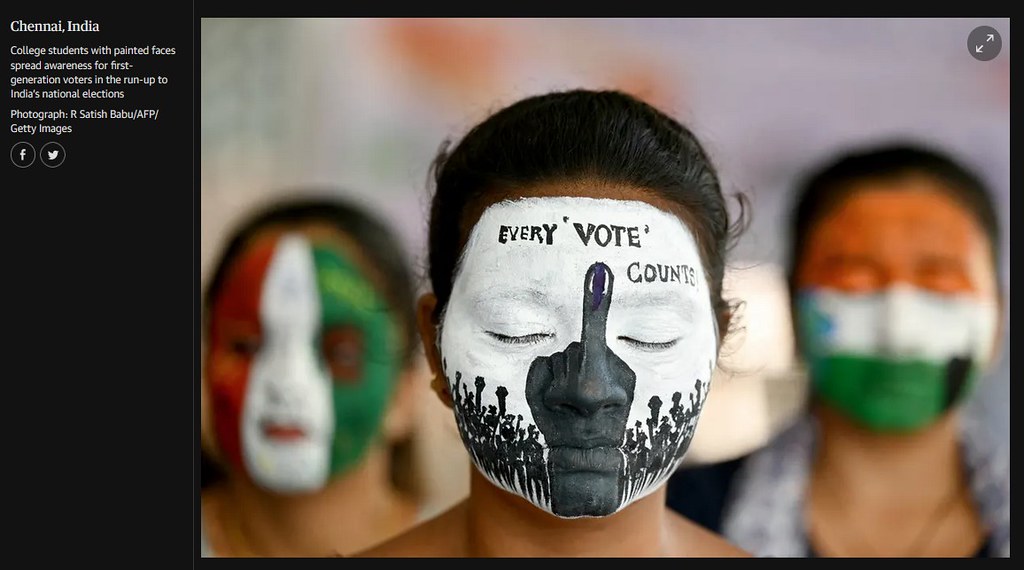
Towards the end of 2025, a new chapter unfolded in India’s ongoing democratic crisis. Across twelve states, the Election Commission initiated what it refers to as a Special Intensive Revision (SIR) of the electoral rolls. While the term may seem innocuous—a bureaucratic tidying-up or a routine exercise aimed at ensuring accuracy—the situation unfolding in West Bengal, Telangana, Tamil Nadu, Kerala, Karnataka, Delhi, Assam, and parts of the Northeast indicates something far more significant. The SIR is not just about verifying voters; it is redefining them and the concept of citizenship in this nation.
Under the SIR, door-to-door verification teams—often accompanied by local police or, in numerous instances, linked to the BJP’s intrinsic connection with the RSS, alongside documented calls for BJP workers to ‘ensure full participation’ in SIR and oversee voter verification1—are likely to overlap with the Sangh’s own network, even if formal records do not explicitly mention the RSS. These teams traverse neighbourhoods to verify documentation, ask about residences, and identify “doubtful voters.” While the public justification is familiar, citing concerns over fake voters, illegal migrants, and electoral fraud, the pattern of deletions reveals a different narrative. While the Election Commission insists that the SIR is a neutral technical exercise, the emerging evidence tells a different story. In states where data is available — notably Bihar2 and parts of Uttar Pradesh3 — voter deletions have clustered most heavily in Muslim-majority neighbourhoods, migrant-dense urban pockets, Dalit and tenant settlements, and informal housing belts. These are also the constituencies where the BJP struggles electorally. The pattern does not yet constitute definitive proof of discrimination nationwide, but it raises the unmistakable possibility that the SIR’s administrative machinery is falling hardest on communities the ruling party views as politically disposable. In essence, it targets constituencies least likely to support the ruling regime. However, the implications extend beyond mere electoral gains for the far-right.
It can be safely assumed that the SIR process is neither coincidental nor accidental. Primarily, it serves as an administrative expression of a broader authoritarian strategy aimed at creating an electorate that structurally favours the ruling party at the helm of the union government, not through persuasion but through curation. India is evolving into a democracy in which the government no longer merely engages with the people—it actively selects them, the “administrative nature” of SIR obscuring its political function. The country possesses a long history of enumerative governance, characterised by colonial censuses that classified communities, property surveys that disciplined peasants, and identity regimes that monitored mobility. The post-1947 state inherited and expanded this machinery. While we traditionally saw enumeration serving the purpose of representation, with the SIR, it transforms into a tool for exclusion.
Nowhere is this shift more visible than in West Bengal, the epicentre of the current SIR wave. For years, the BJP has claimed—without providing credible demographic evidence—that millions of “Bangladeshis” distort the state’s voter rolls. Data4 shows that Bengal’s decadal population growth, however, has been below the national average since the 1990s, and hardly any migration study5 6 suggests mass undocumented inflows. Nevertheless, the narrative persists not because it is true but because it is useful. It provides ideological cover for treating Muslim citizens, particularly in border districts like Murshidabad and North 24 Parganas, as inherently suspect. However, recent reports suggest that Bengali-speaking Muslims are hounded across the country – mostly in BJP-ruled states – and are in many cases pushed back to Bangladesh even from the Birbhum or Medinipore districts, which are not adjacent to the international border. Under the SIR, verification teams (and sections of the media) ask for documents that millions of poor households—especially those living in informal settlements created through Partition displacement—have hardly possessed. A missing rent agreement becomes proof of illegitimacy. A spelling mismatch on a ration card becomes grounds for deletion. It is also important to note that the witch hunt for “Bangladeshis” was first started by the Bengali media, especially Ananda Bazar Patrika, and picked up by non-BJP parties like the Trinamool Congress, the Shiv Sena in Mumbai, and others. Even the Left Front government joined the chorus to vilify the poor before any major evictions in the city.
Assam, meanwhile, experiences the SIR as the continued afterlife of the NRC. The massive 2019 exercise excluded nearly two million residents, many of them Bengali-origin Muslims. But because the BJP found the final NRC numbers politically inconvenient—too many Hindus excluded alongside Muslims—it sought new mechanisms of scrutiny. The SIR quietly reopens the uncertainty that the NRC institutionalised: even those included in it may now find themselves challenged again when the voter rolls undergo “intensive revision.”
In the South, the logic of the SIR adapts itself to new contexts. In Karnataka, the SIR lands on terrain already marked by disputes over Bengaluru’s voter lists. Constituencies such as Mahadevapura, KR Puram, and Yeshwanthpur — zones of extreme urban mobility, massive migrant inflows, unstable rental housing and dense informal settlements — have long been hotspots of contested voter entries and political allegations. Civil society organisations have warned that these are precisely the neighbourhoods where intensive verification is most likely to translate into exclusion, simply because the residents least able to furnish stable documentation are the ones whose political voice is already precarious7 (Times of India, 2025). While no independent data yet proves that the SIR has selectively purged voters in these seats, their demographic profile makes them disproportionately vulnerable to any administrative process that treats documentation as the threshold of democratic belonging. In Telangana, the SIR has expanded to Hyderabad, where civil society groups and representatives of minority communities have raised concerns that densely populated working-class areas, such as the Old City, are at risk of exclusion during the intensive verification process. In Tamil Nadu and Kerala, even though large-scale deletions appear less frequent, the SIR operates as an ideological intrusion: verification teams disproportionately focus on Muslim and Christian neighbourhoods, asserting a central authority over state political cultures that have historically resisted Hindutva.
Delhi reveals another dimension of the SIR: its intersection with the city’s demolition politics. In neighbourhoods such as Jahangirpuri, Mehrauli, and Khajuri Khas—where large numbers of working-class Muslim families have been displaced by demolition drives justified as removal of “encroachments”—civil-society reports and media investigations have documented how loss of residence and documentation renders residents vulnerable to voter-list deletion on grounds of non-residence.8 While the Election Commission frames such deletions as routine corrections, the effect is to convert state-produced displacement into political disenfranchisement. The state produces the displacement and then uses the displacement to justify disenfranchisement. The circularity is not a glitch—it is the method. Through these varied expressions, a national pattern emerges: the SIR functions as a technology of voter suppression designed to fracture the anti-BJP electorate. But it is more than an electoral tactic. It is part of a longer project to redefine citizenship in India—not as a universal political status but as a conditional permission granted by the state.
The rhetoric of “illegal Bangladeshis” plays a central role in this redefinition. The term does not describe actual migration flows; it describes an ideological category. It is a floating signifier, adaptable to any region where Muslims are politically inconvenient. In Telangana and Karnataka, where references to Bangladesh may not resonate, the category shifts to “Rohingya.” In Delhi, Muslim protest sites are reinterpreted as hubs of “voter fraud.” The accusation is never empirically testable. Its political function is to transform entire communities into subjects of suspicion and therefore administrative correction.
This technique resonates with global patterns. Electoral authoritarian regimes—from Erdogan’s Turkey to Orbán’s Hungary to Republican-controlled states in the US—have developed sophisticated systems of disenfranchisement framed as “election integrity”.910 India joins this trend but contributes a distinctly bureaucratic variant—one made possible by the state’s vast administrative apparatus and its caste-inflected social hierarchies. Where American voter suppression uses ID laws and precinct closures, Indian suppression exploits the fragile documentary lives of the poor.
The Election Commission, once revered as a guardian of Indian democracy, is central to this transformation. Its autonomy has eroded through changes in appointment procedures and increasing political alignment with the ruling regime.11 It now defends the SIR as a matter of procedural accuracy. Accuracy, however, is the euphemism through which exclusion is justified. The Commission does not ask why deletions cluster in certain neighbourhoods or why verification practices differ across social groups. It measures its success in numbers: how many entries corrected, how many “doubtful” voters removed. The politics of those numbers recede behind the neutrality of administrative language.
Does the SIR violate the Constitution?
In spirit, unquestionably. Targeted deletions contradict Article 14’s guarantee of equality, Article 15’s prohibition of discrimination, and Article 326’s promise of universal franchise. But the deeper truth is more unsettling: the Constitution itself contains the administrative architecture that enables such exclusion. It centralised state authority, preserved colonial forms of documentation, and granted bureaucratic institutions sweeping discretion. Rights were expansive in text but conditional in practice. The SIR reveals not only the breach of constitutional principles but the limits of constitutionalism itself. Majoritarian regimes thrive not because they break the law, but because the law already contains tools that can be repurposed.
The social consequences extend beyond electoral arithmetic. The SIR transforms citizenship into a condition of perpetual performance. Voters—especially the poor—must constantly prove themselves to the state. Documentation becomes a site of anxiety. Women worry whether a name change after marriage will cost them their vote. Migrant workers fear that mobility will be misinterpreted as illegitimacy. Dalits and Adivasis, who disproportionately live in informal or unstable housing, face higher risks of deletion. The SIR produces a kind of bureaucratic subjectivity, where citizens internalise the idea that political belonging must be earned rather than assumed.
Under these conditions, democracy becomes a hollow ritual. Elections continue, but the electorate has already been filtered. Opposition parties confront a dilemma: to challenge deletions is to risk appearing sympathetic to “fake voters,” a narrative the BJP weaponises. To remain silent is to concede the shrinking of their own base. Civil society groups attempt to track deletions and assist voters, but their resources pale before the scale of the administrative machine.
This is how authoritarianism grows in the twenty-first century—not through coups or the suspension of rights, but through the re-engineering of the electorate. The people are not repressed; they are revised.
In this sense, the Hindu Rashtra may not arrive through a constitutional amendment or parliamentary proclamation. It may arrive through documents: through the NRC, the NPR, the CAA, and now the SIR. It may entrench itself not by abolishing elections but by ensuring that elections increasingly reflect a demographically purified imagination of the nation. The Hindu Rashtra will not replace democracy; it will reprogram it.
Yet resistance remains possible. The SIR is powerful because it is invisible. Making it visible—documenting its effects, exposing its patterns, challenging its ideological claims—is the first step. The second is articulating an alternative vision of democracy: one that treats enumeration as inclusion rather than suspicion, one that asserts political rights as unconditional, one that recognises that the people who most often face deletion are the very people whose struggles have historically expanded Indian democracy.
The stakes could not be higher. If the right to vote becomes a conditional privilege determined by administrative discretion, then the republic stands hollowed at its core. India’s democratic future depends not only on who wins elections but on who is permitted to vote. And the SIR is rewriting that answer in real time.
The battle for the voter list is, ultimately, the battle for the people themselves. If the state insists on revising the electorate, then democracy must respond by revising the state—reclaiming it from those who imagine citizenship as a matter of purity and belonging as a matter of bureaucracy. The republic will survive only if the people insist that they cannot be verified out of existence.
The article was earlier published in Eastern Review, Number 16, January 2026.
1 https://timesofindia.indiatimes.com/city/agra/sir-yogi-asks-bjp-leaders-workers-to-ensure-100-accuracy-in-voter-verification/articleshow/125819993.cms
2 https://thewire.in/rights/election-commission-bihar-special-intensive-revision-muslim-population-seemanchal
3 https://www.hindustantimes.com/cities/noida-news/sp-alleges-voter-deletion-in-minority-areas-during-sir-in-gautam-budh-nagar-101764376009097.html
4 https://censusindia.gov.in/nada/index.php/catalog/43352
5 https://censusindia.gov.in/nada/index.php/catalog/10967
6 https://iasp.ac.in/uploads/journal/003-1699015072.pdf
7 Times of India, “SIR: Experts, activists bat for house-to-house enumeration,” Times of India, Bengaluru edition, December 2024.
8 https://thewire.in/politics/denied-vote-over-aadhaar-typo-slips-denied-how-muslims-faced-voter-suppression-in-2024-elections
9 Anderson, Carol. One Person, No Vote: How Voter Suppression Is Destroying Our Democracy. New York: Bloomsbury, 2018.
10 Levitsky, Steven, and Lucan A. Way. Competitive Authoritarianism: Hybrid Regimes After the Cold War. Cambridge: Cambridge University Press, 2010.
11 Yadav, Yogendra. “Democracy and the Challenge of Majoritarianism in India.” India International Centre Quarterly 48, no. 1 (2021).
About the Author


Editorial Board Member of Alternative Viewpoint