“What do they know of cricket who only cricket know?” – C. L. R. James
Before the commercial explosion of the 1990s and the hyper-nationalist staging of the present, cricket fields often functioned as spaces of progressive expression, especially visible in the decades before the 1980s, when former colonies confronted imperial hierarchy not only politically but symbolically on the field.
Dignity on the Field
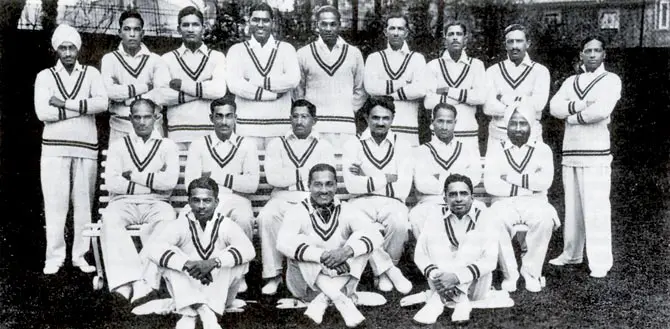
The reversal was clearest in contests between England and its former subjects. India’s rise, though gradual, contained profound social implications. When Vijay Hazare scored twin centuries against Don Bradman’s “invincible” Australians in Adelaide in 1948, it was not merely a statistical feat but an early assertion that technical mastery was no longer the preserve of the imperial center.
By the 1970s, India’s victories in the West Indies and England signalled competitive parity. The spin quartet—Bishan Singh Bedi, Erapalli Prasanna, Bhagwat Chandrasekhar, and Srinivas Venkataraghavan—came from varied regional and caste backgrounds, unsettling the earlier dominance of metropolitan elites. Gundappa Viswanath, widely admired for his artistry, emerged from a modest background in Karnataka, while Kapil Dev, debuting in 1978 from agrarian Haryana, represented a decisive shift away from the old presidency-town axis of Bombay and Madras. Even before India’s 1983 World Cup triumph, the groundwork for a socially broader national team had been laid. Cricket, in this period, was one of the few national institutions where performance routinely overrode ritual hierarchy; spectators cheered excellence rather than lineage, and the visibility of players from outside entrenched elites complicated the social grammar of caste.
The West Indies offered an even more dramatic instance of post-colonial assertion. In the 1950s, George Headley became the first Black captain of the West Indies, symbolising a break from the era when white planters, or lighter-skinned elites, led Caribbean sides. Frank Worrell, the first Black cricketer to lead the West Indian cricket team permanently, recast his side as a confident, unified regional force during the celebrated 1960–61 Australia tour. Alongside him stood figures such as Everton Weekes and Clyde Walcott, whose batting unsettled entrenched racial hierarchies. In 1950, the West Indies defeated England at Lord’s; the calypso refrain “those little pals of mine” captured the irreverent mood of the moment and mocked imperial condescension.
By the 1970s, under Clive Lloyd, that confidence had hardened into dominance. His fast bowlers created a new hierarchy in the cricketing world, often against England itself. The political significance of their ascendancy was profound. For many in the Caribbean, the team’s dominance symbolised decolonisation itself—islands long divided are now acting in concert against the former imperial power. Long before the era of corporate leagues, West Indian cricket embodied a collective, transnational pride that exceeded the boundaries of any single island state.
Drawing on Stephen Wagg’s account in Cricket: A Political History of the Global Game, 1945–2017, the 1968 D’Oliveira affair was not a routine selection dispute but a structural confrontation between apartheid sovereignty and the residual imperial culture of cricket governance. Basil D’Oliveira, classified as “Coloured” under South Africa’s racial regime and denied full opportunity at home, had qualified for England on residence and earned selection on performance. Yet the MCC had prior informal warning—transmitted through establishment intermediaries with South African business ties—that his inclusion would be unacceptable to Pretoria. His initial omission, followed by inclusion after public pressure, exposed how far English cricket’s leadership was prepared to accommodate racial segregation to preserve diplomatic and commercial ties. When Pretoria refused to accept him, the tour collapsed. A domestic selection controversy became a global political dispute. The affair signalled a significant shift, transforming cricket from an isolated imperial exchange to a platform where global civil society confronted a racist state. D’Oliveira’s argument effectively captures the moment when cricket transitioned from a mere postcolonial symbolism to a direct arena of geopolitical contestation.
The episode crystallised the incompatibility between apartheid and international sports. Isolation did not merely penalise the regime’s victims; it also curtailed the careers of white South African greats such as Graeme Pollock and Barry Richards, demonstrating that racial policy had a systemic cost. Cricket thus became an instrument of transnational sanction, where exclusion from competition functioned as political pressure. South Africa’s reintegration in the 1990s was not a gesture of sporting reconciliation but the outcome of sustained cultural and diplomatic isolation in which cricket had played a decisive role.
India’s internal social dynamics before 1980 further illustrate cricket’s capacity to dilute entrenched divisions. Urban elites dominated Indian cricket in the early decades, but by the 1960s and 1970s, regional mobility became evident. Mohammad Azharuddin would rise slightly later, but even in the pre-1980 period, Muslim players such as Syed Kirmani and earlier Mansoor Ali Khan Pataudi symbolised a plural national identity within a formally secular republic. The cricket team, unlike many state institutions, projected a composite character: linguistic, regional, and religious diversity coexisted within a shared jersey. While caste inequities certainly persisted in society, the spectacle of collective representation complicated rigid boundaries. A batter’s century or a bowler’s five-wicket haul elicited national celebration untethered to birth status. In that limited but real sense, cricket enacted a form of civic equality.
Across these contexts, the pre-1980 era reveals cricket’s progressive charge most clearly. Former colonies did not merely participate in the imperial game; they excelled at it, often defeating England and Australia in ways that unsettled inherited hierarchies. Players like Hazare, Worrell, D’Oliveira, and Lloyd were not just athletes but historical agents within a broader narrative of decolonisation. Their performances resonated beyond scorecards. They proposed that we could appropriate and transform the cultural forms imposed by empire into instruments of dignity and solidarity. Before the saturation of global capital and the consolidation of hypernationalist spectacles, cricket offered colonised societies a stage on which to rehearse equality—racial, regional, and civic. That history does not negate the sport’s contradictions, but it does affirm that within the long arc of the twentieth century, cricket functioned as one of the few mass institutions where imperial hierarchy was publicly and repeatedly overturned.
From Triumph to Industry
Between the early 1980s and 2000, Indian cricket changed in ways that went far beyond the game itself. Money, television, and politics began to shape the game. What had once been a modest national pastime became, within two decades, one of the most lucrative and politically resonant sporting industries in the world. Sporting victories, economic liberalisation, and satellite television accelerated that shift. By the end of the century, cricket in India was no longer just a game; it had become an industry shaped by market logic and national ambition.
The turning point came with the 1983 Cricket World Cup, when India defeated the West Indies at Lord’s. Kapil Dev lifting the trophy became an enduring national image. Beyond the immediate celebration, the victory altered how cricket was valued — commercially as much as emotionally. In a country still grappling with economic constraints and post-emergency anxieties, the win symbolises competence and global competitiveness. It convinced corporate India and broadcasters that cricket could unify audiences across class and region.
Before 1983, the sport operated within tight financial margins. Broadcasting remained under Doordarshan, which approached cricket as public programming rather than a source of revenue. Advertising was limited, rights were not competitively auctioned, and player match fees remained modest. Many cricketers relied on stable public-sector jobs. Jerseys carried no corporate logos; endorsements were rare.
The post-1983 shift was immediate. India co-hosted the 1987 Cricket World Cup, the first World Cup outside England, sponsored by Reliance Industries. Major business houses entered cricket sponsorship, turning the game into a national marketing platform. A more decisive change followed in 1993 when television rights were sold to Trans World International for around ₹17 crore. For the first time, broadcasting rights were monetised competitively rather than administratively. Television became a tradable asset.
Economic liberalisation in 1991 accelerated this transformation. Private networks such as Star TV entered the market, intensifying competition for sports content. Cricket, with its huge and widespread national audience, quickly became a goldmine for advertisers. Multinational brands like Pepsi and Coca-Cola built campaigns around star players. By the mid-1990s, Sachin Tendulkar had become not only a batting icon but a global endorsement figure. The Indian cricketer was no longer merely a salaried sportsman; he was a brand.
The commercial transformation of Indian cricket did not simply reflect market expansion; it reconfigured the balance of authority within global cricket governance. What emerged in the 1990s was not the dissolution of national control under global capital, but a reconfiguration in which national institutions—most decisively the BCCI—became mediators of global flows of finance and media power. Rather than being subsumed by Western corporate dominance, Indian cricket repositioned itself at the centre of the game’s political economy. This marked a decisive shift away from the old imperial centre of the game. Authority within international cricket migrated from the old imperial axis to a postcolonial power whose leverage derived from its domestic television market and corporate alliances.
Commercial packaging intensified during the 1996 Cricket World Cup, sponsored by Wills. Branding extended beyond the trophy to stadium perimeters and broadcast design. Multiple camera angles, new graphics, and built-in commercial breaks signalled higher levels of investment. By the late 1990s, endorsement income often outstripped match fees. The cricket board’s annual revenues multiplied, enhancing its bargaining power internationally.
Domestic cricket felt the shift as well. The Ranji Trophy gained improved visibility, while tournaments such as the Sahara Cup in Toronto demonstrated how the India–Pakistan rivalry could be monetised abroad, particularly among diasporic audiences. Bilateral cricket became a commercial spectacle rather than a routine sporting engagement.
This financial expansion reshaped governance and culture. Sponsorship logos moved onto jerseys, and schedules were adjusted for prime-time television. Administrators came to value ratings as highly as victories.
Players were coached in media performance alongside technique. India’s television market made it indispensable to the global calendar and expanded its bargaining power within international cricket.
Yet commercial growth also altered cricket’s ideological register. Post-1983 victories were narrated as affirmations of national arrival. Commentary language shifted toward dominance and pride. Patriotic music underscored highlight reels. The boundary between sport and national performance narrowed.
By the late 1990s, matches between the India national cricket team and the Pakistan national cricket team became the apex of this transformation. Advertising rates soared for these encounters. Broadcasters began presenting these matches as moments of destiny rather than routine tournament fixtures. The World Cup encounters of 1996 and 1999 sharpened that tone, especially against a backdrop of geopolitical tension. After the Kargil conflict, contests between India and Pakistan acquired an overt political charge. Commentary leaned heavily on themes of national pride and historical grievance. What had once been rivalry became both emotional theatre and a powerful commercial driver.
Commercial media incentives reinforced this escalation. Heightened emotion translated directly into ratings and revenue. Broadcasters had incentives to amplify nationalist fervour; administrators, benefiting from soaring rights fees, rarely resisted. Heightened patriotic framing translated directly into ratings and revenue.
By 2000, Indian cricket occupied a dual position. Economically, it had become indispensable to the global game. Ideologically, it served as a symbol of India’s rising power in the liberalisation era. Infrastructure improved and fitness standards rose, but the governing logic had shifted decisively from cultural stewardship to market optimisation. National identity became intertwined with advertising slots and broadcast strategies.
The period from 1983 to 2000 therefore marks the foundational phase of India’s cricket-industrial complex. Capital inflow reorganised governance. Liberalisation-embedded corporate rationality. Satellite television amplified spectacle. And the India–Pakistan fixture crystallised into a commercially charged nationalist event. Cricket became both a mirror and an engine of a transforming India—reflecting economic ambition while fuelling emotionally potent narratives of global stature.
The Game Compressed
The turn of the millennium did not merely consolidate cricket’s commercialisation; it accelerated it through institutional redesign. Broadcast economics, not sporting evolution, primarily drove the introduction of shortened formats like Twenty20 and later T10. The five-day duration and uncertain narrative arc of traditional Test cricket made it poorly suited to the rhythms of commercial television. Even One Day Internationals, once considered the perfect compromise between endurance and spectacle, consumed an entire day’s programming grid. Broadcasters and administrators recognised that the future lay in compression: shorter matches, predictable time windows, and higher intensity that could be packaged for prime-time advertising. The creation of Twenty20 cricket in the early 2000s answered this logic precisely. It reduced the game to roughly three hours, aligning neatly with evening television slots and urban work schedules. The result was not simply a new format but a new commodity—designed for market optimisation.
Twenty20’s appeal was calibrated. Fewer overs mean more aggressive batting, more boundaries and more dramatic swings in momentum. Strategic timeouts allowed seamless advertising insertion. Coloured kits, floodlit stadiums, music, and cheer squads transformed the aesthetic from a daytime sport into a nighttime entertainment product. Cricket became modular: it could now fit into the same temporal architecture as a film screening or a football match. This compatibility with commercial scheduling made it irresistible to investors. The logic extended further with experiments such as T10, where a match could conclude in under two hours, intensifying spectacle while maximising turnover.
The shift also changed the administrative priorities. Now, the franchise-based leagues, built around city identities and private ownership, directly infused corporate capital into cricketing operations. The main goals of success became team value, sponsorship deals, auctions for broadcast rights, and sales of merchandise. Player auctions—televised and dramatized—convert athletes into tradable assets, reinforcing the perception that cricket has entered a fully funded era. While administrators often justified these changes as necessary for popularisation, the economic architecture revealed a different emphasis: scalability, investor returns, and media synergy.
The rise of franchise-based T20 leagues also altered how individual cricketers made their way up to the top level. Earlier, players progressed through nested hierarchies, starting from clubs to domestic first-class and then national representation—within a framework anchored to national boards. The franchise model changed this pathway. Value migrated from developmental systems to auction platforms; allegiance became contractual rather than territorial; and player mobility was shaped less by national progression than by portfolio optimisation. Twenty20 did not merely shorten the game; it reorganised its institutional architecture around capital circulation and broadcast cycles.
Integrity Under Strain
This commercial acceleration brought about regulatory consequences, as rising financial stakes incentivised manipulation. Betting, which has long held a shadowy presence in cricket across South Asia and beyond, expanded in scale and techniques. Informal wagering networks that previously operated at a local level began to intersect with transnational betting syndicates. The increase in short formats significantly raised the number of matches, creating additional entry points for speculation. A three-hour game characterised by rapid scoring fluctuations presents numerous micro-events—overs, deliveries, and individual performances—each of which can be wagered upon. The compression that appealed to broadcasters also facilitated granular betting opportunities.
The match-fixing scandals that implicated international players and bookmakers in the late 1990s and early 2000s had already tarnished the image of the game and exposed the vulnerabilities in cricket’s regulatory framework. These episodes exposed the limits of cricket’s regulatory architecture in a rapidly commercialised environment. Anti-corruption units and formal codes were introduced, but enforcement failed to keep up with technological change. Online betting platforms and encrypted communication made surveillance increasingly difficult. Money moved across jurisdictions with little traceability, while players and intermediaries operated within expanding commercial networks.
Short-format leagues intensified these vulnerabilities. Franchise ownership structures sometimes blurred lines between private investment and regulatory authority. Governing bodies that depended heavily on broadcast revenue faced conflicts of interest when investigating misconduct that could damage brand value. The more cricket became an entertainment industry, the more reputational management competed with transparent governance. Betting scandals and spot-fixing allegations kept returning. Each episode reaffirmed the perception that regulators only intervened once the damage had already occurred.
Betting changed the texture of spectatorship itself. Viewers did not just follow scores; many tracked odds. The distinction between fandom and speculation grew faint. When live betting lines appeared alongside replays and commentary, gambling ceased to be peripheral. Even “regulated” partnerships helped fold it into the sport’s everyday language. The old moral line between play and corruption became harder to defend. When betting becomes embedded in the viewing experience, enforcement appears selective or symbolic.
The regulatory decline was not merely institutional but cultural. The transformation of cricket into a high-velocity entertainment product reduced tolerance for slow deliberation and structural reform. Administrators prioritised expansion—new leagues, new markets, new formats—over strengthening oversight frameworks. Organised betting networks often outmatched and underfunded anti-corruption bodies. Players, meanwhile, moved through a dense web of commercial expectations—deliver on the field, satisfy sponsors, and serve franchise interests. The schedule grew heavier each year. Exhaustion was not incidental; it was structural. And fatigue lowers resistance.
It would be simplistic to argue that shortened formats caused corruption. Betting existed long before Twenty20. Once cricket became a billion-dollar industry, the incentives changed. Oversight frameworks built for an amateur past could not keep pace with the scale of money now circulating. Scandals followed, and public trust weakened with each one.
Thus, the evolution of the T20 and T10 formats reflects a broader political-economic reality: market logic has primarily guided cricket’s modernisation. Innovation now follows capital. Entertainment value and advertising revenue dictate the tempo. Oversight reacts rather than leads. The sport that once unfolded over five slow days now runs on tight calendars and the logic of quick profit. As betting and broadcast interests intertwine, the line between spectacle and speculation thins. The question is not whether cricket will modernise but rather whether the government can restrain the forces driving it. Without that balance, commercial success may continue to corrode the integrity that once sustained the game.
Cricket has become structurally embedded within political and financial power systems beyond sport.
Money Becomes Authority
Over the past three decades, financial and political power in Indian cricket has taken shape through visible decisions and public negotiations. By the late 2000s, the Board of Control for Cricket in India (BCCI) occupied the seat of the wealthiest cricket board in the world. The rapid expansion of broadcast rights drove that transformation. In 2008, media rights for the newly launched Indian Premier League were sold to a consortium led by Sony Pictures Networks India and World Sport Group for over $1 billion on a ten-year deal — an unprecedented figure in cricket. The 2022 IPL media agreement with Disney Star and Viacom18, worth approximately $6.2 billion over five years, was the culmination of subsequent cycles that pushed valuations even higher. No other board operated at anything close to that scale.
That money gave India leverage inside the International Cricket Council. In 2014, the so-called “Big Three” model formalised revenue concentrations among India, England, and Australia. Under this arrangement, the BCCI received the largest share of ICC revenue distributions. Former ICC president N. Srinivasan, who also held influence within Indian cricket administration, was central to these negotiations. Smaller boards like Sri Lanka and West Indies expressed concern about their entrenched reliance on Indian tours. When India declined or postponed bilateral series, the financial consequences for host boards were immediate and severe. Practically speaking, Indian approval was becoming more and more necessary for global scheduling.
Because other boards depend economically on Indian tours, cricketing diplomacy became asymmetrical. Scheduling decisions functioned as instruments of signalling—reward, delay, or isolation.
Even within a formally secular political framework, the Congress-led United Progressive Alliance (UPA) years clearly demonstrate the use of cricket for nationalist projection. After India won the 2007 ICC World Twenty20 in South Africa under MS Dhoni, the team received a grand state reception in Mumbai. Several state governments announced cash rewards, and senior political leaders joined the felicitation ceremonies. The victory was framed as evidence of India’s youthful resurgence in a new global format.
The 2011 ICC Cricket World Cup provided an even clearer example. Hosted primarily in India, the tournament culminated in a final at Mumbai’s Wankhede Stadium. Prime Minister Manmohan Singh attended the semifinal in Mohali alongside Pakistan’s Prime Minister Yousaf Raza Gillani, an encounter widely described as “cricket diplomacy”. The match was framed as a diplomatic thaw amid strained bilateral relations. When India lifted the trophy, nationwide celebrations were accompanied by messaging that linked sporting success to India’s economic ascent and global stature.
The launch of the IPL in 2008 deepened the overlap between business, celebrities, and politics. Franchise ownership included industrialists and film actors such as Shah Rukh Khan, whose Kolkata side quickly became a high-visibility brand. The league depended on coordination with state governments for security and logistics.
The Narendra Modi government openly drew cricket into nationalist mobilisation. The 2019 World Cup match at Manchester came weeks after Pulwama and the ensuing airstrikes. Public debate cast the contest as a continuation of cross-border conflict, and political figures pressed for a boycott. Although play proceeded, the rhetoric fused rivalry with geopolitical conflict.
The renaming of the Motera Stadium as the Narendra Modi Stadium in 2021 made that fusion visible in stone. Naming the world’s largest cricket venue after a sitting prime minister was unprecedented. High-profile matches there featured military flypasts and armed forces tributes, binding cricketing spectacle to overt state symbolism.
India’s influence over ICC tournament logistics during this period also reflected political calculation. The 2023 Asia Cup became a diplomatic negotiation when India declined to travel to Pakistan, leading to a “hybrid model” in which matches were split between Pakistan and Sri Lanka. Politicians discussed Pakistan’s participation in the 2023 World Cup in India just as much as they did in sporting terms. Visa approvals were debated publicly, and the issue took on a diplomatic edge.
By 2023, the BCCI’s annual revenue reportedly exceeded ₹12,000 crore, far outstripping most other boards. In the ICC’s 2023–27 revenue model, India received over 38 per cent of the total distribution – a share unmatched by any other member. That scale of income mattered. It influenced scheduling, tournament venues, and the balance of power within ICC committees. Money did not merely follow authority; it shaped it.
Cricket’s contemporary configuration is best understood not as the erosion of the nation-state but as its recalibration within global media capitalism. The game’s globalisation has been uneven and mediated: national boards retain regulatory authority but operate within transnational broadcasting circuits and corporate sponsorship regimes. What has taken shape is not the erosion of the nation-state but its reworking through media and money. Global capital and national identity now reinforce one another. Cricket brings in vast revenue. It also carries diplomatic meaning and is used to project national strength.
During the UPA years, people presented major wins and the IPL boom as indicators of economic momentum and global stature. Today the mood is different. The language around the game carries a more overt nationalist charge. Matches are framed more readily in nationalist terms, and geopolitical tension is rarely far from the surface.
The Ultra-Nationalist Turn
The trajectory is cumulative rather than episodic. Financial dominance enabled administrative leverage; administrative leverage intersected with political narratives; political narratives amplified the emotional stakes of matches. The pattern can be seen in several directions at once: the Big Three revenue arrangement, diplomatic fixtures staged as political theatre, stadium renamings, and the steady framing of India–Pakistan matches in national security language. Cricket is now woven into statecraft.
The shift is clearest in the way rivalry has been recast. Matches against Pakistan are treated less as sporting contests and more as symbolic extensions of military conflict. Broadcast commentary invokes sacrifice and retaliation; political leaders speak in the idiom of battle. After the 2009 attack in Lahore, Pakistani players were barred from the IPL. Under the BJP government, the bilateral Indo-Pak series effectively stopped, replaced by tightly managed tournament encounters. Military flypasts accompany major fixtures. Victories are publicly likened to battlefield success.
Administrative decisions reflect the same climate. In early 2026, Bangladeshi fast bowler Mustafizur Rahman left the IPL season following political backlash inside India, an episode that showed how participation itself can become subject to majoritarian pressure.
In this environment, cricket does more than mirror nationalism. It helps perform it. Rivalry acquires moral weight, dissent becomes suspect, and spectacle takes precedence over reciprocity. A sport once associated with post-colonial self-assertion now operates within a political and commercial order that rewards alignment with state power.
( The author thanks Sushovan Dhar for his input and advice)
About the Author


Editorial Board Member of Alternative Viewpoint