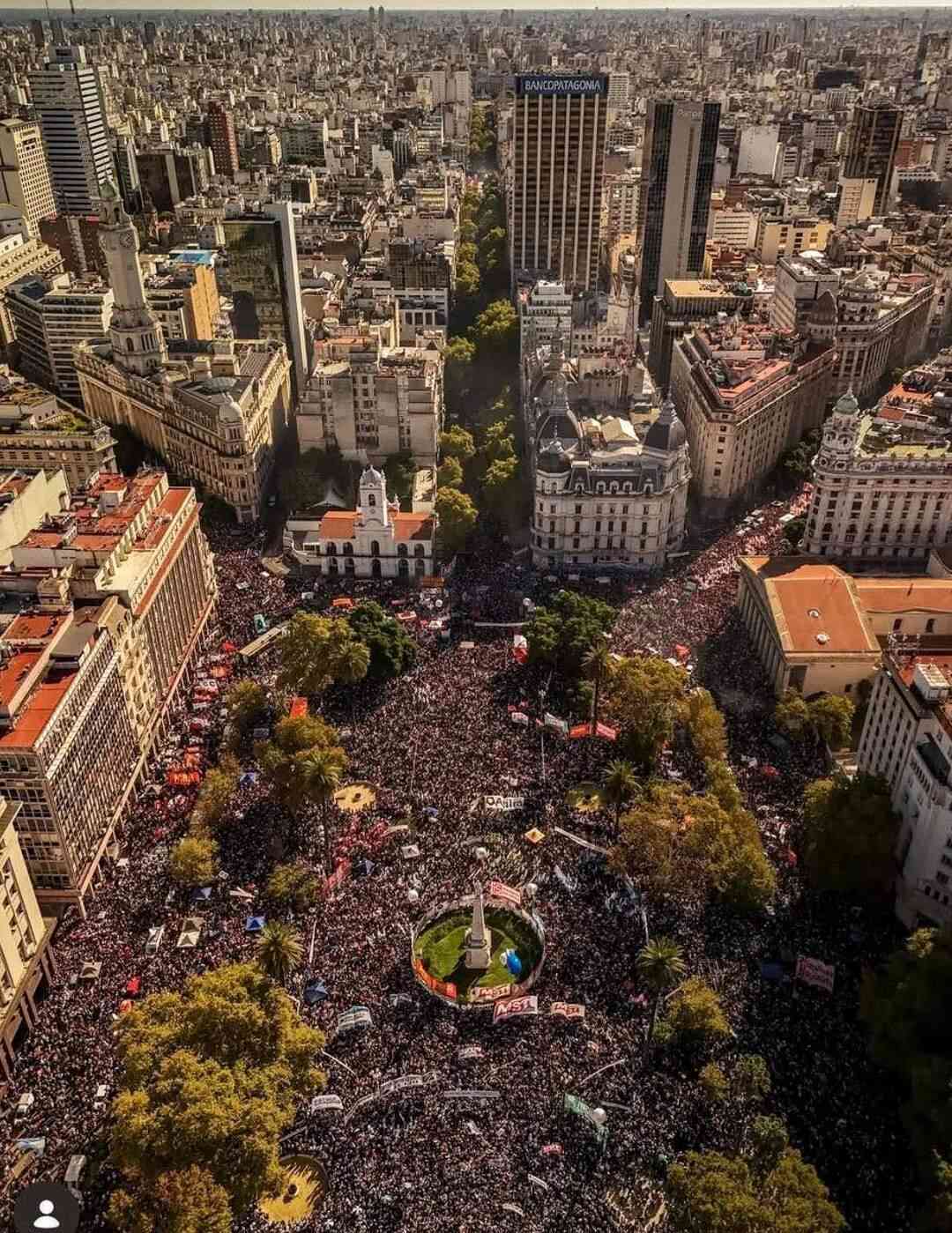
Fifty years after the 1976 military coup, Argentina has witnessed massive mobilisations, particularly on March 24 this year, which brought together youth, workers, and social movements in one of the most significant political moments in recent years. These protests have unfolded amid deepening economic crisis, growing social unrest, and the controversial policies of the government of Javier Milei. The strong participation of young activists has been especially notable, reflecting a broader process of politicisation and renewed radical engagement.
Alternative Viewpoint spoke with Martín Alvarez, a 27-year-old activist from Argentina who participated in the First International Anti-Fascist and Anti-Imperialist Conference, held from March 26-29, 2026, in Porto Alegre, Brazil. Martín is an activist of Agrupación Política Nueva Opción, a teacher-student political body at the Universidad Nacional de Luján. He currently serves as president of the Student Centre of the History Teacher Training Programme. In this interview, he reflects on the significance of the March 24 mobilisation, the role of youth, the current political situation in Argentina, and the emerging dynamics of resistance.
Alternative Viewpoint: The demonstrations on 24 March this year were particularly massive, taking place against a backdrop of repeated days of protest and a strong presence of the youth. What explains this trend, and what social and political factors are driving these demonstrations?
Martín Alvarez: It is true that the latest demonstration on 24 March was particularly massive. In my own case, I take part every year with our group, and the marches are usually huge, but this year it struck me as the largest 24 March rally I have ever attended. There are several reasons for the unprecedented turnout. On the one hand, the fiftieth anniversary of the beginning of the 1976 dictatorship acted as a powerful symbolic catalyst, mobilising multiple generations under the slogan of ‘Memory, Truth and Justice’. On the other hand, having a government like Milei’s, with a discourse completely opposed to human rights organisations, described as denialist, which denies or downplays the number of disappeared persons; justifies the crimes perpetrated by the state; sympathises with the economic and social policies implemented by the dictatorship; and is currently continuing those neoliberal policies and austerity measures against the population – all of this has led the collective of social, political, trade union and neighbourhood organisations to mobilise with all their might towards Plaza de Mayo and in every province of the country. In turn, the united call for mobilisation aimed to unite all political, trade union, and social sectors on a common front against current economic policies.
I contend that the marches in recent years have had limited political significance. It is essential not to conflate the sheer scale of certain demonstrations with their actual impact on the political landscape. The number of individuals mobilised does not necessarily equate to an equivalent degree of political engagement among those participants, particularly in terms of fostering greater politicisation and radicalisation within Argentine society.
In Argentina, the 24 March demonstrations typically unite individuals from various political backgrounds, including those who do not align with any specific political group but possess a historical understanding that the genocide must never be repeated. This year, a significant increase in the number of individual participants was particularly notable, alongside the political parties and organisations that have consistently mobilised. Demonstrators, including individuals, families, and young people, participated in the demonstrations without any affiliation to a specific political or social organisation.
The increasing depoliticisation of Argentina’s society may be one of the factors contributing to this phenomenon. The term “crisis of representation” denotes a crisis within the traditional political parties of the country, as well as the dysfunction of the state and its institutions.
On the other hand, the demonstrations held against Milei’s government failed to derail the policies he has implemented. There is no correlation between the marches and their historical political significance. No mobilisation managed to halt the Law of Bases at the start of Milei’s government. On April 23, 2024, the largest mobilisation in Argentine history since the return to democracy took place, spearheaded by the university movement, which came out in defence of free public education in Argentina. The brutal budget cuts to universities forced a significant section of Argentine society onto the defensive; this section defends state intervention in society, in the economy, and in the role of public institutions. However, the enormous April march did not have the expected political effect of putting a stop to the cuts in universities. Eventually, the National Congress passed a University Financing Act, which sought to restore the budget and the salaries of teaching and non-teaching staff at national universities. That law was vetoed by the executive, then challenged in court, and even though the judiciary ruled in favour of the universities, to this day, the law remains unimplemented, and the cuts in this sector of Argentine society continue.
One of the principal weekly protests occurring in Argentina involves pensioners. Initially, these protests were mass demonstrations that successfully united trade unions, social organisations, football supporters, and individuals in solidarity with the pensioners’ fight against cuts to their pensions. These cuts have left them with an income insufficient for basic living expenses, plunging them into poverty and destitution. However, the government’s response has been to persist with its austerity measures and enforce harsh, systematic repression week after week. This approach has diminished the scale of the demonstrations and gradually isolated the pensioners, leaving them adrift in what remains a significant struggle.
Recently, in February 2026, the National Congress passed the Labour Modernisation Act, which aims to formally legalise and intensify the exploitation of the Argentine working class by making working conditions more flexible, eroding purchasing power, and repealing historic gains. In the same month, a Juvenile Criminal Code was passed, lowering the age of criminal responsibility in Argentina from 16 to 14. That same week, Congress gave preliminary approval to the reform of the Glacier Law, which seeks to redefine protected areas and relax restrictions on mining.
These were all government offensives in favour of large capitals and corporations. Structural reforms are being implemented to consolidate a new defeat and to discipline the working class and the people. The demonstrations held against these policies were not massive. They were small. There was no resistance in the streets. The bourgeoisie’s waning support for Milei, rather than popular resistance, is the primary reason for any delays in court reforms.
It is important to make these points. While the massive march on March 24 may appear to reflect growing radicalism and may bring together significant sectors of society that wish to halt the libertarian government, limiting oneself to this single mobilisation may, in analytical terms, lead to the invocation of that famous phrase: “Don’t let the trees obscure the forest.”
Less than a month lies between the reforms in question and the march on 24 March. The latter was massive. Yet the marches demanding a firm defence against structural reforms in Argentine society carried no weight whatsoever.
Alternative Viewpoint: How would you describe Javier Milei’s political project? What new elements does it introduce into Argentine politics?
Martín Alvarez: Javier Milei’s political project represents the historical agenda of Argentina’s right-wing parties, which have now radicalised into an “ultra-right” form due to the new structural conditions of the global economy, increasingly favouring the most monopolistic sectors of big business.
It seeks to finish destroying the historic gains of the working class and the Argentine people in order to generate a greater transfer of value and wealth to finance capital and big business. The project seeks to dismantle Argentina’s industry and facilitate imports, thereby benefiting transnational corporations. This project also involves systematic and massive indebtedness, which subjugates the country to the demands of international financial institutions, ultimately leading to a loss of sovereignty and control over national economic policies. Another key feature is the total surrender of the country’s natural resources. The land and mountains are being exploited for the benefit of a small number of mining and agribusiness companies. A new development introduced by the Milei government, compared to previous governments, is the overt aim of the total destruction of the state, particularly in those areas linked to the state’s social protection functions, which may lead to increased inequality and reduced access to essential services for the population.
Alternative Viewpoint: There is growing concern about attempts to downplay or reinterpret the period of the dictatorship. How important is historical memory in today’s political struggle?
Martín Alvarez: Historical memory plays a crucial role in contemporary political struggles. This understanding is vital not only for challenging the current government’s misleading rhetoric but also for prompting a re-examination within our own ranks—the people—of how we interpret what was the most intense period of class struggle in Argentina.
Argentina is often cited as a global example of achieving justice through the conviction of the leading military figures who presided over the dictatorship. However, it is important to acknowledge that this dictatorship involved not only military personnel but also civil and ecclesiastical authorities. The prevailing narrative in our country tends to portray a ‘Military Party’ as the primary force behind the dictatorship. This perspective creates an impression that the military operated alone, overlooking the support and resources provided by various corporate and civilian entities complicit in the regime’s actions.
The repressive apparatus of the dictatorship obscures the role of corporate involvement. The complicity of businesses and civilian actors in the military government receives insufficient attention, undermining our understanding of how these groups collectively enabled the regime’s actions. It is essential to shift the narrative to emphasise military cooperation with civilian actors over civilian cooperation with the military. Civilians, particularly business groups and factions of capital, are often the driving force behind coups. In Argentina, we tend to focus exclusively on military factions, which prevents us from recognising the influence of economic groups that have historically shaped political power and decision-making and leads to ongoing struggles for genuine democratic representation and accountability in the government. Today, many groups in government positions were once part of the dictatorship.
Fifty years on, we have transitioned from a military coup to a system of bourgeois democracy. In Argentina, however, we have experienced a double defeat. This situation is evident in the practical sense, as the formation and development of a revolutionary social force from the late 1960s onwards was militarily and politically suppressed by the regime’s forces, culminating in a genocide whose full death toll remains unknown to this day. This historical context has led to a defeat in how these events are remembered by society. With the restoration of democracy, the institutional narrative surrounding these events has been characterised by denials of the underlying logic behind the actions of the involved forces. The opposing factions have been portrayed as mere participants in irrational violence.
This narrative serves as an ideological representation of confrontations that retain social relevance today: it suggests that the conflict occurred between two isolated groups, lacking alliances or connections to the broader society, which observed in fear as a violent struggle unfolded, unable to attribute responsibility or intervene. This interpretation, known as the ‘Theory of the Two Demons’, is articulated in the first preface (1984) of Nunca Más as a de-subjectivised ‘terror’ from the far right battling against the far left during the 1970s. Such an understanding of events is detrimental to the population and particularly harmful to the various sectors currently engaged in struggle. It also provides justification for certain denialist positions adopted by Javier Milei’s government, which undermine historical accountability and perpetuate narratives that dismiss the struggles of marginalised communities. The struggle includes the ongoing fight for social justice and recognition of the historical injustices faced by these groups, as well as the systemic inequalities that persistently affect their access to resources and opportunities.
Understanding the process of struggle highlights the triumph of counter-revolutionary forces and the subsequent defeat of the people’s movements. This defeat elucidates why the number of “poor people of the present” significantly exceeds that of “poor people of the past.” Their poverty is not only objective—marked by a widening chasm between them and the privileged classes over the past 50 years—but also a consequence of being pushed into undesirable areas by the violence inherent in the ruling class’s regime of accumulation, coupled with ineffective state policies. Numerous young individuals, lacking viable employment opportunities or disinterested in seeking work, resort to various forms of violence and street crime for income, often in collusion with the police force. This force is shielded by a class-based criminal justice system that espouses retrograde and conservative perspectives.
They are also subjectively poorer, as the losses they have experienced extend beyond mere material deprivation. For the majority, the current situation has compromised their ability to reflect and comprehend its historical reasons. As a result, they find it hard to unite with each other and other groups to tackle their common problems and fight for their rights. Nonetheless, every day, many segments of the population demonstrate moral and material forms of resistance, such as organising protests, advocating for policy changes, and supporting each other in their communities.
Alternative Viewpoint: What role do workers, trade unions and social movements play in resisting austerity and right-wing policies?
Martín Alvarez: The primary force opposing the government in Argentina is Peronism. This movement controls a majority of the country’s trade unions, which are organised under the CGT (General Confederation of Labour), and maintains a robust presence within social movements. Additionally, Peronism continues to hold positions within the government, with representatives as deputies, senators, governors, mayors, and councillors throughout the nation. Milei’s government owes its ability to implement its agenda to the complicity of Peronism, which is currently undergoing a process of disintegration. This disintegration is manifested in Peronism’s internal divisions, a decline in electoral support, a lack of a coherent programme offering an alternative to the current model, and its ‘peaceful co-existence’ with far-right agendas.
But when discussing the degree of weakness—or otherwise—of the popular group, one must keep in mind something important: the level of the trade union organisation in Argentina is extremely high. Even under conditions that are unfavourable for workers and their trade union representatives, the level of union organization in Argentina remains extremely high. That is why, at demonstrations, people chant, ‘Where is it? We can’t see it, the famous CGT!’. It is known that if the trade union movement takes action, it carries significant weight. Everyone knows the truth.
This observation emphasises that a high level of organization does not necessarily indicate a strong willingness to engage in conflict. Organisations can serve to hinder the popular movement when the leaders of parties, movements, and trade unions are co-opted by forces that align with the interests of the ruling regime.
Therefore, one cannot underestimate organisational capacity and the extent to which trade unionism is embedded in Argentina. When the CGT calls a strike, it is one with characteristics not replicated anywhere else in the world, such as the sheer scale of participation and the solidarity shown across various sectors of the workforce. These strikes have a profound impact, effectively bringing the entire country to a halt. That is why the power of the trade unions remains significant. Despite their failure to channel all that strength into supporting popular struggles, the trade unions remain significant.
There are other movements that carry significant weight in Argentina: the women’s movement and the gender movement. This sector of society drove one of the most recent major marches against fascism in Argentina. We can also highlight the environmental movement, which, although it has seen a decline recently, has regained strength in the face of the regressive reform of Glacier Law, particularly as activists have organised protests and campaigns to protect natural resources and advocate sustainable practices.
It is also important to highlight the university movement, which in recent years has led to significant struggles in defending public education, free tuition, and the aforementioned university funding law. In turn, we must highlight the struggles of pensioners, who continue to mobilise on their own for decent living conditions.
The levels of social unrest unfolding in Argentina are truly significant. They have grown considerably this year. It is worth noting the high level of unrest in the country’s provinces: there are urgent situations in Jujuy, Chaco, Santa Cruz, Chubut, Catamarca, etc.
However, this significant level of social unrest is not sufficiently coordinated, as different groups are pursuing their agendas without a common strategy or leadership to unify their efforts. We are still witnessing the fragmentation of social struggles. At present, there does not appear to be a force capable of unifying the demands and formulating a political project to which the movements and the various sectors of society can adhere, which is crucial for effectively addressing the underlying issues causing the social unrest, such as economic inequality, political corruption, and social injustice.
Alternative Viewpoint: How would you assess the current state of the Argentine left: its strengths, limitations and future prospects?
Martín Alvarez:Some argue that, while much of Peronism has remained passive, endorsed regressive policies through parliamentary votes, or shown little willingness to take to the streets to confront the government, sections of the left—specifically, the Workers’ Left Front – Unity (FIT-U)—have been actively involved in the struggles of recent years. The population is beginning to perceive them differently. Some Argentine leftist leaders have recently gained popularity in opinion polls. However, such support does not necessarily translate into votes, and simply possessing strength is insufficient for the left. Nonetheless, it is evident that, over the years, certain left-wing leaders have started to emerge who challenge the type of movement that needs to be established, broadening perspectives at a time when large segments of the population that once voted for Peronism are now in search of alternative voices, such as progressive policies and social justice initiatives that resonate with their current needs. This indicates a potential shift in political dynamics that could reshape future elections.
Others argue that the left is too large. The left has parliamentary representation, a large number of activists, and a predisposition for direct action. In other words, there is a substantial amount of left-wing activism, which generates mobilisation in response to any issue. However, the distinction between quantity and quality reappears, and one must not confuse the two when analysing leftist organisations. And yet, despite all this potential, there is talk of the weakness of the Argentine left. The metaphor used to highlight the left’s inability to lead struggles or occupy positions of power goes something like this: “We are hungry even though the fridge is full.” In other words, there are plenty of people on the left to contest power. This phenomenon can be explained by the fact that, despite having a large membership, the left still fails to gain political ground in a context of social regression, characterised by a massive crisis of representation in the political system and the decay of Argentina’s two major political parties—Radicalism and Peronism; that is, the left is not gaining ground even under Milei’s government.
This inability of the left to articulate the struggles currently taking place is linked to the question of how the class struggle is advanced. We are trapped in a liberal consensus regarding the democratic transition, which limits the left’s ability to effectively challenge the status quo and advocate for the needs of the working class, especially when addressing the urgent issues faced by marginalised communities in Argentina, such as economic inequality, access to education, and healthcare disparities. Organising just a little of what’s out there would achieve enormous results, such as fostering greater unity and collaboration among various factions within the revolutionary camp. But for such an outcome, the Left should engage with the vanguards rather than relying so heavily on the logic of parliamentary representation. This engagement could lead to more innovative strategies that directly address the needs of marginalised communities and the working class, such as grassroots initiatives and direct action campaigns that empower these groups. Polling well may help with representation, but it can hurt the vanguards by creating a perception that they prioritise popularity over the urgent needs of marginalised communities and the working class. Perhaps the Left should not appear to be so likeable at times like these. Instead of solely relying on parliamentarism, the Left should act as a representative of the people. The organised working class, under the leadership of a vanguard, carried out the Russian Revolution, not the fragmented masses. This case serves as just one example among various instances where revolutions have occurred.
In that sense, the Argentine left is politically disarmed and lacks authority. It is trapped in the logic of representation, and the sheer number of demonstrations with no political impact has led it to inaugurate a ‘marchodrome’ in the province of Buenos Aires.
We should look at some recent experiences in Argentine history, such as the piquetero movement. We need to focus on processes of self-organisation and autonomy from the state. A left that acts as a militant organisation, capable of disrupting the movement of goods and people in different parts of the country.
Despite all the problems we face, the Left continues to fly the flag of socialism, advocating for social justice and equality while seeking to mobilise grassroots support for systemic change.
Alternative Viewpoint: Do you see any links between what is happening in Argentina and broader trends in Latin America, including the rise of far-right forces?
Martín Alvarez: The situation in Argentina is clearly part of a broader regional trend. Milei represents a local phenomenon that aligns with a global pattern. We can observe the rise of the ‘far right’ in various governments, including those of Kast, Bolsonaro, Trump, Bukele, Le Pen, Viktor Orbán, Meloni, Vox, and Chega. While each of these leaders possesses unique characteristics, they share a common trait, particularly in Latin America: they act as instruments of US imperialism, frequently enacting policies that serve US interests instead of addressing the needs of their own citizens.
Alternative Viewpoint: Recent mobilisations in Argentina appear to be reshaping the political landscape. In your view, how are these struggles transforming the balance of forces domestically, and what lessons might they offer to radical and anti-fascist movements internationally?
Martín Alvarez: Beyond political organisations, a shift is beginning to take place in the Argentine people’s perception of the government. A sense of unease is becoming apparent; it is not yet enough to defeat the government or resist its economic policies, but it is a starting point for beginning to engage in dialogue, to coordinate, and to unite forces among all sectors willing to fight against what we are facing. In this sense, opportunities are opening up for the left.
There is still no organic space to organise the struggle against fascism. That space must be built. The demonstrations in Argentina should serve as a valuable lesson for us. We cannot march on different fronts in a disjointed manner. We must build the capacity to unite the struggles of the present. We cannot march against repressive forces without organising an appropriate defence during the demonstrations. We must draw on the various experiences of street combat that took place in the past and are taking place in some parts of the world today, such as the tactics used in protests against authoritarian regimes, to inform our strategies for effective resistance.
In addition to mobilising, the left must establish a territorial presence and contest real power on every front. Becoming an authority goes far beyond an electoral front against the far right. It involves having a policy for leading and organising vanguards, which means actively engaging with and supporting grassroots movements that challenge right-wing policies and promote progressive change. The sectors of society that are resisting right-wing policies include various groups and individuals. The vanguard sectors. To achieve these goals, we must advance the theoretical struggle and organise a core of resistance. The vanguard is organised around a pole, acting as a significant force that challenges society. That core must be built.
Homeland or Death. We shall prevail!
About the Author


Martín Alvarez
Martín Alvarez is an activist of Agrupación Política Nueva Opción, a teacher-student political body at the Universidad Nacional de Luján. He currently serves as president of the Student Centre of the History Teacher Training Programme.