As climate breakdown intensifies alongside deepening geopolitical instability, frustration with the United Nations climate process has reached a new level. Three decades of COP negotiations have produced increasingly urgent declarations, yet fossil-fuel production continues to expand while global emissions remain dangerously high. Even the limited breakthrough at COP28 in Dubai, where countries formally acknowledged the need to “transition away from fossil fuels”, exposed the structural limits of a consensus-driven process increasingly shaped by fossil-fuel interests, corporate lobbying, and geopolitical deadlock. Against this backdrop, the Santa Marta Summit in Colombia marked an important political development: the first major attempt outside the formal UN climate framework to build an implementation-oriented coalition focused directly on moving beyond oil, gas, and coal.
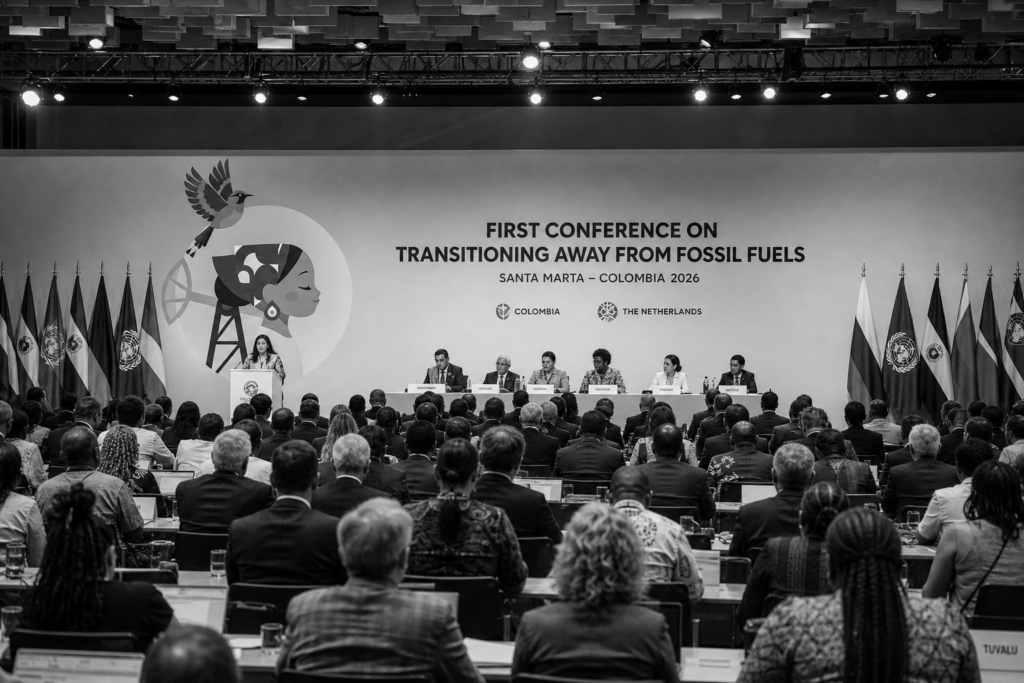
Held from 24 to 29 April in the historic city of Santa Marta and co-hosted by Colombia and the Netherlands, the conference brought together 57 countries and the European Union, representing roughly one-third of the global economy. Participants included climate-vulnerable states, small island nations, fossil-fuel importers, developing economies, and major fossil-fuel producers such as Brazil, Australia, Norway, Angola, Nigeria, and Mexico. Unlike the often stalled COP process, Santa Marta acted as a “coalition of the willing”: a meeting meant not to achieve total agreement but to promote practical cooperation among countries ready to speed up transition efforts, create national plans, tackle funding challenges, and find ways to move away from fossil-fuel reliance.
Crisis of the COP Framework
The timing of the summit was politically significant. As global energy markets became more unstable, many countries saw the shift away from fossil fuels not just as a way to address climate change, but also as a matter of energy independence, economic strength, and long-term safety.
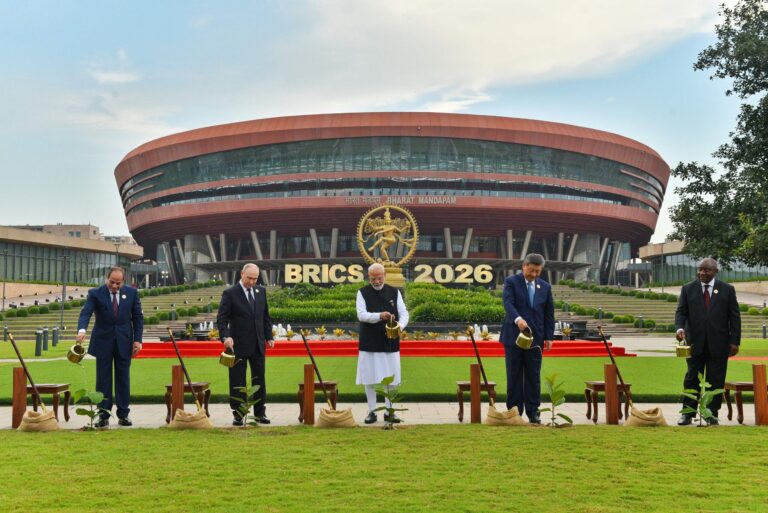
The summit also exposed deep contradictions within the politics of transition. Many participating countries remain structurally dependent on extractive revenues, while several of the world’s largest emitters, including the United States, China, India, and Russia, were absent from the process altogether. Parallel discussions among civil society groups warned that without significant changes to the system, “transition” could just turn into a new type of “transaction”: swapping fossil fuel extraction for new forms of extraction focused on transition minerals, green investments, and unfair trade practices. Questions of debt, climate finance, corporate power, Indigenous sovereignty, and the legal barriers created by international investment regimes therefore emerged as central concerns rather than secondary issues.
Santa Marta did not produce a binding fossil-fuel treaty, nor did it resolve the contradictions of global climate politics. Its significance lies elsewhere. Rather than offering a definitive blueprint for a post-fossil future, the summit represented an emerging attempt to move beyond the procedural paralysis of existing climate diplomacy and openly confront the political, economic, and geopolitical conditions sustaining fossil-fuel dependence. In that sense, Santa Marta may be understood less as a completed alternative than as an important diagnostic moment in the search for new forms of climate coordination beyond the exhausted architecture of the COP process.
Beyond COP: The Emergence of Implementation Politics
The political significance of the Santa Marta Summit lies not simply in the number of participating countries but in the attempt to move climate politics beyond the increasingly exhausted framework of the COP negotiations. For many governments, researchers, and climate movements, frustration with the UN climate process has deepened not only because of insufficient progress but also because of the structural contradictions embedded within the negotiations themselves. While climate summits have produced increasingly urgent declarations about the dangers of global warming, they have largely failed to directly confront the continued expansion of fossil-fuel production.
The COP process has increasingly highlighted the growing divide between scientific urgency and political action over the years. Negotiations based on consensus often allowed big fossil-fuel-producing countries to weaken or stop stronger commitments. The increasing number of industry lobbyists made it seem like these institutions were being controlled by outside interests. At COP30 in Belém, for instance, one in every twenty-five participants reportedly represented fossil-fuel interests. Even where ambitious language entered official agreements, implementation remained weak and fossil-fuel expansion continued largely uninterrupted.
Consequently, international climate negotiations primarily focused on emissions management ignoring the transformation of the political economy of fossil fuels. Market-oriented mechanisms such as carbon offsets, emissions trading and speculative technological fixes, including carbon capture and storage, were frequently touted as pathways compatible with continued extraction. Critics increasingly argued that these approaches functioned less as transition strategies than as mechanisms for delaying structural change while preserving existing energy and investment regimes.
The growing criticism of the COP framework was, rightly, not only against diplomatic inefficiency but also of the broader model of climate governance that had emerged around it, one that often sought to manage emissions without directly confronting the political and economic structures driving fossil-fuel expansion. For many climate justice movements and researchers, the central question increasingly became whether ecological transition could remain compatible with an economic system structurally dependent on continuous extraction, accumulation and growth.
From Negotiation to Implementation
Against this backdrop, Santa Marta attempted to establish a different political logic. Instead of being just another place for countries with conflicting interests to try to agree, the summit saw the participation of countries ready to push for changes outside the usual slow processes of traditional climate diplomacy. Its emphasis was less on producing another declaratory agreement than on building mechanisms for implementation, coordination, and political convergence around fossil-fuel phaseout.
This shift was visible in several ways. Discussions looked at not just emissions targets but also practical issues that the COP process has often had trouble dealing with directly: how to rely less on fossil-fuel money; how to change trade and financial systems for a future without fossil fuels; how to handle stranded assets; how to align national transition plans; and how to raise funds for countries with debt problems and economies that depend on extraction.
The Return of Supply-Side Politics
One of the summit’s most significant political shifts was its explicit emphasis on the supply side of the climate crisis. Previous climate negotiations largely concentrated on reducing emissions through efficiency measures, technological adaptation, or demand management while avoiding direct confrontation with fossil-fuel extraction itself. At Santa Marta, however, participants increasingly framed the expansion of oil, gas, and coal production as the central contradiction of climate politics. The discussions, therefore, moved closer to questions long raised by climate justice movements: whether meaningful decarbonisation is possible without planned reduction of fossil-fuel extraction.
This also shaped the summit’s critique of so-called “false solutions”. Delegates and civil-society participants often challenged methods that allow for more fossil-fuel production while claiming to be making progress, such as relying too much on offsets, carbon markets, and uncertain technological solutions. Such methods were criticised for avoiding the major changes needed for a true shift away from fossil fuels.
Science, Sovereignty and Geopolitics
Santa Marta combined science more centrally within climate policymaking. Participants repeatedly stressed the widening disconnect between scientific warnings and governmental action. The launch of the Science Panel for the Global Energy Transition (SPGET) reflected an effort to align transition planning more closely with scientific timelines consistent with limiting warming to 1.5°C. Unlike the highly politicised bargaining that often shapes COP outcomes, the Santa Marta process attempted to frame scientific assessment as a basis for implementation rather than as another arena for diplomatic compromise.
Yet Santa Marta’s implementation-oriented approach also revealed the growing geopolitical character of climate politics. The transition away from fossil fuels was increasingly discussed not simply as an environmental necessity, but as a question of energy sovereignty, trade restructuring, fiscal stability, and strategic autonomy in an era of intensifying geopolitical fragmentation. The energy shocks generated by war and market volatility reinforced the perception among many participating countries that dependence on fossil fuels had become not only ecologically unsustainable but also economically and politically destabilising.
Nevertheless, the summit did not overcome the deeper contradictions shaping the global transition. Many participating states themselves remain heavily dependent on extractive revenues, while several of the world’s largest emitters, including the United States, China, India, and Russia, remained outside the process altogether. Santa Marta therefore did not constitute an alternative climate order. Rather, it represented an emerging attempt to create new forms of coordination capable of advancing transition politics beyond the limits of consensus-based multilateralism.
Climate Justice, Territory and the Politics of Transition
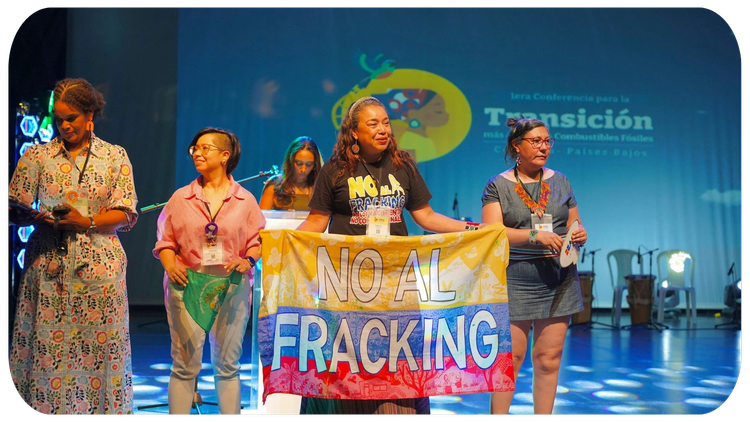
If the official summit in Santa Marta reflected growing dissatisfaction with the paralysis of conventional climate diplomacy, the parallel gatherings organised by social movements, Indigenous organisations, trade unions, environmental networks, and affected communities pushed the debate in a more radical direction. The People’s Summit for a Fossil-Free Future and the Conference for Fossil-Fuel-Free Territories transformed Santa Marta into more than a diplomatic forum; they foregrounded competing visions of what a transition beyond fossil fuels should actually mean.
At the centre of these discussions was a fundamental political question: would the transition represent a genuine transformation of the global political economy or merely a reorganisation of extractivism under a “green” framework? For many civil-society organisations and territorial movements, the danger lay in reducing the energy transition to a technological substitution, replacing oil, gas, and coal with new extractive frontiers organised around lithium, cobalt, rare earth minerals, large-scale infrastructure projects, and green investment regimes. In this critique, the problem was not simply fossil fuels themselves but a broader model of accumulation based on dispossession, unequal exchange, and the commodification of nature.
This tension was sharply captured by some Latin American and Brazilian collectives that warned of the risk of “transition” becoming merely a new form of “transaction”. The phrase expressed growing concern that the language of decarbonisation could legitimise new cycles of extraction, infrastructural expansion, and corporate accumulation without altering the underlying structures that produced ecological destruction and inequality in the first place. In this view, a post-fossil future that reproduces sacrifice zones, territorial dispossession, and asymmetrical trade relations would remain trapped within the logic of extractivism even if its energy sources changed.
The People’s Declaration adopted alongside the summit reflected this broader critique. Rather than treating climate transition narrowly as an issue of emissions reduction or energy technology, it linked decarbonisation to questions of reparative justice, debt cancellation, democratic control over energy systems, labour rights, Indigenous sovereignty, agroecology, and opposition to militarism. The declaration also rejected a range of “false solutions” – including carbon offsets, speculative geoengineering, large-scale bioenergy projects, and excessive reliance on carbon capture technologies – arguing that such approaches often function to prolong fossil-fuel dependence while transferring ecological and social costs onto vulnerable populations.
Questions of territory and sovereignty emerged as particularly important themes. Indigenous organisations and frontline communities repeatedly pointed out that many areas chosen for fossil-fuel extraction, mining, and new infrastructure have a history of colonial violence, displacement, and environmental harm. As a result, demands for a fossil-free transition were increasingly articulated not simply as environmental claims but as struggles for territorial autonomy, collective rights, and democratic control over land, water, and natural resources.
One of the more significant proposals from the broader Santa Marta process was to establish “fossil-fuel-free zones” – territorial frameworks that aim to limit or prevent further expansion of extraction activities. Supported strongly by Indigenous movements and civil-society organisations, the proposal linked climate policy to concrete territorial governance mechanisms, including restrictions on new exploration licences, managed closure plans for existing extraction sites, and the protection of ecologically vulnerable regions. While still largely aspirational, such proposals indicated a growing effort to move climate politics beyond abstract targets toward territorially grounded forms of transition planning.
Debt, Finance and Green Colonialism
Many discussions in Santa Marta highlighted the structural constraints facing countries in the Global South. For states heavily dependent on extractive exports, the transition away from fossil fuels raises immediate questions concerning debt, fiscal survival, employment, and development financing. Participants repeatedly pointed to what some described as the “debt-fossil fuel trap”, in which indebted economies remain structurally pressured to expand extraction in order to secure foreign exchange, service external debt, and attract investment. In this context, demands for climate justice increasingly became inseparable from calls for debt relief, public financing, technology sharing, and reforms to international financial institutions.
These debates also exposed the uneven character of the global energy transition. While industrialised economies possess greater financial and technological capacity to restructure energy systems, many countries in the Global South confront the transition under conditions shaped by debt dependence, unequal trade relations, and pressure to continue supplying raw materials to the global economy. Under such conditions, fears of a new “green colonialism” increasingly entered the discussions.
Legal Regimes and Democratic Transition
The summit also refocused attention on the role of international investment and trade regimes in limiting democratic transition policies. In particular, controversies about Investor-State Dispute Settlement (ISDS) mechanisms highlighted how fossil-fuel companies can use international arbitration mechanisms to undermine state policies that could affect future profits. Sometimes they referred to legal disputes involving companies like Shell and ExxonMobil as examples of how trade and investment arrangements could function as structural barriers to the post-fossil transition. For many, this invoked a further question of whether states can meaningfully pursue climate transition while remaining embedded in global legal and financial architectures designed to protect extractive capital.
The debates in Santa Marta revealed that the transition beyond fossil fuels is not simply a technological or environmental challenge. It is also a struggle over development models, state sovereignty, territorial rights, financial power, and the unequal organisation of the global economy. The summit therefore exposed a growing divide between visions of transition centred primarily on green growth and technological adaptation and those calling for deeper transformations in patterns of production, consumption, ownership, and political power.
For all its tensions and ambiguities, Santa Marta demonstrated that climate politics is increasingly moving beyond the narrow framework of emissions accounting toward broader disputes over how societies organise energy, territory, and economic life itself.
Despite its political significance, the Santa Marta process also revealed the profound contradictions shaping any attempt to build a post-fossil international order. The summit brought together an unusually broad coalition of states, movements, and institutions around the need to accelerate transition away from fossil fuels. Yet many of the underlying political and economic dynamics reproducing fossil dependence remained unresolved.
Fossil Dependence and Unequal Development
The first inconsistency was in the makeup of the coalition itself. Countries participating in the initiative, such as Colombia, Brazil, Nigeria, Angola, Australia and Norway, still rely heavily on extractive industries for export revenues, fiscal stability, employment and foreign exchange earnings. For many economies in the Global South, fossil fuels are not just energy sources, they are also the foundation of national development models that are embedded in the global trade and financial architecture. This creates an inherent tension between climate commitments and developmental imperatives. Governments may speak the language of transition while accelerating extraction to meet debt obligations, fiscal pressures and economic instability.
The contradiction is especially sharp in conditions of capitalism developed unevenly on a world scale. Industrial economies have built their wealth through centuries of carbon-intensive growth, while many of the countries being asked to make the transition are still structurally subordinate in global production chains. Rapid decarbonization demands, therefore, often bump into lingering questions of historical responsibility, climate debt, technology access and uneven financial power. If there is no massive public finance, debt relief and redistributive mechanisms, the transition risks reproducing rather than overcoming existing global inequalities.
The absence of several of the world’s largest emitters and geopolitical powers further exposed the limits of the Santa Marta coalition. The United States, China, India, Russia, and major Gulf oil-producing states did not participate in the process. Their absence highlighted both the possibilities and the constraints of implementation-orientated coalitions outside the UN framework. On the one hand, smaller alliances may move more quickly when freed from consensus-based paralysis. But then again, the lack of major powers brings up tough questions about scale, enforceability and geopolitical leverage. Any transition process that does not involve some of the central actors within the global fossil economy is inherently limited in its ability to reshape energy systems at the planetary level.
The summit also underscored the growing fragmentation of the international order itself. Climate politics is more and more tangled up in trade wars, military conflicts, energy security concerns, sanctions regimes, and geopolitical competition over strategic resources. Energy shocks, amplified by the escalating Middle East conflict, revealed how deeply fossil fuels are still embedded in global power structures. Under such conditions, states may simultaneously pursue decarbonisation rhetorically while prioritising energy security, industrial competitiveness, and strategic autonomy through continued investment in extraction and resource control.
Green Extractivism and Ecological Sacrifice
Debates over transition minerals revealed another major contradiction within the post-fossil agenda. While the summit challenged fossil-fuel dependence, it also revealed the danger that decarbonisation may generate new forms of extractivism organised around transition minerals and green infrastructure. The projected expansion of lithium, cobalt, copper, nickel, and rare-earth extraction raises the possibility that the ecological burdens of “green transition” will once again be displaced onto peripheral territories and vulnerable communities. In this scenario, fossil capitalism does not disappear so much as reorganise itself through new commodity chains, technological regimes, and investment frontiers.
This anxiety was strongly articulated by indigenous organisations, territorial movements, and climate justice networks participating both within and alongside the Santa Marta process. For many of these actors, the central issue is not simply whether fossil fuels are replaced but what kind of social and ecological order emerges through the transition itself. They warned that a decarbonisation process driven primarily by global competition, corporate investment, and accelerated extraction of “critical minerals” could reproduce familiar patterns of dispossession, ecological degradation, labour exploitation, and unequal exchange under environmentally updated forms. In this critique, the danger is that the transition merely reorganises extractive capitalism through new commodity chains, investment frontiers, and zones of ecological sacrifice – shifting pressures from oil and coal regions to lithium basins, rare-earth corridors, mega-infrastructure projects, and Indigenous and rural territories across the Global South. Growing concerns over “green colonialism” and “green extractivism” reflected precisely this fear: that decarbonisation in the Global North may depend upon intensified resource extraction and territorial control elsewhere.
Financial Architecture and Corporate Power
At the institutional level, the summit exposed how international legal and financial systems continue to reinforce fossil dependence. ISDS mechanisms remain particularly significant in this regard. Trade and investment agreements contain ISDS frameworks that allow companies to sue governments over policies that threaten anticipated profits, such as environmental and transition policies. Fossil fuel companies have used such mechanisms repeatedly to pressure governments that are trying to regulate extraction, phase out projects or restructure energy systems. As a result, states attempting ambitious transition policies may confront not only domestic economic pressures but also costly international litigation backed by transnational capital.
Debt structures constitute another major obstacle. Many countries in the Global South remain trapped within financial arrangements that incentivise extractive expansion as a means of securing export revenues and servicing external obligations. Under these conditions, calls for climate transition without corresponding transformation of the international financial architecture risk becoming politically unsustainable. This explains why questions of debt cancellation, grant-based climate finance, subsidy reform, and restructuring of development finance occupied such a central place within Santa Marta discussions.
State, Movements and Competing Visions of Transition
The summit also revealed unresolved tensions concerning the role of the state itself. While Santa Marta represented an effort by governments to coordinate transition policies beyond the COP framework, many activists and social movements expressed scepticism toward state-led transition strategies that remain tied to growth-orientated developmental models and foreign investment dependence.
Santa Marta functioned less as a coherent alternative model than as a space in which multiple and often conflicting visions of post-fossil transition temporarily converged. Some participants imagined transition primarily in terms of green industrial policy, investment coordination, and technological modernisation. Others understood it as inseparable from anti-extractivism, reparative justice, Indigenous sovereignty, and systemic economic transformation. The summit’s political significance may therefore lie not in resolving these tensions, but in making them visible within an emerging international conversation about the future of energy and development.
The challenge facing the Santa Marta coalition is thus not simply technical implementation but political coherence. Whether the process becomes a durable and transformative force will depend on its ability to confront the structural conditions that continue reproducing fossil dependence: uneven development, corporate power, debt regimes, geopolitical competition and extractive models of accumulation. Without addressing these deeper contradictions, the transition beyond fossil fuels risks remaining constrained within the very systems that produced the climate crisis in the first place.
Conclusion
The Santa Marta Summit did not produce a binding fossil-fuel treaty, nor did it resolve the profound contradictions shaping the global energy transition. The coalition that emerged in Colombia remains politically uneven, economically constrained, and geopolitically incomplete. Many participating states continue to depend heavily on extractive revenues, while several of the world’s largest emitters and fossil-fuel powers remain outside the process altogether. The structural obstacles confronting any post-fossil transition, i.e., debt dependence, unequal development, corporate power, geopolitical fragmentation, and the institutional architecture protecting extractive capital, remain firmly in place.
Yet the significance of Santa Marta lies precisely in the fact that it made many of these contradictions more visible rather than concealing them beneath the procedural language of multilateral diplomacy. More than a definitive roadmap for a post-fossil future, the summit functioned as a political space in which governments, scientists, social movements, Indigenous organisations, trade unions, and affected communities confronted questions the existing climate regime has largely failed to address directly: how to reduce dependence on fossil-fuel extraction; how to finance transition without reproducing debt and inequality; how to reconcile energy transformation with territorial justice; and how to move beyond forms of ‘green transition’ that merely reorganise extractivism through new technological, mineral, and financial frontiers.
Santa Marta marked an important shift in the evolution of climate politics. For decades, international climate diplomacy largely revolved around emissions targets, mitigation pledges, market-based mechanisms, and negotiated consensus within increasingly paralysed institutional structures. The Santa Marta process signalled a growing recognition that the climate crisis cannot be addressed without confronting the political economy of fossil fuels itself, including the systems of trade, finance, investment, and geopolitical power through which fossil dependence is reproduced.
The summit was a sign of a larger shift in what energy transition means. The transition from fossil fuels is no longer being marketed as an environmental necessity. The transition is now tied to questions of sovereignty, debt, industrial restructuring, and territorial control. Under conditions of war, energy insecurity, and intensifying geopolitical fragmentation, climate politics is becoming more openly connected to struggles over development models, strategic resources, and competing visions of the future world order.
Whether the Santa Marta coalition evolves into a durable and transformative political process remains uncertain. Much will depend on whether participating countries can move beyond declarations toward concrete implementation: developing credible transition roadmaps, restructuring financial priorities, limiting new fossil-fuel expansion, and creating mechanisms capable of supporting equitable transition in the Global South. The credibility of the process will ultimately be measured less by diplomatic symbolism than by the material transformations it can sustain.
Nevertheless, Santa Marta demonstrated that parts of the world are increasingly searching for political forms capable of moving beyond the exhausted architecture of conventional climate diplomacy. The summit did not establish a post-fossil order. But it signalled that the struggle over how such a transition will unfold and whose interests it will ultimately serve has entered a new and more openly contested phase.
About the Author


Debajit Chanda
Editorial Board Member of Alternative Viewpoint.