Luiz Inácio Lula da Silva, October 25, 2026, came from behind to win a fourth presidential term. He lost to Flávio Bolsonaro on October 4 (47.03% vs 45.16%) but won the run-off (51.79% vs 48.21% of valid votes). Interestingly, since Brazil’s return to democracy no candidate has yet recovered from a first round deficit. In the electoral court’s final count, he had 64.26 million votes to 59.83 million for his opponent, a difference of 4.4 million. He has been elected with more votes than any other candidate in Brazilian history, more than 64 million, compared with some 60 million in 2022 and fewer than 53 million when he won in 2002.
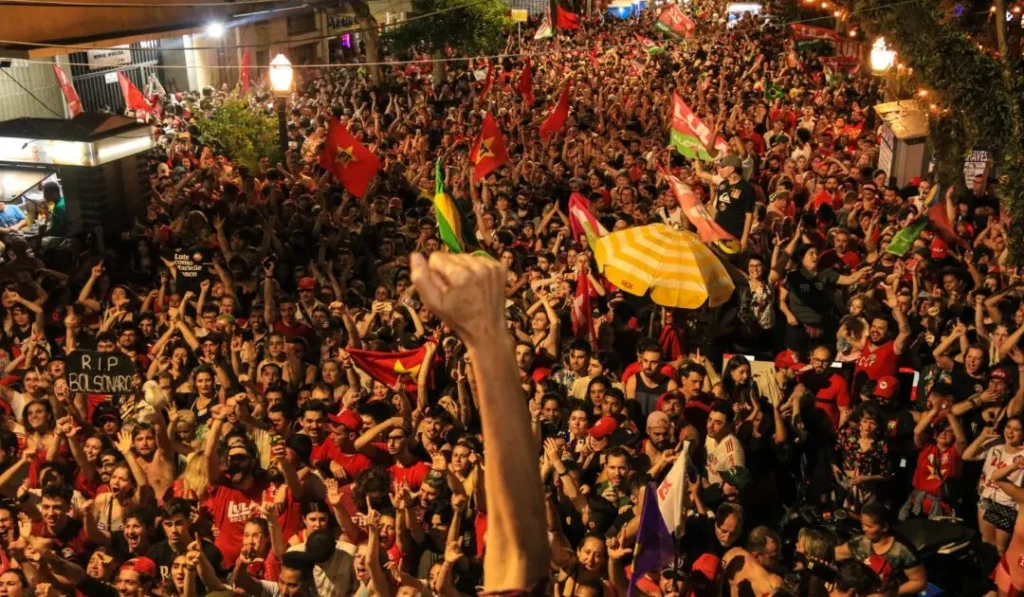
But even these figures of interest do not tell the real story. In three weeks, a mass mobilisation overturned an election the far right thought it had won, a groundswell even the Workers’ Party (PT) campaign did not foresee. It was packed with students, women, Afro-Brazilian religious communities, shop and call-centre workers, and Northeastern migrants who packed long-distance buses to vote at home. Many on Brazil’s socialist left already rank it alongside the 1978–79 strike wave that shook the military dictatorship and the 1984 Diretas Já campaign.
The outcome resonates beyond Brazil, primarily for three reasons. It ended a streak of far-right wins across Latin America. It was a fight for national sovereignty, a public referendum against Donald Trump’s Washington and the platform monopolies of Silicon Valley. And it showed how a concrete working class demand, a shorter working week, can still draw a section of the poor away from reactionary ideology. However, the victory is fragile since the right controls the Congress; the markets moved within hours to indicate the preference of capital and the far-right’s base is still intact.
How the tide turned
The left was demoralised by the first round. Movimento Esquerda Socialista (MES), a tendency of the PSOL, considers that the PT’s campaign in the first round was moderate and bureaucratic, lacked material and was based on wrong forecasts. The changes that occurred were largely determined by factors outside the campaign machinery and mainly outside the trade unions, which, with the exception of the university teachers’ union Andes-SN, were virtually absent. The fuel was anti-imperialist and anti-fascist anger more than any one government announcement.
The whole movement started with a protest by students from the Federal Fluminense University (UFF). Then Flávio Bolsonaro, who’d just won the first round and was feeling elated, said he could change the constitution. That boast became a rallying point, leading to larger protests in all five regions, including two massive rallies on São Paulo’s Avenida Paulista that drew between 1.2 and 1.5 million people. Similar events occurred in Porto Alegre, Rio, Recife, Belém, Salvador, Fortaleza and 12 other state capital cities. More than 2,000 members of Afro-Brazilian terreiro communities marched through São Paulo’s Largo da Batata on October 22, carrying a banner that read “Drums for Democracy“.
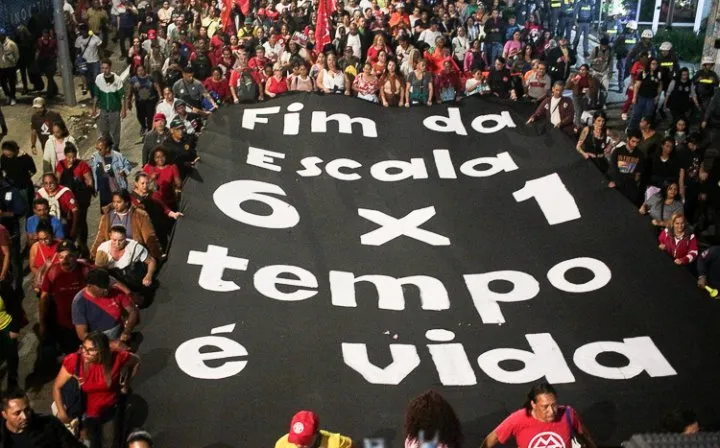
There was one material anchor for this energy: the demand to end the 6×1 schedule, under which millions work six days for one day off. The Lula government had supported a reduction of the legal working week from 44 to 40 hours with two days of rest. The demand was so popular that the right’s deputies, including Centrãoi, voted to end the 6×1 schedule rather than confront their voters over it; by some accounts, it even flipped Flávio’s own vote.
For workers in shopping malls, supermarkets, pharmacies, telemarketing and fast food, in more than five thousand municipalities, the demand for a shorter work-week was not an abstraction. Lula’s other promises for the second round were equally concrete: renegotiating household and small-business debts, wage and pension increases, free public transport on the weekends, investment in the public health system (SUS) and public education, and action against femicide.
The digital battle changed too. A WhatsApp channel led by federal deputy André Janones, called Exército do Lula (Lula’s Army), reached almost 11 million participants. There was the centralised digital party, the only instrument capable of confronting the long-lasting reign of Bolsonarism on Meta’s platforms. One caution here: replicating its success won’t be simple. Commentators on the left warn that the big platforms are already moving against tactics such as Janones’s and that only real digital sovereignty can respond to them.
The turnout followed the streets. Abstention was down from 21.08% in the first round to 19.22% in the run-off, the lowest for a presidential second round since 2006; about three million people who had stayed home on 4 October turned out to vote. The share of blank and spoilt ballots fell from 4.77% to 3.24%. Lula gained well over ten million votes between the rounds and grew in every state and the Federal District, according to the PT’s own count. In Bahia, the abstention fell from 19.97% to 16.71% with 71.31% of the vote for Lula; and in Pernambuco, it fell from 18.17% to 15.18% with 69.2% for Lula. The other side resorted to obstruction. Public transport was partly suspended in Salvador and São Paulo on polling day and the electoral court extended voting until 7 p.m.
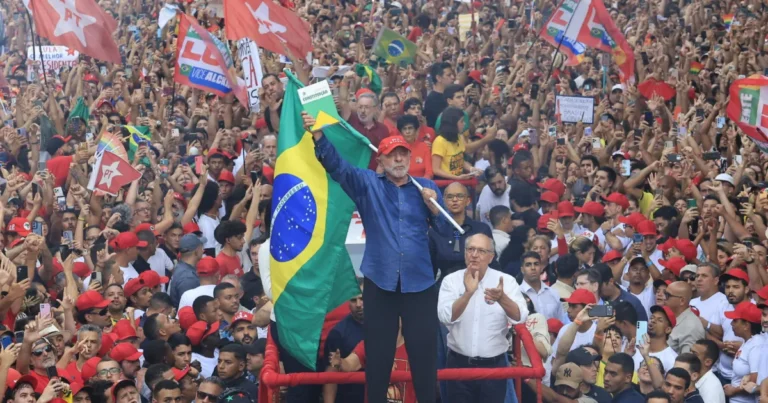
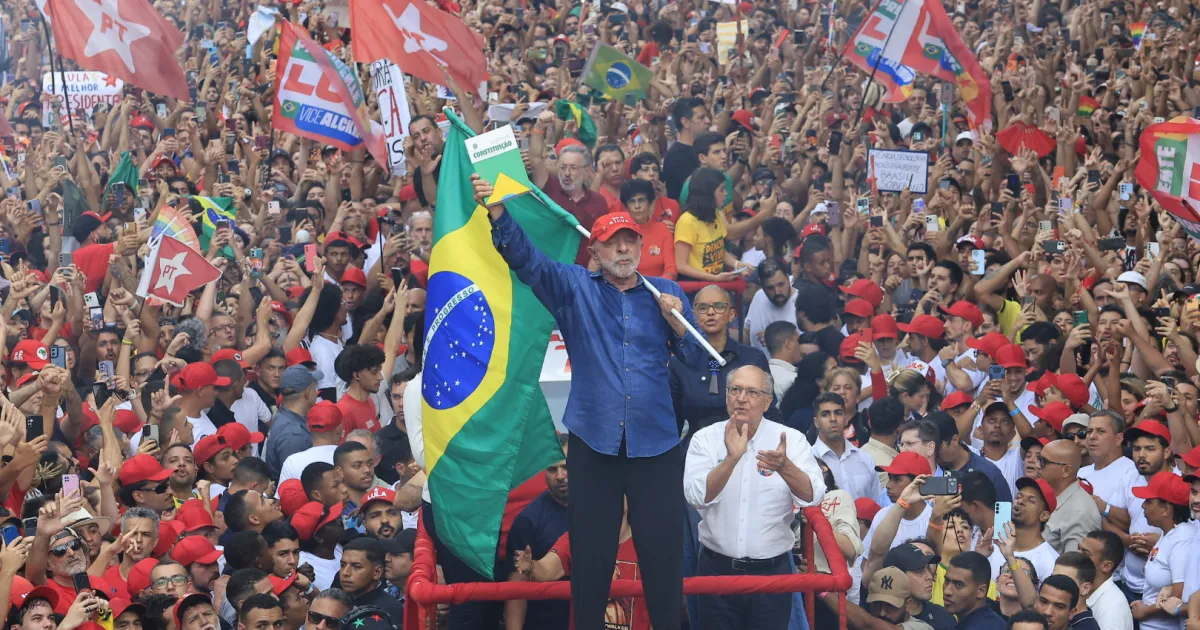
In his victory speech on the Paulista Avenue, Lula named the forces to whom he owed the win: “the rebellious youth”, the women who stood up to femicide, and the ones who believe that ending the 6×1 schedule is good for Brazilian society. He promised to “change the way of governing this country” and give ordinary people more say in government decisions, a pledge the PT has since spelt out as participatory budgeting, on the model Porto Alegre pioneered in the 1990s.
Two blocs, two class alliances
Political scientist André Singer, who was Lula’s press secretary, uses an image by Fernando Henrique Cardoso: the Brazilian bourgeoisie swings like a pendulum between democracy and authoritarianism. There is a material basis for the swing. Modernising the capital requires state capacity, infrastructure and reform. But Brazilian capitalism, subordinated to the world market as a primary exporter, also depends on a large reserve army of labour and on social exclusion.
When reform crosses a red line – land and labour reform in 1964, the PT’s social programmes by 2014–16 – capital withdraws its support and the government falls. But when authoritarianism becomes too expensive, as with the 2022–23 attempted coup and plots to murder Lula, his vice-president and a Supreme Court judge, its cosmopolitan wing moves back in. Singer notes that Brazil is the only country in the current wave of far-right governments that actually saw a classic military coup attempt.
The 2026 run-off was a battle of two cross-class coalitions. The “confederacy” behind Flávio, as Singer calls it, is composed of agribusiness in a corridor running from Rio Grande do Sul through the interior of São Paulo and Minas Gerais to the Centre-West and the southern Amazon; the extractive industry and the garimpeiros, the small-scale gold miners who profit from the dismantling of environmental and Indigenous protections; small and medium businesses; the security forces, from the military to private security; and the evangelical churches. Evangelicals amount to around 30% of the electorate, with about 70% of them voting for the far right – a Brazilian Bible Belt. MES summed up the bloc as Brazil’s “BBB”, standing for beef, bullets and the Bible, or bankers, betting firms and the Bible, or bankers, betting firms and billionaires. The coalition comprised the financial sector, large parts of the regional oligarchies and the milician networks in Rio.
Behind Lula, there was a concertación, after the Chilean front that ended the Pinochet era: the PT, the wider lulista electorate, the remnants of the old centre-right PSDB, symbolised by Vice-President Geraldo Alckmin, and the cosmopolitan fractions of finance and industry. Its electoral ballast is structural: some 85% of Brazilian voters live in households with incomes below five minimum wages.
The victory’s fundamental contradiction is that it was driven by the youth, the Northeast, Black and Indigenous communities, and the precarious service proletariat. The ruling coalition is also backed by sections of capital with a conditional loyalty to democracy, whose interests are diametrically opposed to the second-round programme. We ought not overlook the fact that the social base of the far right is still intact: in 2022, 47% of voters identified with the right, almost exactly Flávio’s share in the first round. And a lot of the working class itself voted for him.
A presidency without a majority
Lula won the presidency; the right won Congress. From 2027, Bolsonaro’s Liberal Party (PL) will be the largest bench in both houses.
| Bloc (Chamber of Deputies, 513 seats) | Seats from 2027 |
|---|---|
| PL (Flávio Bolsonaro’s party) | 121 (up from 99 elected in 2022) |
| PT–PCdoB–PV federation | 88 (PT: 70) |
| União Progressista (União Brasil + PP) | 87 |
| Republicanos | 41 |
| Novo | 10 (up from 3) |
According to business magazine Exame, the PL has 28 seats in the Senate, and right-wing parties will, in total, occupy 49 of the 81 seats, exactly the three-fifths necessary to change the Constitution. The parties of the left (PT, PSOL, PCdoB) held or grew slightly, with the PSOL-Rede federation just reaching the electoral threshold to qualify for public funding and broadcast time.
These three regimes now compete within the Brazilian state. The only chance for the working classes for direct involvement in national politics is at presidential elections. The Congress is dominated by local oligarchic machines and the Centrão, the bloc of patronage parties that trade votes for ministries, budget amendments and posts, and has been moving toward a de facto semi-presidential system that takes economic policy away from the hands of the elected president. The third regime is the autocratic project of the Bolsonaro family, which Singer calls authoritarianism with a fascist bias. The elections for the presidencies of the two houses in February 2027 will be a test of the ambitions of the Centrão.
Capital reacted in two instalments. Initially, the Ibovespa gained 7.7% in a single session after Flávio’s first-round lead on October 9, with the dollar falling to about R$5. Political analysts José Menezes Gomes and Osvaldo Coggiola see the rally, led by Petrobras and Banco do Brasil, as a bet on the privatisation promised by the Bolsonaro camp, on a brutal fiscal adjustment and a return to import-parity fuel pricing that once sent petrol above R$9 a litre. The buyers, possibly, would have been global oil majors, foreign banks and laundered money from organised crime and betting firms, they warn.
The run-off reversed the gamble. On Monday, 26 October, B3 registered its first circuit breaker since March 2020, minutes after opening; the Ibovespa fell more than 17% at a certain point and closed 13.88% down. The dollar jumped 8.21% to R$5.40, its biggest one-day gain since 1999. Former central banker Gustavo Franco estimated that some R$1 trillion exited the exchange. According to Bloomberg’s index, Brazil’s ten richest people lost US$15 billion collectively, with BTG Pactual founder Andre Esteves losing US$4.4 billion alone. Such behaviour can indeed be called “market terrorism”. The purpose was clear: to extract a commitment to austerity from the fourth Lula government before it takes office.
The pressure is already having the desired effect. The PT has announced a government that will aim for a primary surplus and “spend less than it collects”. JP Morgan has responded that fiscal discipline alone will not be enough and that pensions and wages will also have to be cut via a social security reform that only the right-wing Congress can approve. But Brazil’s budget hardly runs a current spending deficit. Its hole is financial. Interest payments on a public debt of 80% of GDP produce a deficit of 9% of GDP. Rentiers buy government bonds at 13.75% with inflation around 4%, a real return of almost 10% a year. The second-round programme – a 40-hour week, pension increases, debt relief, free transport, and more money for health and education – runs straight into the fiscal framework (arcabouço fiscal) that Lula’s third term treated as sacrosanct and with which the creditors are protected.
If the conflict ends with the capital triumphant, the Brazilian left knows well what comes next. Dilma Rousseff was re-elected in 2014 on an anti-austerity platform but then appointed a banker as finance minister and implemented the cuts promised by her opponent. Her base was demobilised, and in two years she was ousted by a parliamentary coup that opened the way for Jair Bolsonaro.
Bolsonarism in flight, not in retreat
How the losing candidate behaved after the vote said more about Bolsonarism than any campaign speech. On October 26, Supreme Court Justice Alexandre de Moraes ordered Flávio Bolsonaro to hand over his passports and banned him from leaving the country. Part of the justification for the order was an interview given two days before the runoff, in which his brother, Eduardo, said Flávio should leave Brazil if he lost. Flávio was heading to the United States with his family on October 27, the day after posting a video saying he had never thought of leaving, reportedly via the Argentine border town of Puerto Iguazú.
The Supreme Court has two cases against him. One is the financing of the biopic about his father, Dark Horse, with money sought from Daniel Vorcaro, the former owner of the failed Banco Master. Negotiations for at least $24 million and a US fund linked to Eduardo are being investigated for corruption, money laundering and capital flight. The other is linked to an account of a betting company, through which about R$130 million passed between March and May 2025. He denies any wrongdoing. His term in the Senate, and thus his special judicial status, will expire January 31, 2027.
He issued a letter from the US on 28 October claiming to be the “true president-elect of Brazil,” alleging that the election had been stolen without providing any evidence. The letter passed through at least four versions in a day: “president-elect” became “leader of Brazil”, and a crest reading “Estados Unidos do Brazil”, an archaic name of the republic, was quietly corrected. But his own campaign manager, Senator Rogério Marinho, said the PL had no evidence to back up its fraud allegations.
Trump did his part. It was “a very strange election”, he said, but he would not recognise Flávio, saying Washington had let him in. The ties of the Bolsonaro clan to Trumpism are not merely rhetorical. Eduardo has been living in Texas since March 2025 and was convicted by the Supreme Court in June 2026 for lobbying Washington to sanction Brazilian officials. Former intelligence chief Alexandre Ramagem, sentenced to 16 years for the coup plot, is in Florida. Former deputy Carla Zambelli has fled to Italy, and logger Oswaldo Eustáquio to Spain. At least four countries now provide refuge for fugitives of the movement.
We would make a mistake to read the situation as a collapse. Flávio’s exile leaves São Paulo governor Tarcísio de Freitas free, who supported Flávio but quickly accepted the outcome, positioning himself as the institutional heir of the far right, i.e., bolsonarism without the Bolsonaros. Boycott lists are circulating across the country, indicting businesses and workers accused of supporting Lula. A newly elected PL state deputy in Porto Alegre has been identified as an instigator. The movement’s leadership is fragmenting, but its base, nearly half the electorate, still remains united.
Sovereignty: why the world was watching
It was the first time that a Brazilian election was fought explicitly regarding national sovereignty. Earlier in 2025, Trump imposed 50% tariffs on Brazilian goods, citing the prosecution of Jair Bolsonaro. Washington also imposed sanctions on the Supreme Court judge who led the coup trial; Bolsonaro was nonetheless convicted and sentenced to 27 years. In fact, Flávio’s candidacy was an attempt to bring a Trump client back to the Planalto. The left PSOL said the runoff was a plebiscite on Brazil’s subordination to Washington, with Peter Thiel, Palantir and Meta siding with the far-right.
There is a lot to play for. With some of the world’s largest known deposits of rare earths – the 17 elements at the core of the US-China race for electronics, electric vehicles, satellites and precision weapons – Brazil is a key player. It also has oil, water, the Amazon and strategic river routes. A Bolsonaro government aligned with Trump’s “Shield of the Americas” would have opened these to Washington on Washington’s terms.
Lula’s victory does not settle the question; it only opens it up. Sociologist Frederico Henriques warns that reserves of rare earths alone are not enough. Brazil has always exported raw materials without processing them, resulting in profits remaining abroad; therefore, a “green” extractivism would merely update this dependency. Sovereignty, he says, is not about the nationality of shareholders but about who controls the technology and who enjoys its fruits. Nor is the answer to trade one superpower for another. The US track record in Latin America can’t be equated to the Chinese presence, but Chinese capital is not organised around the interests of Latin American people either. Brazil’s BRICS membership cannot be a substitute for a project of its own. The draw is real: the US share of Brazilian exports halved, from 24.4% in 2001 to 12.2% in 2024, while China’s share rose tenfold, from 3% to 30% in 2025. Lula has already announced plans to open up oil exploration in the Amazon, targeting Chinese demand – a change in the old dependency.
The point is made sharply on the digital front. The campaign was determined by Meta’s grip on the flow of political speech, and Lula used his victory speech to promise regulation of the platforms that brought outside interference, according to him. Deputy Sâmia Bomfim, from the PSOL, presented a constitutional amendment on digital sovereignty. Regulation is the least of it: public infrastructure, control of data and computing capacity are now strategic assets in the same way as oil.
Elsewhere on the continent, the outcome has shifted rightward in favour of Trump and the US. In Ecuador, Daniel Noboa was elected in May 2025; in Bolivia, that November, Rodrigo Paz ended almost 20 years of MAS rule. In January 2026, Nasry Asfura returned Honduras to Washington’s orbit. In March, Pinochet admirer José Antonio Kast took Chile. In May, Laura Fernández held Costa Rica for the right. In June, Keiko Fujimori won Peru’s runoff by under 50,000 votes on her fourth attempt. In Colombia, the far-right businessman Abelardo de la Espriella narrowly defeated Iván Cepeda, ending the country’s first left government. In January 2026, in a shocking operation, US forces bombed Caracas and captured Nicolas Maduro and his wife, marking the first direct US military intervention in South America. Cuba was blockaded into shortages of food, medicine and power. Panama had already been driven out of China’s Belt and Road Initiative.
Brazil is the first to break the cascade. Trump’s reaction, that with Lula “the communists perpetuate themselves in power,” adds to the pretexts for direct pressure and even intervention. Israel Dutra, of PSOL, had argued that Lula’s victory would be an international turning point if Trump lost the US midterms. He eventually lost on November 3, when Democrats flipped seven Senate seats, including Texas, and took control of both houses of Congress in a vote dominated by living costs. In the light of the US results, Brazil looks less like an exception and more like an early warning. But at home, the far right survives, even as its leading family is crushed.
Brazil’s student uprising is part of a wider youth revolt popularly known as the Generation Z wave: student lists born in university assemblies have just won the elections in Serbia, students are fighting police in France, and mass protests over housing and education have hit Portugal, Spain, Belgium and Italy. That energy has defeated an organised, fascist-leaning movement at the national ballot box in the biggest country of the Global South, Brazil.
What we should take from Brazil
The structure of Bolsonarism is formed by a disciplined electoral bloc representing a religious majority and is financed by crony conglomerates, agrarian-extractive capital, while security forces, act as a political constituency. We, Indians, are not unacquainted with the nature and structure of bolsonarism. Propaganda armies of WhatsApp fight the information war. At the same time, this movement wraps itself in the national flag while aligning its fortunes with Washington’s strategic designs. Of course, Hindutva is not bolsonarism, and India’s institutions have been much less inclined to hold the powerful to account as compared to Brazil’s Supreme Court, but the comparison yields at least four important lessons.
First, when material demands are universal and tangible, they can override identity politics. The 6×1 campaign targeted the young, insecure service workers without unions that the far right was wooing. India has been moving in the opposite direction. The four labour codes that came into force on November 21, 2025, allow companies with up to 299 employees, up from 100, to lay off staff without government approval. From 2023-25, factories in Karnataka, Andhra Pradesh, Maharashtra and other states began extending the working day to ten or twelve hours. Maharashtra had to withdraw, but the way is clear. The demand for a living wage, a shorter working week, and the right to rest is not a diversion from the fight against communalism but one of the few weapons that can successfully reach workers who have been captured by communal forces.
Second, we can raise the issue of debt as a mobilising weapon. Lula vowed to renegotiate debts of households and small businesses, and the ban on online betting was to fight a plague that had pushed countless families to arrears. From the microfinance borrowers of rural India, Nepal and Bangladesh to IMF-austerity-bound Sri Lanka and Pakistan, household and sovereign debt shapes daily life across South Asia. This reality is the one directly addressed by the left, which puts debt relief and debt audits at its centre.
Third, the youth revolt needs an outlet and a programme. In Sri Lanka in 2022, in Bangladesh in 2024 and in Nepal in 2025, young people overthrew governments. In all three instances, the political dividend was lost or taken by others. In Brazil the rise of the youth was combined with an electoral front and a concrete programme. While it wasn’t a revolution, it did transform anger into a setback for the far right and clearly raised the question of what comes next.
It is possible to be united against fascism and independent of the government. Brazil’s radical left embraced the Lula campaign with fervour but baulked at a full merger. The experience of Dilma Rousseff is an example of this. The base that re-elected Dilma Rousseff remained loyal even when Congress removed her from office in 2016 following her austerity measures in 2015. A coalition that wins and then governs in the interests of capital is undermining its base of support and leading to a resurgence of the far right. Any wider opposition to the BJP is caught in the same dilemma.
From the L of Lula to the L of Luta
Supporters of Lula campaigned with their index and thumb raised in the shape of an L. Since the vote, Brazilian activists have been circulating a new slogan: turn the L of Lula into the L of luta—struggle. The “third round” has started, and it’s being fought on two fronts at once.
The first is defensive: defending the result, not allowing any repeat of the January 8, 2023, attack on Brasília, hunting down the coup plotters and their funders wherever they have fled, and refusing any amnesty deal or mediation with the coup-plotting factions within the PL and its allies. It also means resisting retaliation: Bolsonarist networks are already calling for “political dismissals” of Lula voters, and reactionary state governors are gearing up for their own offensives. The PT has itself recorded killings, assaults and threats against Lula voters in the workplace. On 24 October a PT councillor in Montes Claros was hit in the face by a rock thrown during a motorcade. The second offensive demand is for the government to deliver what was achieved through street protests in the second round: the end of the 6×1 schedule, a genuine reduction in working hours, significant public investment in health and education, free public transport, a ban on betting firms, a tax on billionaires, an amnesty for the debts of millions, an emergency plan for climate disasters, and an end to femicide and police killings in the favelas. Black organisations are already saying 20 November, Black Consciousness Day, should be a national show of strength.
None of this will be handed down from the palace but will have to be fought for. Lula will be pulled between the streets and the fiscal promises he has made to capital, as he had throughout his third term. The Centrão will haggle over every item, vote by vote. Capital, which initially supported democracy out of fear of disorder, can withdraw its support as soon as the second-round programme begins to incur costs.
That’s why the debate in the Brazilian left today is about independence: can the socialist left, the workers movement, support the government against the far right without being a hostage to its alliance with capital? Dutra says that PSOL, which passed the electoral threshold and brought in thousands of new members during the campaign, should refuse ministries and positions of trust in the federal government, fighting in Congress only in direct connection with the streets. Others were more blunt about the danger: the workers’ movement still has no political face of its own, divided and trailing the visible options. Without one, they warn, October’s mobilisation could spark further betrayal and popular frustration.
The PT has a different view of its role. The National Executive promises the fourth term will open “a cycle of structural change”: reform of the justice system and the political and electoral system, democratic regulation of the big platforms, participatory budgeting and development “without austerity on the poorest”. It depicts the party as a permanent bridge between government, parties and social movements. That promise sits uncomfortably with the surplus target already announced by the PT, and the third round will be fought in the space between the two.
The lessons of the Brazilian elections are very important for several reasons, but what Brazil showed on 25 October was that the far right can be defeated when the oppressed raise their own demands. Whether this defeat is permanent will depend on whether the mobilisation it created outlasts the elections. This is not a question that is confined to Brazil.
iCentrão (“big centre”): a loose bloc of mid-sized, mostly right-of-centre parties in Brazil’s Congress, currently including the PP, União Brasil, Republicanos, PSD and MDB. Lacking a programme of its own, it trades its votes to whichever government holds power in exchange for ministries, posts and budget amendments (emendas parlamentares). Because no Brazilian president commands a congressional majority, every government since redemocratisation has depended on it; it sustained Lula and Dilma Rousseff before voting to impeach Rousseff in 2016.
About the Author

Editorial Board Member of Alternative Viewpoint