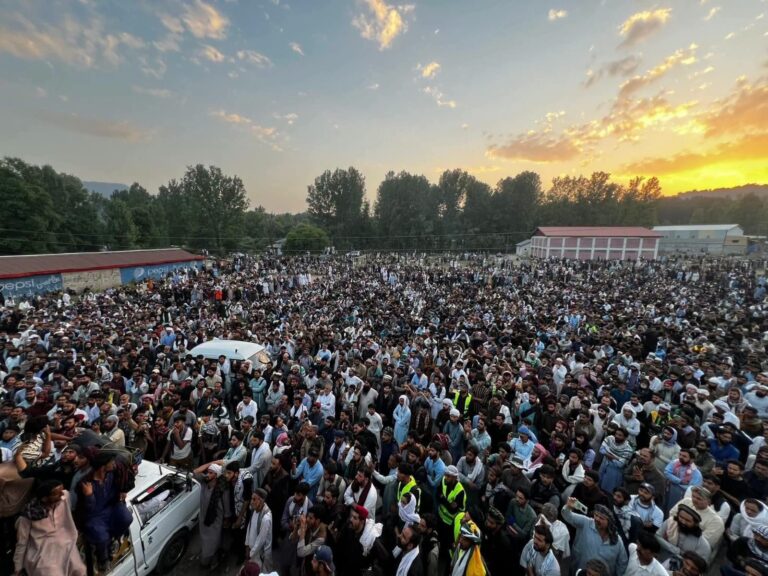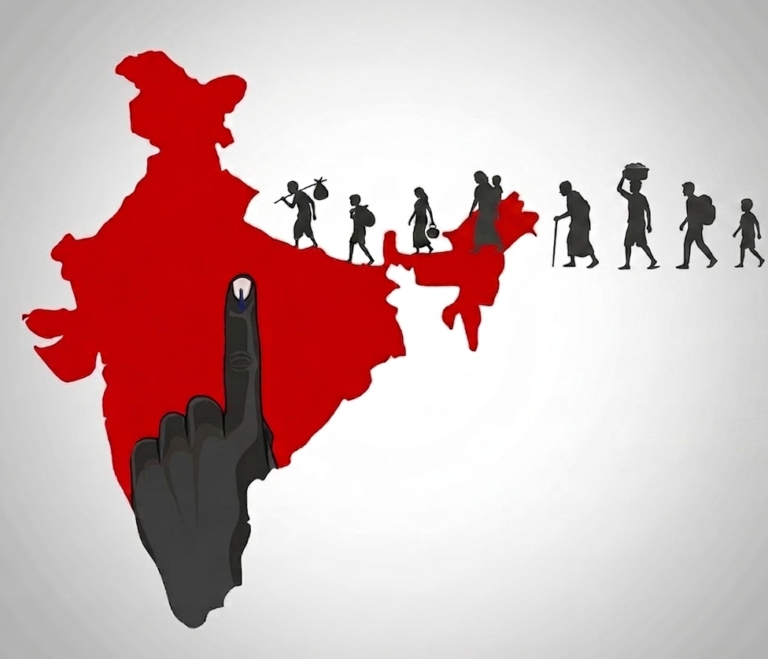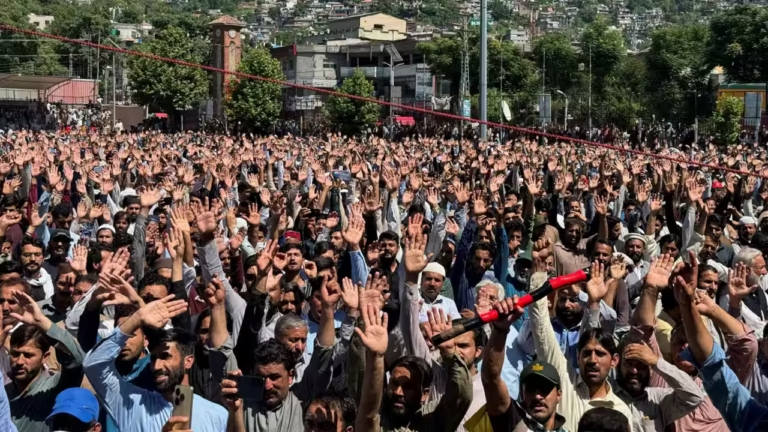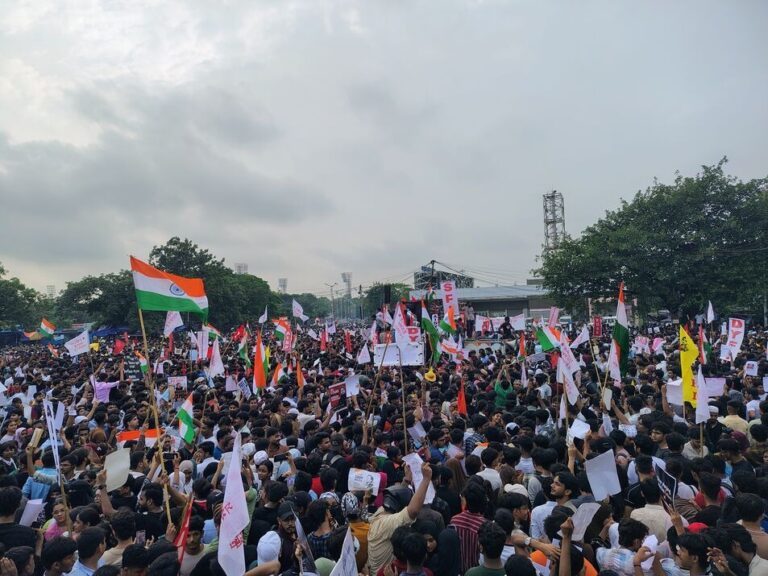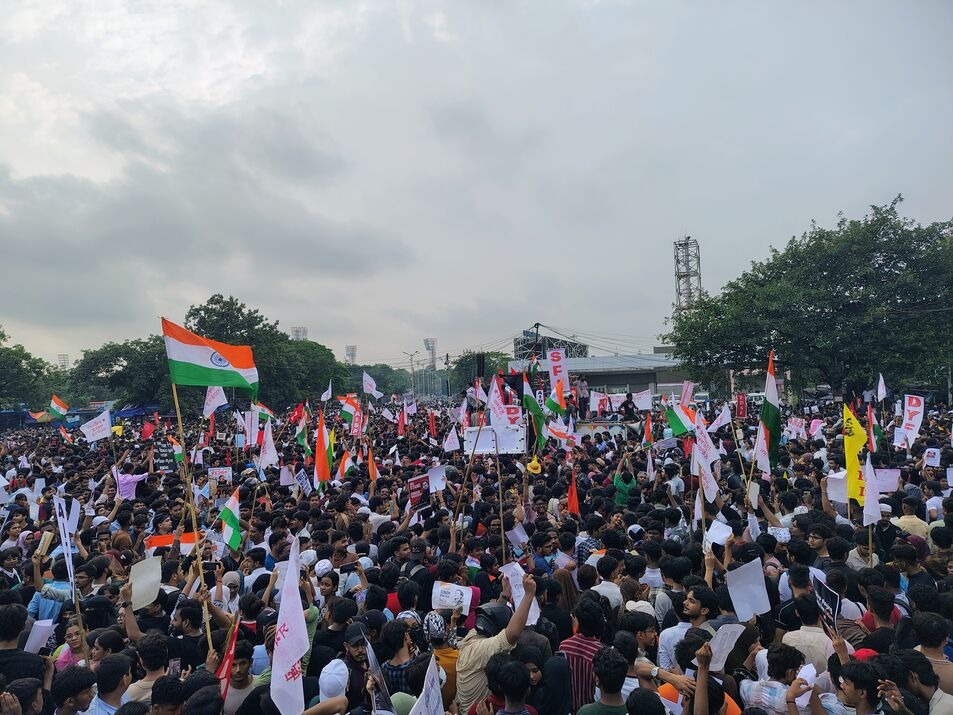
On the afternoon of 25 July 2026, Dharmendra Pradhan posted his resignation letter to X. Hours later, after a third round of talks with Union ministers J.P. Nadda and Jitendra Singh, spokespersons for the Cockroach Janta Party announced that the government had conceded the movement’s remaining demands, compensation of ₹10 million for the families of students who took their own lives after the NEET cancellation, and an assurance that no cases would be pursued against those who marched on 20 July.
No Union minister in Narendra Modi’s tenure had been forced out by a street movement before. Not during the anti-CAA mobilisation, which the state answered with the Delhi pogrom and a decade of UAPA prosecutions. Not during the wrestlers’ protest. The farmers won a full repeal in 2021 and that remains the largest material defeat the regime has suffered, but they did not take a minister’s head, and they had behind them the organised weight of Punjab’s peasantry, decades of union structure and a year of encampment. The Cockroach Janta Party had none of that. It was two months old, with no membership rolls, no registration, no treasury, no cadre and no ideology beyond, in its own words, satire. That is the fact that requires explanation. Not the resignation, which was a tactical retreat, but the conditions under which a joke acquired the power to extract one.
An insult from the bench
The movement began, appropriately for the argument that follows, in the Supreme Court. On 15 May 2026, hearing a contempt petition about fraudulent professional credentials, the Chief Justice of India, Surya Kant, remarked from the bench that there were youngsters like cockroaches who, finding no employment, became media people and activists and attacked everybody. He called them parasites of society.
The clarification came the next day: he had meant only those entering regulated professions with fake degrees. It was legally accurate and politically irrelevant. The clip had already been cut and circulated. The qualifier did not travel but the word did. As The Wire noted, that vocabulary has a history, and the history is not reassuring: parasites are not negotiated with, they are exterminated.
On 16 May, Abhijeet Dipke, a political communications strategist in his twenties then finishing at Boston University and formerly attached to the Aam Aadmi Party, announced a platform for all the cockroaches out there. Eligibility criteria: unemployed, lazy, chronically online, able to rant professionally. Slogan: Voice of the Lazy and Unemployed. Name: a straight parody of the ruling party’s. Within seventy-eight hours the account had three million followers; within five days, more than the BJP’s own handles; by mid-July, above twenty-two million. A state that has spent a decade perfecting the manufacture of online consent had been outflanked on its own terrain in under a week, by a pun.
The first street action came on 6 June at Jantar Mantar, alongside the Students’ Federation of India, the All India Students’ Association and the All India Students’ Federation. That detail is worth holding on to. It complicates the story of pure spontaneity that both the movement’s admirers and its detractors prefer. The demand was singular: the resignation of the Education Minister over the leak of the NEET-UG paper of 3 May, an examination sat by some 2.28 million candidates competing for roughly 130,000 medical seats, subsequently cancelled and re-held on 21 June.
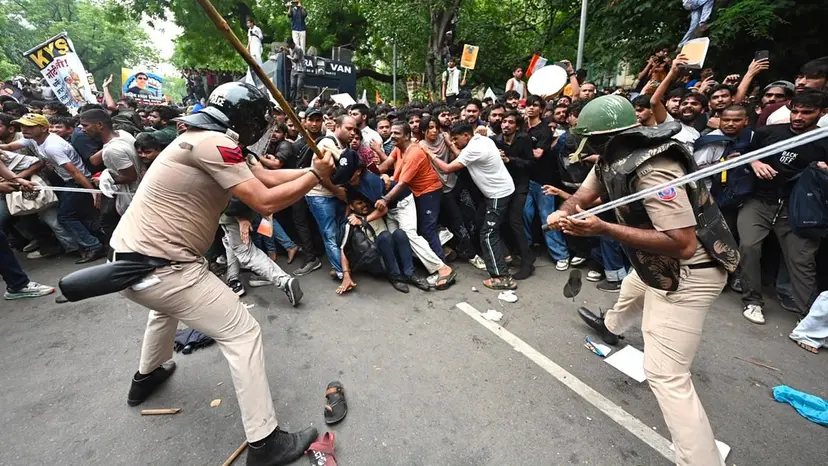
Then the sit-in refused to end. Sonam Wangchuk began a hunger strike at the site on 28 June and was on it twenty days before the police removed him to hospital against his will. Protests spread to Pune, Bengaluru, Lucknow, Mumbai, Patna, Kolkata. On 20 July, some twenty thousand people attempted to march on Parliament and met barricades, batons, tear gas and a government-ordered internet blackout. Rahul Gandhi was detained outside the Prime Minister’s residence the next day; the Monsoon Session was suspended amid the uproar. Five days after that, the minister was gone.
The old playbook failed
The Modi government has one repertoire for internal opposition, and it has been remarkably effective. It has three movements: delegitimise, criminalise, exhaust.
Delegitimisation came first. The CJP was declared anti-national and foreign-funded; its X account was blocked in India on national security grounds; anchors arrived dutifully at the Soros hypothesis. The movement’s answer was to post its follower analytics, then film grave confessions that China had wired sixty rupees for bus fare and Pakistan forty for lunch. The canard did not simply fail; it was converted into content. A machinery built to induce fear found its output metabolised as comedy.
Criminalisation, the workhorse of the last decade, was structurally unavailable. Consider what the instrument is designed for. Between 2015–16 and 2024–25, the Enforcement Directorate registered cases against 193 politicians and secured two convictions, 138 of them during Modi’s second term. The point of the ED was never conviction. The point was process: the summons, the attachment, the years of custody before trial, the standing offer that the file closes if the leader crosses the floor.
This is a technology for disciplining people who have assets, careers, constituencies and futures to protect. It is useless against nineteen-year-olds whose grievance is that they have no future to protect. There is nothing to freeze, no party to defect to, no career to end. Wangchuk was detained and the crowd grew. Dipke was assaulted on camera and the crowd grew. Gandhi’s detention pushed the opposition, for once, into the street rather than the studio.
Exhaustion was tried longest. The government ignored the sit-in for nearly two months. Normally this is decisive: protests are expensive, students go broke, heat and boredom do the work of the police. It failed because the material basis of exhaustion had been removed. Supporters ordered food to Jantar Mantar through delivery apps from other cities and other countries; reels shot during the blackout were carried on foot to where there was connectivity. Waiting out a movement assumes the movement has to be somewhere, and one distributed across twenty-two million accounts cannot be waited out at an address.
What remained was force, and force was the government’s decisive error. The 20 July lathi charge did not disperse the movement. It produced the images that turned a student agitation into a national one: young women in torn clothes, boys returning the next morning in helmets and padded trousers with placards offering themselves for further beating, roses handed to constables. Coercion is only productive when it is invisible or when it is total. Applied in daylight, filmed from four angles, against people the regime’s own rhetoric calls the pillars of a developed India, it is simply advertising for the other side.
A movement that will not sit in the harness
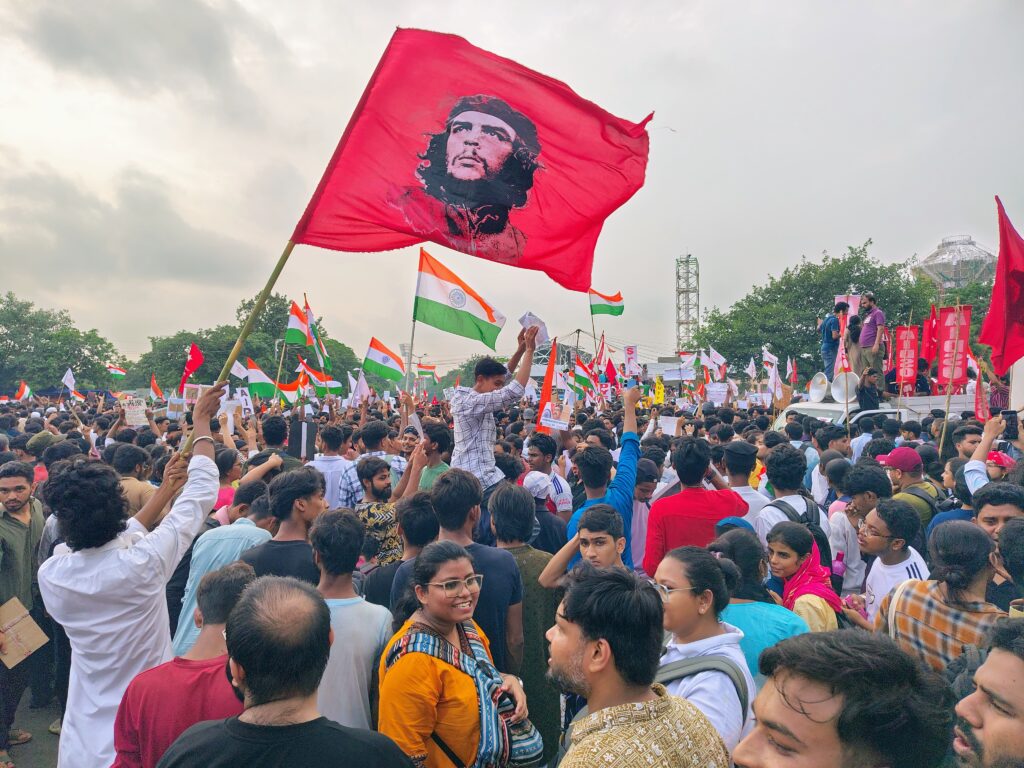
Every organised force in Indian politics tried to grip this thing and found nothing to hold. The BJP could not communalise it, because it had no confessional marker. This is the single most important tactical fact about the CJP and it deserves to be stated plainly: for the first time in a decade, a mass mobilisation appeared that the Hindutva apparatus could not translate into the language of the Muslim, the infiltrator, the urban Naxal, the anti-national. Shaheen Bagh could be coded as Muslim. The farmers could be coded as Khalistani. The Kashmiri, the Christian missionary, the Bengali-speaking migrant: the regime has a slot for each. It had no slot for a Hindu, upper-caste-adjacent, aspirational, exam-taking teenager from a small town in Bihar or Maharashtra whose parents very probably voted BJP. The attempt was made anyway. The man who slapped Dipke reached for the Jihadi script. But it could not stick to a movement whose social base is the regime’s own recruiting ground.
The opposition could not lead it. Congress, the Left student fronts, the regional parties all attached themselves to it, and their presence mattered; the parliamentary disruption gave the sit-in political oxygen and the arrests outside the Prime Minister’s residence nationalised it. But nobody was able to convert the movement into a constituency. The CJP repeatedly refused political affiliation and repeatedly refused registration as a party. In Lucknow, the students explicitly turned away party banners.
And capital could not be made to speak at all. As Mitali Mukherjee documented in Frontline, the silence of corporate India was total and instructive: not a word from Tata, Adani, Ambani, Reliance, or from the unicorn founders who post daily about Indian talent. Anand Mahindra, whose group’s IT arm employs much of Pune’s young workforce, found room those weeks for sport, music and employee awards and none for the students being lathi-charged in that city. The coalition partners were equally absent. Nitish Kumar and Chandrababu Naidu, the kingmakers of 2024, both went to ground. The TDP offered performative sympathy while affirming confidence in the government, this in a state where youth unemployment stands at 16.2 per cent.
This capacity to escape every available harness is the movement’s power. It is also, by the same mechanism, its limit. That is the whole question of what happens next.
The economy that grows without employing
The loose formulation, “India is in economic crisis”, will get the analysis wrong. India is not in a crisis of accumulation. Real GDP grew near 7 per cent through FY26, faster than any other G20 economy; inflation averaged around 2 per cent; corporate balance sheets are the healthiest since the pre-2014 boom. By every indicator a finance ministry cares about, the machine is working. What has broken is the relationship between that machine and the people supposed to live off it.
The official unemployment rate of 3.1 per cent is the most misleading statistic in Indian public life: in an economy without unemployment insurance almost nobody can afford to be counted as unemployed, and distress self-employment is recorded as work. Disaggregated, the picture inverts. Youth unemployment runs at roughly 9.9 per cent, 13.6 in urban India; graduate unemployment at 11.2. The Azim Premji University’s State of Working India 2026 supplies the number that should be printed on every budget document: fewer than 7 per cent of male graduates find a permanent salaried job within a year of graduating, and 3.7 per cent find white-collar work. Around 40 per cent are not working at all.
The classical texts would recognise this without difficulty: the production of a relative surplus population, this time not of dispossessed peasants but of certified graduates. India has expanded higher education faster than employment, deliberately, because degrees are cheap to supply and jobs are not. The result is a stratum sold a credential as an entitlement that turns out to be unenforceable. Its members are not proletarianised in the classical sense. Most come from families with some property, some savings, the capacity to fund three years of coaching. But they are being declassed in advance: they will not inherit their parents’ security, and they know it by nineteen.
Corporate India’s silence was therefore not cowardice, or not only cowardice. It was accurate class judgement. Record profits, a suppressed wage share, negligible investment in employment-generating capacity, no questions asked: the last decade has been exactly what capital wanted. A movement demanding that the state produce decent work is a movement against the arrangement they have profited from. There was nothing for them to say.
The exam and not the wage
If the crisis is one of jobs, why did the explosion come over an examination? Because where the organised private sector hires a vanishing fraction of entrants, the public examination is the last rationed ladder out. The state has stopped promising work. What it still promises is fair competition for the little that remains — merit, transparently measured, equally available. That promise is the load-bearing wall of the whole arrangement, because it converts mass exclusion into individual failure. If you did not get in, you did not work hard enough.
And it has been demolished by evidence rather than argument: some seventy leaks in seven years affecting around 17 million aspirants across fifteen states. A Public Examinations Act was passed in 2024 with ten-year sentences and ten-million-rupee fines; it has stopped nothing, because it punishes after the fact and leaves the structure untouched.
That structure is a sector of accumulation in its own right: private testing vendors, printing contractors, transport handlers, “dummy schools” that exist on paper so children can attend coaching instead, and a coaching industry drawing 200,000 teenagers a year to a single city in Rajasthan. Each link is a point at which the paper can be sold, and it is sold. This is not a corruption of the system; it is the system’s logical development once education has been converted into a market in scarce entry tickets.
Here is where the question of dignity acquires its material footing, and it is worth being exact about the mechanism, because dignity treated as a mood explains nothing. What the examination distributes is not only access to work. It distributes the terms on which a young person is permitted to understand their own failure. Meritocratic ideology performs a specific operation. It takes a shortfall produced by the structure of accumulation — 130,000 seats against 2.3 million candidates — and reassigns it to the individual as a verdict on their worth. The graduate who cannot find work does not experience an economy; he experiences a judgment on himself, delivered with the full authority of an apparently neutral procedure. That is what makes the injury private and the anger unorganisable. Humiliation is the form in which surplus population is administered.
The leak destroys that operation. Once the paper has been sold, the verdict is exposed as a transaction, and the shame changes address: it stops being mine and becomes theirs. This is why an exam scandal detonates where an unemployment statistic does not. It is not that young Indians care about procedure more than wages. It is that the leak returns to them, at a stroke, the standing to be angry. And standing, not information, is what mobilisation requires.
The human accounting is in the NCRB data: 14,488 student deaths by suicide in 2024, rising faster than the national suicide rate. The compensation the CJP extracted was not charity. It was an insistence that these deaths be recorded as a cost of policy, with an author.
The exam, then, is not a displacement of the jobs question. It is the jobs question in the only form the Indian state has agreed to discuss it — and the only form in which the humiliation it distributes can be handed back.
Institutions that no longer function as institutions
The most quietly devastating document the movement produced is its manifesto, which lists five demands: bar Chief Justices from post-retirement appointment to Parliament; arrest the Chief Election Commissioner if any citizen’s vote is deleted; reserve half the Cabinet for women and raise reservation from a third to a half; guarantee an independent media; and disqualify any legislator who defects from holding office for twenty years. Read as a programme it is unserious. Read as a symptom it is an X-ray. Every one of those demands is an attempt to repair, by crude external constraint, an institution that has stopped constraining itself.
The judiciary supplied the movement’s founding insult, and had supplied something heavier a month earlier. West Bengal’s Special Intensive Revision struck roughly 9.1 million names from a pre-draft roll of 76.6 million. On 13 April, with polling ten days away and some 3.4 million appeals against exclusion undecided, a bench of Chief Justice Surya Kant and Justice Joymalya Bagchi held that pendency conferred no right to vote. It declined to go further on the reasoning that it could not burden the appellate tribunal judges. The working capacity of a tribunal was weighed against 3.4 million votes, and the votes lost. Bengal voted on 23 and 29 April and the BJP won it for the first time. One month later the same Chief Justice reached, from the same bench, for the word cockroach. Set beside a longer record of deference on electoral process and habeas corpus petitions that ripen only after the accused has served years undertrial, this explains why a generation does not experience the Supreme Court as its protector. The Election Commission had removed some 4.7 million electors in Bihar before extending the exercise nationwide, its Chief Commissioner publicly demanding an apology from the Leader of the Opposition. Parliament, during the very weeks in question, could not hold a debate on a cancelled national examination; the opposition was refused the floor and then detained on the street. Broadcast media had so thoroughly forfeited its standing that anchors were physically driven out of Jantar Mantar by the people they had come to cover. And the police, in the capital, conducted a punitive charge on a permitted protest and cut the internet to keep the footage from moving.
None of these are formal breaches. The SIR was upheld. The prohibitory orders were issued lawfully. The shutdown was ordered under a rule. And this is the point at which the polite vocabulary — backsliding, illiberalism, competitive authoritarianism — stops describing anything. What is in place in India is a fascist formation, and the term is used here in its analytic sense rather than as invective. The marks are the standard ones: a mass cadre organisation older and larger than the party it fields, with its own uniformed formations and a presence in tens of thousands of villages; a doctrine of national regeneration through the identification and purging of an internal enemy; the fusion of that movement with the personnel of the state; the organisation of a mass base among the young in the movement’s own institutions; and a leader cult that supplies political legitimacy directly, without institutional mediation. What distinguishes the Indian case from the European originals is that none of this has required the abolition of the constitutional form. The institutions have not been abolished; they have been hollowed and re-tasked, and they continue to emit the procedural signatures of a democracy while performing the functions of something else. This is not a lesser variant. It is the more durable one, because a fascism that holds elections and wins them has solved the legitimation problem that destroyed its predecessors.
A generation that has grown up entirely inside this arrangement does not experience it as a corruption of the norm. It experiences it as the norm, and reacts accordingly — which is to say, without the deference that older oppositions still cannot shake off.
Gen Z arrives in India
Since 2024 a wave has crossed the global South — Bangladesh, Kenya, Sri Lanka, then Indonesia, Nepal, Madagascar, Morocco, Peru, the Philippines, Serbia — and two governments fell outright. The shared repertoire is familiar: Discord and Instagram instead of committees, the One Piece flag instead of a party banner, leaderlessness treated not as a weakness but a security feature.
India was the conspicuous absence: the largest young population on earth, every grievance that lit the fuse elsewhere, and no fire. The explanations were never mysterious: a deeper and more experienced repressive apparatus; a hegemony that has organised a substantial portion of Indian youth into the regime’s own project through the Sangh’s institutions; and a scale and fragmentation by language, caste and region that makes national simultaneity difficult in a way it is not in a capital-centric polity.
What broke the pattern was not a general anti-regime slogan. It was a sectoral grievance so precisely located at the point where the state’s promise meets young people’s lives that it could travel across every one of those fragmentations at once. The exam is the one experience shared by the Bihari and the Kannadiga, the Dalit and the Brahmin, the boy and the girl, the BJP household and the Congress one. Nothing else in Indian public life is so universal and so intimate.
But the comparison has to be made carefully, because the obvious scoreboard is the wrong one. Elsewhere, Gen Z movements toppled heads of government and then found they had no capacity to govern or even to bargain over what followed. Six months on, France 24 found that few substantive demands in Nepal, Madagascar or Morocco had been met: personnel changes won, the argument about structure lost. This is the defining weakness of the whole cycle. These revolts have learned to remove governments and not to succeed them.
Measured by that scoreboard — heads of government toppled — India’s movement scores lowest in the cycle. And the measurement is worthless. What those movements broke were governments, not regimes: administrations with thin party machinery, no mass ideological organisation beneath them, no cadre in the villages, and legitimacy resting on patronage that had already run out. A president who flees is not evidence of a deeper rupture than a minister who resigns. It is evidence that there was less holding him up. Nepal’s Oli fell in two days because almost nothing was under him.
What the CJP faced is not of that order. It faced a fascist formation at the height of its powers: the largest party membership on earth, resting on a century-old cadre body present in tens of thousands of villages; a captured media ecology; a legal apparatus tested against a decade of opponents. And then the part with no equivalent in Kathmandu or Antananarivo — a hegemony, a substantial fraction of Indian youth already organised into the regime’s own project. That formation had absorbed the anti-CAA movement, the wrestlers, the abrogation of Article 370 and two general elections without conceding a minister. In eight weeks, without organisation or money, this movement made it blink. That is not a smaller achievement than toppling Oli but a harder kind, and the first demonstration in twelve years that the thing has a limit.
And there is a further thing won, which appears on no ledger of demands. A fascism of this type governs substantially through the impression of its own permanence — the sense that there is no outside to it, that opposition is not merely defeated but pointless. That is not decoration on the power. It is a working part of it: what makes editors self-censor before anyone calls, a businessman calculate that silence is cheaper, a young person conclude that the sensible move is a visa. Twelve years went into building it, and by the summer of 2026 it looked complete.
What the CJP did was demonstrate, in public and on camera, that the impression was an impression. It did not defeat the regime. It established that the question of the regime’s defeat is a real question rather than an idle one, that this government responds to pressure like any other, that its repertoire has an outside, that a minister can be removed by people with nothing. Twenty-two million accounts and several million people watched it happen. Fear of a state is substantially fear of its permanence, and permanence, once it has visibly failed once, is difficult to reassemble.
That gain is real and it is also fragile. An aura is not a structure; it can be rebuilt, and the machinery for rebuilding it is entirely intact. But fascist orders do not usually begin coming apart with the seizure of anything. They begin coming apart with the withdrawal of the assumption that they cannot be moved.
One qualification is owed to the others, and it should be stated rather than buried: shallow roots do not mean soft hands. Those regimes killed far more people than India’s did. Nepal’s toll ran to dozens in two days, Kenya’s higher over a longer period. What the Indian state possesses is not restraint but depth, which is a different resource and, for a movement, a harder one to exhaust.
The limit of what was won is nevertheless exactly where it always is in this cycle. The movement took a minister. It did not take the National Testing Agency, the coaching economy, the examination-contracting chain, or a single job. The distinction worth holding is between the size of the concession, which is small, and the significance of having extracted one at all, which is not.
The settlement and what escaped it
Look closely at the settlement itself, and it is thin. The government gave up a person and kept a structure. Pradhan resigned “for the students”, warning as he went against those working against the national interest — a formulation that leaves the delegitimisation narrative standing in the act of surrender. Modi did not appear; Nadda and Jitendra Singh conducted the negotiations, insulating the Prime Minister from both the concession and the credit. Compensation is expensive but finite. Immunity costs nothing and buys demobilisation. Not conceded: restructuring of the NTA, an examinations law with enforcement rather than punishment, parliamentary oversight of testing bodies — every structural demand in the CJP’s own charter. Nor anything whatever about employment, the grievance underneath the whole agitation.
And built into it was the clause every such settlement contains: go home. A movement whose entire strength was its refusal to disperse agreed to disperse in exchange for a resignation and a promise. The BJP has learned the arithmetic of concession precisely: a minister is cheap, a structure is not. Let the anger discharge itself into a personnel decision, and let a successor absorb what remains of it.
That is the whole of what the government won at the table, and it is close to irrelevant. The significance of these eight weeks was never going to be settled by what two ministers signed in a room at the Constitution Club. The government controlled the negotiation. It did not control what the agitation had set moving outside it, and by the time it sat down a good deal had escaped.
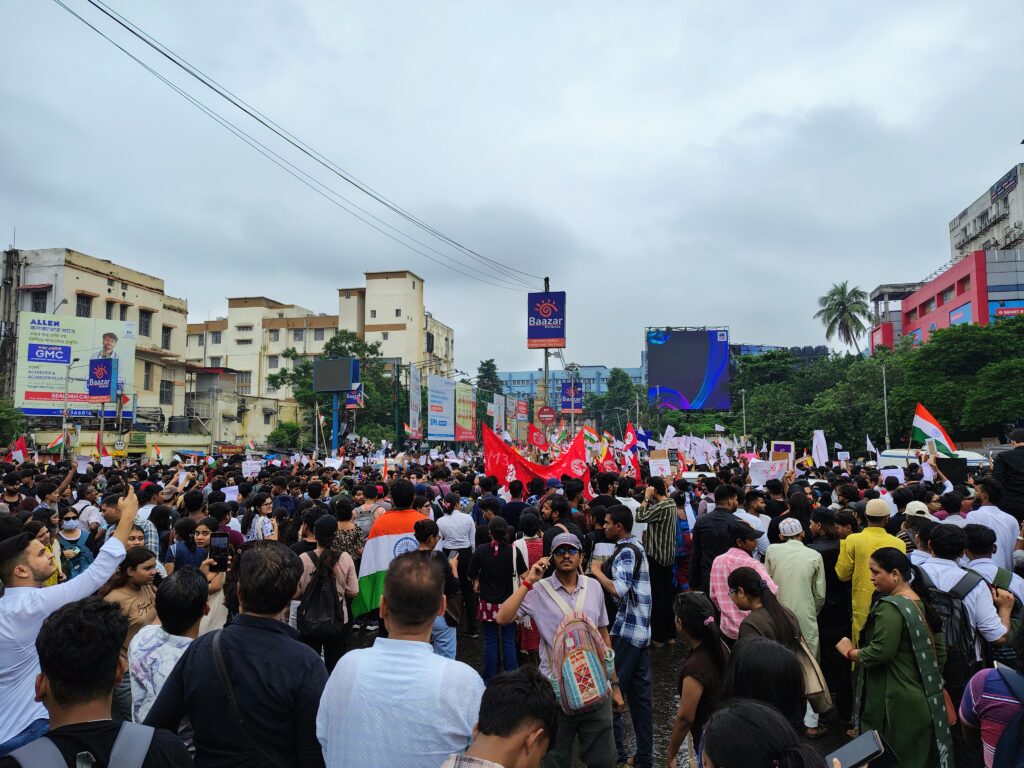
Bihar did not follow the Jantar Mantar script; it produced something older and harder. Within days the protests became a confrontation with the state as such. In Jehanabad police opened twenty to thirty rounds of fire to clear a crowd from the District Magistrate’s residence. In Patna they baton-charged Dak Bungalow Chowk. Police then published photographs of more than a hundred people, inviting the public to identify them — mass identification borrowed from the counter-insurgency repertoire and applied to teenagers. CPI(ML) counted police action in eighteen districts. AISA answered with a statewide bandh on 25 July that shut down rail and road across Bihar. None of that is a meme. It is the classical form of the thing: a student agitation escalating into general political confrontation, with a Left organisation supplying the structure, in the state with the country’s worst youth unemployment.
The Left student organisations have come out of this transformed. AISA, the SFI and the AISF were at Jantar Mantar on 6 June, before the CJP was a national phenomenon, and have spent two months in the position the Indian Left has been denied for a decade: at the centre of a popular national agitation rather than defending its own campuses. AISA called and delivered a statewide shutdown. That is organisational capacity being rebuilt in public, and it will not evaporate when Jantar Mantar empties.
The organised working class and the peasantry were already in motion on their own account. The ten central trade unions and the Samyukt Kisan Morcha struck nationally on 12 February against the four labour codes, before any of this began. But on 10 August they went further, with a nationwide jail bharo on an eleven-point charter: repeal of the labour codes, a legal price guarantee for farm produce, withdrawal of the Electricity Amendment Bill, a minimum monthly wage of ₹42,000 (about $480), and the honouring of the written assurances of December 2021 on which the farmers’ movement was demobilised. In Tripura alone around twelve thousand were detained and released. Courting arrest en masse is not a strike. It is a tactic chosen when a movement judges that the state’s willingness to fill its jails has become a political liability rather than a deterrent — which is a judgement about the atmosphere the students created. A movement whose grievance is the absence of decent work has appeared alongside one whose grievance is the legal destruction of the work that exists, and within a fortnight of Jantar Mantar emptying, the second was in the streets. Whether that becomes a common front is the open question of the next year. That the question is live at all is new.
The parliamentary opposition, told for a decade that it was irrelevant, has found a street to stand on. The detentions, the disrupted Monsoon Session, the discovery that youth unemployment mobilises rather than merely fills a manifesto: none of it makes the opposition adequate. But it ends the phase in which the regime faced no visible antagonist.
And then the by-elections of 3 August, worth reading precisely rather than triumphally. Of three seats the BJP held Manjalpur comfortably and Congress held Datia, which it already held. The result that matters is Bankipur. The BJP had not lost it since 1995, and Nitin Nabin won it for a fifth consecutive term in 2025 by more than fifty thousand votes. Eight weeks after the students took the streets, it fell to a debutant on a turnout that collapsed by seven points — in Patna, where the police had fired and posted photographs of the young. One urban seat forecasts no general election, and Jan Suraaj is not an anti-fascist formation. But a fortress held for thirty-one years, falling in the city where repression was heaviest, is the kind of result party managers read carefully and journalists under-read.
So the ledger is drawn twice. At the table the government conceded a person and kept everything else. In the country an examination scandal has become a national argument about employment, the Left has recovered a mass audience, a state has been through a general strike and armed repression, a seat held for thirty-one years has fallen, and twelve thousand people in a single small state have queued up to be arrested. To call that “a resignation” is to accept the government’s own accounting, in which politics is what happens in negotiating rooms. It isn’t, and demonstrating as much has been this movement’s chief service.
Whither the Left
I want to end by refusing the two consolations on offer, and then by saying something to the people this essay is actually written for. The first consolation is that the ground has shifted irreversibly, that the emperor has been seen naked and cannot dress again. He can. This movement erupted eight weeks after the BJP won West Bengal for the first time in its history, retained Assam for a third term, and watched the Left lose Kerala. That leaves not a single state in India under a Left government. The regime is at the height of its electoral dominance and its coercive capacity is untouched.
The second consolation is the mirror image, and it is the one I want to spend the remaining part against: that this was theatre, that memes are not politics, that a movement dissolving on receipt of a resignation was never serious. That verdict is not analysis. It is the self-protection of people who have lost for twelve years and would find it easier if the young lost in the same way.
Because here is what the Left has to reckon with. It has just spent a decade producing correct analyses of Hindutva, correct warnings about the labour codes, correct positions on federalism, correct resolutions on unemployment, and mobilising almost nobody. And then a twenty-something with a phone, no line, no cadre and no theory of the state produced, in eight weeks, what the organised Left could not produce in twelve years: a mass mobilisation across caste, language and region that the Sangh could not communalise, the ED could not intimidate, and the Prime Minister could not ignore. That is not an occasion for the sneer about spontaneity. It is an occasion for a very hard look in the mirror.
And it should be read as an opening rather than a rebuke, because the opening is real and it is larger than the movement itself. Begin with what the demands actually contained. I have argued throughout this essay against reading the CJP as a class movement in disguise, and I hold to that. Its base is the credentialed and the aspirational. The delivery worker who carried biryani to Jantar Mantar at two in the morning was serving the protest rather than joining it. But look at what the students were driven to demand once they started. A fair examination, which turned out to be impossible without dismantling a private testing and coaching industry. Jobs, which turned out to be impossible without confronting an accumulation model that has generated a decade of profits without employment. Compensation for the dead, which turned out to be an argument about whether the state owes anything to those it has failed. None of these can be conceded within the existing arrangement. The students did not begin from class analysis. They arrived at its doorstep by taking the state’s own promises seriously and following them to where they broke. That is not a class movement. It is proof that a class movement is available — that the material exists, in the hands of anyone willing to connect the graduate’s blocked ladder to the informal worker’s absent floor.
Second, dignity. It would be a serious error to file this movement under economics. It began with an insult, and its animating passion was the refusal to be classified: to be told from the highest bench in the Republic that one is vermin, and to answer by adopting the word. The Left has ceded this ground catastrophically. For a decade the only force offering Indians a usable account of their own worth has been the Sangh, which supplies majoritarian dignity as compensation for material dispossession: no job, no wage, no future, but you belong to the nation and the nation belongs to you. That is a real offer and it has been accepted by millions, which is precisely why arguments consisting only of statistics have bounced off it. What the CJP demonstrated is that this offer has a competitor: a dignity grounded not in whom one is permitted to despise but in what one is owed, and in the refusal to accept another’s right to name you. That is the register in which fascism has to be fought, and it is the register the Left abandoned when it decided that indignation was unrigorous.
Third, method. Every technique the regime relies on was tested in these eight weeks and several were found to have limits. Delegitimisation fails against people who accept the slur and amplify it. Lawfare fails against people with nothing to attach. Exhaustion fails against a distributed body. Force fails when it is filmed. Communalisation fails against a movement carrying no confessional marker. These are not universal solvents. They were partly conditional on the movement’s peculiar composition, and the regime will study its defeat as carefully as anyone. But they are findings, and they were obtained empirically, at some cost, by people who were not asking anyone’s permission. A serious Left would treat them as reconnaissance.
So: what follows from all this is not a balance sheet. It is a task, and the task falls to a Left that does not currently exist in the form required. The existing Left is not equipped for it, and saying so is not sectarianism. A politics organised around assembly arithmetic, seat adjustments and the defence of a shrinking parliamentary presence cannot lead a movement built on those three refusals. That the SFI, AISA and the AISF were at Jantar Mantar from 6 June is to their enormous credit and is the most hopeful institutional fact of this year, as is AISA’s delivery of a statewide bandh in Bihar under fire. But the student fronts have been ahead of their parent organisations throughout, which is the whole point. The parliamentary Left’s instinct on encountering a formation like the CJP is to ask how it can be brought into the fold or converted into votes. Both instincts will kill it. What is needed is a Left willing to be an ally of a movement it does not control — one that supplies what such movements demonstrably lack, without demanding leadership in exchange: continuity, memory, legal defence, a national organisational spine, an analysis of who owns what.
And there is the harder half, which is programme. The anti-fascist front in India has for years meant an electoral arrangement among parties, in which the Left contributes seats it cannot win and receives a share of a defensive posture. That is not a front. It is a queue. A real anti-fascist politics has to answer the question the Sangh answers and the opposition does not: what is the alternative offer? Not merely “not them”, but decent work as a right rather than a lottery; education as a public good rather than a market in entrance tickets; a floor beneath the informal worker; a dignity that does not require an enemy. That programme is available right now, in fragments, in the students’ charter, in the eleven points the unions and the Kisan Morcha carried into the police vans, in the delivery riders’ unwritten grievances. Somebody has to assemble it. That is the work of a New Left, and its constituency has just spent eight weeks announcing itself in the streets.
The Indian Left is at its lowest point since independence. Not one state. A parliamentary presence that rounds to nothing. An entire generation raised without any memory of it as a force. All of that is true, and none of it is the whole truth. The conditions that produced its irrelevance have just been visibly cracked by the very people it had written off as depoliticised, careerist and lost to the phone. They were not lost. They were waiting for something to be worth doing. When it appeared, they did it better and faster than their elders had managed in a decade.
What the Cockroach Janta Party produced is not a resignation. Resignations are recoverable, and the BJP has already begun the search for a successor. What it produced is confidence — demonstrated, filmed and nationally distributed — that this government can be made to move, that its repertoire has an outside, and that the thing it fears is not organised opposition but a generation that has stopped being afraid. That confidence is now in circulation and cannot be withdrawn.
It will not organise itself. Movements of this kind arrive, force a concession and disperse. What determines whether they become a turning point or an anecdote is whether anyone was ready to receive them. Nobody was ready this time. The next one is coming; the conditions that produced this one have not been touched. The question is whether, when it arrives, there exists a Left that has spent the intervening period building rather than explaining.
The balance of forces is not a thing one predicts. It is a thing one builds. The cockroaches have shown that the floor can be made to shake. It falls to us to be worth joining when it does.
About the Author


Editorial Board Member of Alternative Viewpoint