The G7 at Évian and the decay of the Western directorate
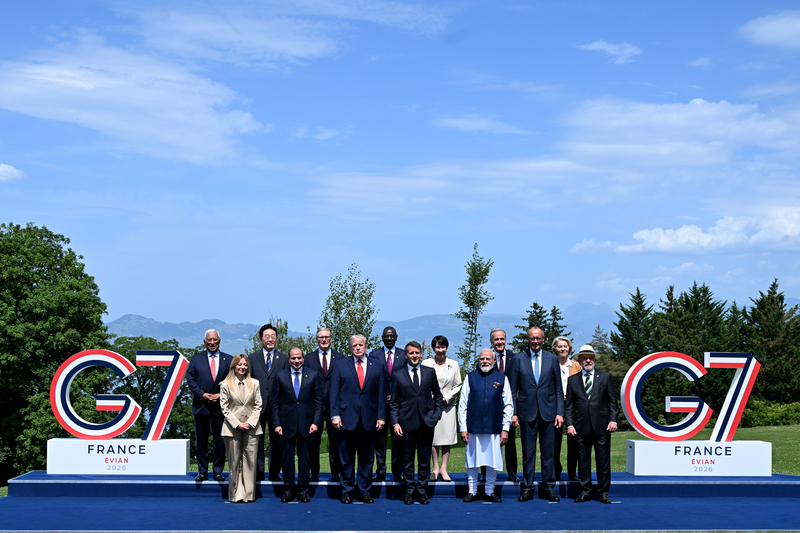
For three days in the middle of June, the spa town of Évian-les-Bains was sealed off from the country it belongs to. Sixteen thousand police, gendarmes, soldiers and border guards held a perimeter that ran along the southern shore of Lake Geneva and across the frontier into Switzerland; the rail line was suspended, the lakefront divided into coloured zones, movement rationed by QR code. On the far side of the lake, in Geneva, some sixty thousand people marched under the banner of a “No G7” coalition that called the gathering illegitimate and outdated; a Tesla burned in the street with Eat the Rich painted on its flank, and the windows of an audit firm and a bank went in. Inside the cordon, in the gardens of a belle-époque hotel, the leaders of the seven richest industrial powers posed for a photograph.
The summit had been moved back a day so that the American president could attend a cage fight at the White House on his birthday. It would close not with a communiqué but with a dinner: the host, Emmanuel Macron, laying on Versailles – gold leaf, the full apparatus of the ancien régime repurposed as diplomacy – to keep his guest from leaving early, as he had left the previous summit in Canada on the first evening. And it was over that dinner, rather than at the conference table, that the one consequential thing happened. Donald Trump signed a memorandum ending the war with Iran, a deal brokered not by the assembled directorate but bilaterally, through Pakistani mediation, and announced with the casual proprietorship of a man closing on a building. The other six issued a statement praising him for it.
This is the image to hold. A body that must reschedule itself around a televised fight, fortify a lake against its own citizens, and stage a royal banquet to prevent its most powerful member from walking out; and that produces, as its headline achievement, a deal it had no hand in making. The question Évian poses is not whether the G7 is ridiculous. It plainly is. The question is why a forum this hollow still matters at all; why governments that can no longer set the terms of anything continue to converge each summer behind their barricades; and what it would mean to take both halves of that puzzle seriously at once; the visible impotence and the residual, stubborn weight.
The argument here is that Évian is not the spectacle of an institution dying. It is the spectacle of one reverting. The post-war Western directorate was always two things at once: a club of allied capitalist powers, and a truce among them – an arrangement that suspended the rivalry between the core economies for as long as a single hegemon could underwrite the terms and a single adversary could supply the discipline of a common enemy. What is fracturing at Évian is the truce. The rivalry it suppressed is returning, from outside in the form of a challenger the bloc can no longer manage, and from within in the form of a member that has turned on the others. But – and this is the half that the obituaries miss – the machinery the directorate built to run the world economy has not gone anywhere. The dollar still clears the planet’s trade; the debt of the poor is still restructured on Western terms; the sanctions architecture still bites. Évian is a body losing the power to set the agenda while keeping the power to enforce it. That gap, between a falling capacity to command and an intact capacity to coerce, is the whole subject.
What the club was for
It helps to remember what the thing was for. The group was convened in 1975, at French initiative, out of the wreckage of the first oil shock; an intimate, improvised conversation among heads of government, the “spirit of Rambouillet” that its nostalgists still invoke. At that first meeting the assembled powers could claim roughly two-thirds of the world’s wealth. They were the management committee of the capitalist core at the moment it was reorganising itself: the body that presided over the turn to open capital accounts, floating currencies, the discipline of the Fund, the long offensive that would later be called by the name of a consensus. Russia was admitted in 1998, a consolation prize for losing the Cold War, and expelled in 2014 for annexing Crimea. The high-water mark had come in 1989, when the Soviet surrender arrived, in effect, mid-summit.
Weight without command
That world is gone, and the figures say so without any need for embellishment. Measured at market exchange rates, the metric that matters for the things the directorate actually controls, the invoicing of trade and the denomination of debt, the G7’s share of world output has fallen from around 64 per cent in 2002 to about 44 per cent in 2024, and from something above 65 per cent in the early 1990s. A twenty-point fall in two decades is not a soft landing. But note what the same metric refuses to say. In dollar terms the enlarged BRICS have not overtaken the G7; that overtaking is real only in purchasing-power terms, and only since the middle of the last decade. Choose the conservative measure and the bloc remains the largest single concentration of output on earth, still spending close to half the world’s military budget. The decline is genuine and it is also not an eclipse. The directorate has not been replaced. It has been hollowed.
The hollowing is most visible where the power is most concentrated: in money and in debt. Here the contrast with the GDP numbers is the entire point. The dollar’s share of central-bank reserves has slid to a quarter-century low near 57 per cent, down from over 70 in the late 1990s; gold has been bought by the tonne; even allies have begun to edge away; France has repatriated its gold from New York, Canada has stood up a sovereign fund to reduce its exposure to Washington. And yet the dollar still stands on one side of the overwhelming majority of foreign-exchange transactions and denominates the bulk of the world’s foreign-currency debt. The store of value erodes; the plumbing holds. The financial weapon is being blunted, slowly, by its own overuse, but it is a weapon the cartel still wields in concert, which is itself the point: a euro or a yen is no refuge from a sanction the G7 imposes together.
And the discipline that machinery enforces on the global South is intact to the point of cruelty. The mechanism built to restructure the debts of the poorest – anchored, as ever, in the Fund and the Paris Club – has in five years admitted four countries and closed the books on none. By the most recent accounting it has cut something like seven per cent of the relevant debt stock. While the creditors deliberated, Zambia’s currency fell by a third and Ghana’s by half; the Fund withheld its money pending the creditors’ assent, which the creditors withheld pending the Fund’s. Le Monde reports that debt service now swallows between thirty and fifty per cent of public revenue in Ghana, Zambia and Kenya. Meanwhile development aid has been cut to the bone, by more than half in the United States, by a fifth in France, and the official prescription is to “replace” it with partnership, by which is meant the handing of development finance to private creditors, on the argument that yesterday’s poor have grown rich enough to compete. The structural power is not declining. In the one domain that matters most to the countries on its receiving end, it is intensifying, even as it changes hands at the margin: China now co-chairs the creditor committees, and the Paris Club itself has begun to concede that the framework must move faster. The chokehold remains; the fingers on it are no longer only Western. That is the shape of the whole: a directorate decaying as an agenda-setter while persisting as an instrument of coercion.
Taxing its own
If the structural power is what survives, the truce is what is breaking; and it is breaking first among the members themselves. The clearest sign that a cartel has stopped being a condominium is that it begins to tax its own. By Évian the United States had imposed tariffs on the European Union and Japan, settling around a fifteen per cent ceiling, ten for Britain; the legal scaffolding of the trade war was so improvised that the Supreme Court struck down its central mechanism in February, forcing a scramble for other authorities. Against Canada, the closest neighbour, the longest ally, the administration ran a full tariff war while floating the annexation of the country as a “fifty-first state” and musing aloud about “economic force.” The House of Representatives voted, across party lines, to repeal the Canada tariffs; the rebuke went unheeded. A directorate whose lead member treats the others as marks is no longer coordinating anything. It is the rivalry returning in the idiom of customs duties.
The same fracture runs through the bloc’s defining security question. On Ukraine the United States and the European members now hold structurally divergent positions, and the divergence is no longer rhetorical. Washington’s peace plan, – drafted without Europe, read across the continent as a reward for aggression — pulled in one direction; Europe, having quietly become Ukraine’s principal backer, pulled in the other. European military aid rose by two-thirds in a single year; a ninety-billion-euro loan was assembled for 2026–27; a rearmament fund of up to a hundred and fifty billion was stood up under the banner of “readiness.” The American president cast public doubt on the value of the alliance itself. What had been dismissed for a decade as Gaullist fantasy – European strategic autonomy – arrived not as ambition but as necessity, the involuntary consequence of a guarantor that could no longer be trusted to guarantee. At Évian the achievement the Europeans were quietly proudest of was getting the American signature onto the Ukraine language at all. When a member’s signature on the bloc’s central commitment is treated as a coup, the bloc has already half-dissolved.
Even the technologies of the future arrived at Évian as instruments of intramural coercion. Days before the summit, Washington blocked the export of a leading American AI model to all foreign nationals, allies included, on grounds of national security; and the shock in Paris was instructive. A former prime minister called the company in question “their Strait of Hormuz,” naming the thing exactly: a chokepoint the hegemon could close at will. The French interior service announced it would drop the American data-analytics firm Palantir, whose backers sit close to the president, for a domestic supplier. Minerals, money, and now compute: the same pattern, the lead state weaponising every interdependence against its own camp, and the camp beginning to route around it. France and Japan, two of the most exposed, have started building bilateral cooperation in critical minerals, in space, in AI; outside the American framework entirely. This is what a cartel looks like as it devolves into hedging sub-coalitions: members insuring themselves not only against the rival, but against their own leader.
The official theme of the summit – the one the host had chosen – was “global imbalances,” and the choice carried more substance than the proceedings gave it. By the Bank of England’s reckoning, global current-account imbalances now sit near their highest in a century and a half, and on each of the three previous occasions they ran higher, crisis followed; the surpluses in particular have become structurally entrenched, the share of excess-surplus economies sustaining them for five years or more having climbed from about 16 per cent in the 1990s to 76 per cent in the 2020s. That is the measurable signature of an adjustment mechanism that has stopped working; the open order’s exhaustion written in its own ledgers. The discourse around it at Évian, though, was its own small comedy of fracture. The prescription, as Macron delivered it, was tripartite: China to curb its overcapacity and subsidies, Europe to invest, the United States to address its twin deficits. The German chancellor pointed at the undervalued yuan. But the imbalances rhetoric, aimed squarely at Beijing, has the awkward property of implicating two of the cartel’s own members: Germany runs the largest current-account surplus in the G7 relative to its economy, and Japan the second. The bloc cannot define its shared economic grievance without naming its own members as the problem. And in the numbers beneath the rhetoric there is a quieter admission still: as Washington decoupled from China – cutting its trade with Beijing by over a fifth – the displaced Chinese surplus washed onto its allies, Europe and Japan absorbing the imports, Canada serving as a transshipment route. The hegemon’s adjustment becomes the cartels burden. There is no common interest here to coordinate around. There are divergent exposures wearing the costume of a common interest.
Business as before
What, then, did Évian actually do? The most honest answer was given not by its critics but by the press of capital itself, which arrived – across the Financial Times and the Economist, across at least five reporters – at a single conclusion none of them quite printed as a thesis: the summit’s product was keeping the American president in the room. The Economist’s Paris correspondent, asked directly whether the G7 was still relevant, allowed that the communiqués were the fruit of compromise after which everyone went away and got on with things “business as before,” and located the body’s residual value in the chance for leaders to talk privately in the hotel gardens. A columnist in the FT, writing as a fictional football manager, set down the spine of it without the conceit: the host tried to make the summit about imbalances, “the Chinese demurred, the Americans disengaged, and the topic got kicked to the G20.” The bloc had gone in, on its own correspondents’ account, with low expectations and a single objective; to keep the guest on site. It is the agenda of a body that no longer expects to decide things, only to prevent its own rupture.
That objective was met at a price, and the price reveals the hierarchy. South Africa, personally invited by Macron the previous year, was disinvited under American pressure – Washington threatening to boycott if Pretoria attended – and Kenya substituted in its place. The guest list of the world’s self-appointed directorate now bends to the moods of its strongest member. So does its agenda: France could keep climate on the table only by smuggling it in as a study of past “extreme weather events,” the words “climate change” kept out of the ministerial communiqué entirely, a phenomenon a French correspondent likened to the wizards in a children’s book refusing to speak the name of the villain for fear of summoning him. Governance by omission, the agenda dictated by the absent sensitivities of one man.
And here the presses divide in a way that is itself evidence. The Economist reads Évian with cautious hope; an “Évian moment,” a “new tone,” the order adapting. The FT reads the same three days as accommodation shading into debasement. The host’s own paper, Le Monde, splits down its middle: Macron at his closing press conference pronouncing the summit “objectively a success,” a moment of unity after months of discord, and, to those who called him too pliant, insisting that “Versailles is an instrument of power”, while the paper’s own senior columnist wrote, in the same week, that the G7’s “manifest obsolescence can hardly be contested,” that it survives “by the force of habit alone.” Four organs of allied capital, four different objects: the order adapts; the order is looted from within; the host insists on its potency while his columnist writes the obituary; and, in the Asian business press, the members are seen quietly hedging against their own leader. The divergence is not noise to be reconciled. It is the cartel seen from four fractions of capital that no longer perceive the same thing.
The organising absence
The challenger that the directorate can no longer manage was not at the table, and did not need to be. China was the organising absence of the entire summit – the unnamed object of the minerals declaration, which committed the members to reduce their dependence on a “single supplier outside the G7” without once printing the supplier’s name; the unnamed target of the imbalances theme; the unnamed adversary of the forced-labour language. A club that once defined itself by what it was building now coheres around what it fears. And the fear is well founded, because the dependence is real: China refines the overwhelming majority of the world’s rare earths, and its export curbs on permanent magnets had sent the price of the materials that go into every electric motor and guided weapon vaulting upward. The flagship American proposal – a formal critical-minerals trading bloc – was refused by Washington’s own allies and watered down to a non-binding framework. The directorate could not even agree on how to confront the thing it had convened to confront.
The deeper point is that this dependence is the bill for the directorate’s own project. The bloc spent forty years building the open world economy that allowed capital to chase margins to China, China to climb from the low-value industries of the 2000s into the electric vehicles and batteries and high-tech exports that analysts now call a “second China shock,” and the chokepoints of twenty-first-century production to migrate east. The “de-risking” agenda, the stockpiles, the friend-shoring, the traceability standards, the talk of resilience, is the architect trying to wall off a structure he spent his career demolishing. It is not the posture of a confident hegemon. It is a defensive clawback, and a confession.
It is also, revealingly, a project the bloc cannot pursue without consulting the very power it is arrayed against. Days before Évian, the host convened a pre-summit video call on the world economy that included the Chinese vice-premier – an unusual instance, the wire reports noted drily, of China engaging with a body it has long dismissed as illegitimate and unrepresentative of the world. The directorate had to invite the rival it blames onto the call about the imbalances it would then formalise as the rival’s fault. And in the months before, five of the seven leaders had made their separate pilgrimages to Beijing. The cartel cannot hold a common line on China because each member is privately negotiating its own. The legitimacy of the G7 is now contested from two directions at once, by the anticapitalist coalitions burning Teslas in Geneva, and by the rising state it excludes, and the convergence of those two critiques, from below and from the east, is the measure of how isolated the thing has become.
A mutation, not a threat
The second pressure on the truce is harder to see clearly, because it is usually filed under the wrong heading. The resurgence of the far right across the bloc – a movement leading the polls in France and Britain, governing in Italy, topping or near-topping them in Germany, and holding the White House outright – is routinely described as an external shock to the liberal order, a threat the establishment must “balance” against, symmetrical with the threat from China. This is a category error, and correcting it is where the analysis earns its keep.
The far right is not a challenge to the imperial order in the way China is a challenge to the bloc’s primacy. China is a rival centre of accumulation contesting the directorate’s place in the world. The far right is internal to the imperial states, and it is better understood as a mutation of the imperial project than as its antagonist. It does not knock at the door to dismantle the domination the bloc exercises over the global South; it knocks to administer that domination in a different idiom; to recode it from the universalist register of free trade and the rules-based order into the nativist register of borders, deportation, and civilisational defence. The American administration is not a threat to American hegemony. It is a particular modality of exercising it: transactional, unilateral, meaner. The new right wants harsher borders, more aggressive economic nationalism, more muscular projection; not less empire but a more brutal one. Its self-understanding, which deserves a fair hearing, is the inverse: that it represents the democratic majorities a managerial elite has betrayed, a correction rather than a rupture. But the test is in the programme, and the programme is the intensification of domination, not its retreat.
This is why “balancing between China and the far right” mis-describes the predicament. With China the bloc contains a rival it wishes to exclude. With the far right the establishment is not containing an external force; it is being colonised from within; the mainstream absorbing the insurgent programme rather than defeating it, the old cordon sanitaire dissolving as conservative leaders govern with the radical right’s votes and adopt its positions on migration as common sense. And both pressures, properly understood, descend from a single source: the exhaustion of the open-world model the directorate itself built. The globalisation that manufactured the Chinese rival also hollowed out the Western working class that now supplies the far right’s base; a class realignment visible in the figures, with the radical-right parties taking pluralities and majorities of the working-class vote that social democracy once owned. The directorate is managing the two children of its own contradiction. The de-risking agenda is the geopolitical bill for globalisation coming due; the far right is the domestic one.
And here the internal and external fronts fuse into a single vertigo. The far right is not merely knocking at the directorate’s door. In its most powerful member it is already in the command centre. The bloc is attempting to contain China through an alliance commanded by a far-right unilateralist who simultaneously attacks the alliance – tariffs his partners, covets Greenland, treats the courted as marks. The two-front problem has the disorienting feature that one front runs through the White House. This also makes the far right a faithless instrument for the very anti-China project the establishment needs it for: it shares the nationalism but not the multilateral discipline that containment requires; it is protectionist, which serves the decoupling story, but isolationist and transactional, which corrodes the alliance the decoupling needs; and it is not even coherent on the adversary, its energy spilling onto allies and migrants rather than concentrating on the rival. The Greenland designs split the European new right from the American one. The nativist surge cannot be aimed.
Pluralisation or decay
The strongest objection to all of this should be met head-on, because the essay is weaker if it ducks it. The liberal reading denies the premise. There is no “imperial directorate” in decay, it says – only the benign pluralisation of a richer world, others maturing as the West graciously shares a table it once monopolised; and the G7 was never an imperial instrument but a club of democracies coordinating in good faith, now adjusting to a more crowded room. The reserve figures even lend it support: the dollar’s slow diversification looks more like a portfolio adjustment than a flight from a weaponised system, and the G7 currencies sanction in concert, so there is no rival haven anyway.
Concede the gradualism. The decline is slow; the alarms are often overblown; multipolarity has not arrived on any metric that controls the world’s money. But the concession turns. Pluralisation of output has not pluralised control – the dollar plumbing, the Fund’s debt chokehold, the sanctions architecture remain core-anchored even as they fray, and a third of low-income countries are poorer than they were five years ago while the cartel polices their debts from behind government-debt ratios of its own that average over 126 per cent of GDP. The directorate disciplines from a glasshouse. And the fraying that the liberal reading mistakes for serene power-sharing is in fact driven by the core’s own conduct; the weaponisation that teaches the world to diversify, the tariffs on allies, the lead state at war with its own camp. That is not maturation. It is decay, administered from within.
Neither pole
Which leaves the conclusion, and the one move that neither the liberal nor the campist can make. The decline of the Western directorate is not the liberation of the global South, because the powers rising into the space it vacates offer the South nothing better. China is a creditor and an extractor; it sits inside the Zambian creditor committee not to relieve the debt but to bargain over it. Russia wages a flagrantly imperial war on a neighbour’s sovereignty beneath an anti-imperial banner. The BRICS are a heterogeneous coordination forum of rising and aggrieved states, several of them sub-imperial powers in their own neighbourhoods, seeking better terms within global capitalism rather than its abolition – no member proposes to end unequal exchange or the debt peonage of the poor; they want a larger seat at the table that imposes them. Even Le Monde‘s editorialist, declaring the G7 obsolete, calls the BRICS an empty shell with no funds and no project; the recent G7 chair calls the rules-based order a useful fiction. The liberal can see the obsolescence and the emptiness both; and has nowhere to go from there but a shrug.
India is the case that makes the trap concrete. Courted by the directorate, invited to Évian, met with ceremony on the sidelines and, in the same week subordinated by the very hegemon courting it: its strategic standing quietly downgraded as Washington renamed its Pacific command and dropped the gesture toward Delhi, three of its sailors killed in an American strike, the United States tilting transactionally toward both Beijing and Islamabad. A rising Southern power finding no safe pole – neither the transactional hegemon nor the authoritarian-capitalist challenger – is the argument made flesh. Multipolarity, from the vantage of the country caught between the poles, is not freedom. It is a vice.
So the directorate at Évian is best understood not as a hegemon performing a balancing act, but as a bloc whose own globalising project generated both a rival it cannot discipline and a revolt it cannot govern, now trying to reproduce its dominance while its lead member is captured by the revolt – and while the rival it fears offers the world no emancipation either. It will not vanish; nothing is ready to replace it, and the machinery of coercion outlasts the capacity to command. It will persist, fortified and obsolete, ratifying a unilateralism it can no longer direct, policing the debts of the poor from inside its own crisis. The first Évian, in 2003, was the target of a movement that believed another world was possible at the zenith of the Western order. The second is a defensive huddle behind sixteen thousand troops at that order’s dusk. Between the two summits the question has not changed, only become more urgent and less answerable by anyone now in the room: not which pole will inherit the world, but whether the world’s majority will be anything more than the terrain on which the rivalry of the poles is fought. The only position that survives the evidence is the one that refuses both – that holds out for the debt sovereignty and the self-determination of the South against the falling directorate and its rising challengers alike. It is not represented at Évian. It was, perhaps, somewhere in the smoke on the other side of the lake.
About the Author

Editorial Board Member of Alternative Viewpoint