Dharavi is often described as a “city within a city.” In Mumbai’s landscape of sharp contrasts, it stands as one of the most visible islands of neglect. Under the current ruling dispensation, there is a blatant push for its redevelopment. Over the past two decades, large-scale redevelopment has emerged as a central strategy for urban transformation.
Parallelly, we have witnessed how each of these so-called development processes disrupts the lives and livelihoods of those affected. Many of them often find themselves in debt traps, homeless and with livelihoods more vulnerable than before, as access—once ensured by proximity—is lost. With the current plans for Dharavi’s redevelopment, we shall witness it all over again, and this time the scale will be unparalleled in the urban history of India.
From Marginal Settlement to Economic Ecosystem
To understand Dharavi, one must begin with its origins. It was not merely an unplanned settlement but, in part, an administrative outcome of colonial public health measures and spatial segregation, when populations engaged in “dirty work” were pushed out of the city’s core. Over time, enterprising communities transformed this marginal space into a livable and economically vibrant hub. With the onset of industrial expansion and the growing demand for labour, Mumbai attracted waves of migrants. In the absence of adequate and affordable housing, informal settlements like Dharavi emerged as practical solutions to a deep structural housing deficit. What is often labeled a “slum” is, in reality, a product of economic necessity, resilience, and systemic gaps in urban planning.
No single theoretical framework can fully explain the phenomenon of Dharavi—a pre-industrial
environment embedded within the heart of a modern metropolis. As Ananya Roy argues, urban informality is not an exception but a mode of urbanization shaped and regulated by the state itself. Dharavi thus represents a complex fusion of economic and residential ecosystems, generating an estimated one billion dollars in annual economic activity while sustaining the livelihoods of vast numbers of semi-skilled and unskilled workers.
Land, Value and the Logic of Redevelopment
Redevelopment must also be understood as a process of land revaluation. Dharavi occupies centrally located land whose exchange value has risen sharply over time. Its existing use—dense, low-rise, and oriented toward small-scale production—generates relatively modest financial returns compared to what large-scale real estate development could yield. The pressure to redevelop Dharavi therefore emerges not simply from concerns about housing or infrastructure, but from the widening gap between its current use and its potential exchange value.
Its dense network of small and medium enterprisesspans sectors such as recycling, food production, garment manufacturing, and leather goods, alongside traditional communities like the potters of Kumbharwada and the fishing community of Koliwada.
Each of these economic activities, along with their supporting systems, has evolved organically over time, creating an intricate web of interdependence. This internal logic—adaptive, efficient, and deeply local—often remains invisible to outsiders. In this sense, Dharavi reflects what AbdouMaliq Simone describes as “people as infrastructure,” where social and economic networks themselves function as the backbone of urban life. These relationships enable production, distribution, and survival in ways that formal planning frameworks often fail to capture.
It is precisely this complexity that large-scale redevelopment projects fail to recognize. By reducing Dharavi to a spatial problem to be “fixed,” such interventions risk dismantling not only physical structures but also the economic and social networks that sustain everyday life. As Mike Davis reminds us, settlements like Dharavi are not anomalies but products of deeper structural inequalities, making purely top-down redevelopment approaches both inadequate and potentially harmful.
In this context, redevelopment is not merely a question of infrastructure but of justice. Disrupting Dharavi’s ecosystem without adequately understanding or preserving its internal dynamics could lead to the loss of livelihoods, fragmentation of communities, and erosion of a system built over generations. Any meaningful intervention must therefore move beyond top-down planning and engage with Dharavi as a living, working city. In doing so, it must uphold what Henri Lefebvre conceptualized as the “right to the city,” ensuring that Dharavi’s residents are not displaced subjects of redevelopment but active participants in shaping their urban future.
The Spatial Economy of Dharavi
The organic evolution of Dharavi’s work-life ecosystem is etched into its geography, specifically along the two arterial roads that crisscross the settlement. Most occupations are strategically aligned along the 60-Feet and 90-Feet roads, creating a bustling economic spine where commerce and community intersect. This organization is especially evident near major transport hubs, where the flow of people and materials dictates local industry.
Near the Mahim railway station lies the 13 Compound, a massive industrial engine that recycles approximately 60% of Mumbai’s waste. These activities depend on dense spatial clustering, low costs, and proximity—conditions that are difficult to reproduce in formal redevelopment frameworks. The ecosystem here follows a systematic logic: segregation points for wet waste are located close to the creek, followed by specialized units for plastic, paper, and electronic waste. In the narrow crevices between these units, a culture of frugal innovation—or jugaad—thrives. Here, skilled technicians salvage electronic components to repair household items, offering everything from fully reassembled mixer-grinders to niche spare parts for televisions and microwaves.
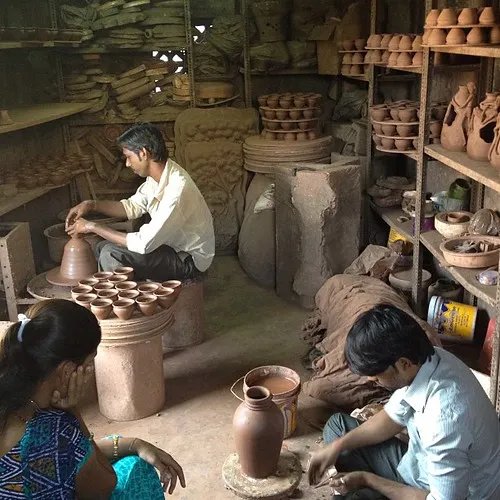
Further along, at the busy intersection of the 60-Feet and 90-Feet roads, is Kumbharwada, the potters’ colony. The spatial layout here serves both business and tradition; retail and wholesale shops line the front, while homes and workshops are tucked behind. Deep within these clusters are shared kilns used by multiple families. This community is governed by a highly active Kumbhar Association. This body manages the procurement of clay, dictates market pricing, and resolves internal conflicts. Led by office bearers, the association maintains significant influence within local political circles.
Along the 90-Feet and 60-Feet roads are wholesale farsan shops—wafers, mixture, chikki, chakli, sev—you name it, and it is available. A large share of this production is home-based, with ancillary processes distributed across shared and domestic spaces.
The landscape shifts again at the T-junction, where plots once dominated by large timber markets
have evolved into a diverse commercial hub of sweetmeat shops, soft drink godowns, and garment outlets. While the storefronts suggest a simple retail environment, venturing deeper reveals a sprawling manufacturing core. These large-scale garment units are the backbone of a local textile industry, specializing in everything from nightgowns to high-quality jeans, further illustrating Dharavi’s role as a hidden powerhouse of production.
On the peripheral road lies the more well-known leather market, which operates both at retail and wholesale levels. Leather tanning was moved out of Dharavi following the recommendations of the Chitale Committee report, which emphasized reducing industrial pollution in flood-prone areas after the 2006 Mumbai floods. What remains is the production of bags and apparel in numerous workshops located within Dharavi’s internal lanes. The showrooms are often owned by individuals who do not reside in Dharavi but come from other parts of the city and are thriving businessmen. Their status—in terms of class and caste—is entirely different from that of the workers employed in these manufacturing units. This distinction is important when discussing redevelopment. This layered structure of ownership and labour highlights internal class differentiation within Dharavi itself—an important factor in understanding how redevelopment will affect different groups unevenly.
Crisis, Policy and Economic Disruption
Various policy decisions have impacted Dharavi’s economic landscape over time. Demonetisation in 2016 derailed a number of units across Dharavi, as most garment units operate on cash. Spatially, these units are spread across Dharavi, particularly in areas with higher residential density, as a significant amount of ancillary work—such as buttonholing, thread cutting, ironing, and packaging—is outsourced to women home-based workers. There are also numerous eateries, colloquially called bhishi, that provide two meals a day for single male migrants who live and work in these manufacturing units.
Demonetisation in 2016 had a profound effect on Dharavi’s predominantly cash-based economy. Much of the informal work—particularly in sectors like garment manufacturing, leather processing, recycling, and small-scale trading—relies heavily on daily cash transactions. The sudden withdrawal of high-denomination currency notes severely constrained liquidity, leading to a sharp slowdown in economic activity. However, the full extent of transformations during this period, including shifts toward alternative payment methods or the emergence of new forms of employment, remains largely undocumented.
The COVID-19 pandemic further disrupted Dharavi’s economic fabric. Lockdowns and mobility restrictions forced many small enterprises to shut down temporarily, and in some cases permanently. Businesses had to reorganize their operations—some downsized, others shifted trades—while many workers faced unemployment or migrated back to their hometowns. Over time, new livelihood strategies emerged, reflecting the resilience and adaptability of Dharavi’s workforce.
The state plays a central role in this transformation. Through planning frameworks, eligibility criteria and redevelopment schemes, it structures how land is assembled and reallocated. While redevelopment is framed as rehabilitation, it simultaneously enables the conversion of socially productive land into real estate assets. Public authority thus mediates a process in which the risks of displacement are borne by residents, while the gains from land revaluation accrue elsewhere.
Redevelopment and the Reordering of Urban Space
Dharavi’s economy is built on proximity, relationships, and an organic spatial logic that cannot be replicated through top-down planning. What appears as disorder is, in fact, a highly functional system of production and social reproduction.
The proposed redevelopment must therefore be understood not simply as an attempt to improve housing conditions, but as part of a broader restructuring of urban land. Dharavi’s central location and rising land values make it a key site in the ongoing transformation of Mumbai’s metropolitan landscape.
What is at stake is not only the displacement of residents, but the dismantling of an entire economic ecosystem embedded in urban space. In this process, the state does not operate as a neutral arbiter. It actively facilitates the reorganisation of land toward higher-value uses, enabling the conversion of collectively inhabited space into real estate assets.
The result is a restructuring of the city in which the costs are borne by those whose labour sustains it, while the benefits are captured through the revaluation of land. Dharavi’s redevelopment thus reflects a wider shift in which urban transformation proceeds through the displacement, fragmentation and reordering of working populations in the service of capital accumulation. In this sense, redevelopment operates not simply as urban improvement but as a mechanism for reorganising class relations in space through the revaluation of land.
About the Author

Shweta Damle
Founder-Director, Habitat and Livelihood Welfare Association, and member of the Working Committee, Working People's Coalition (WPC).