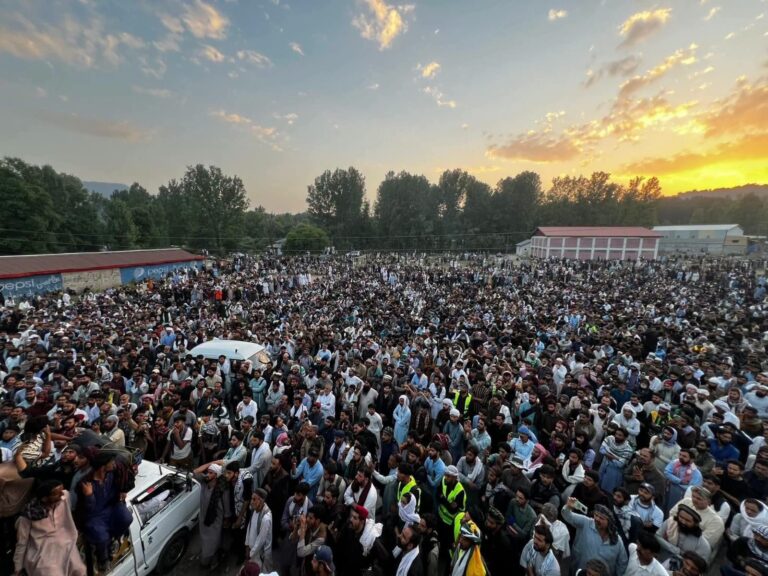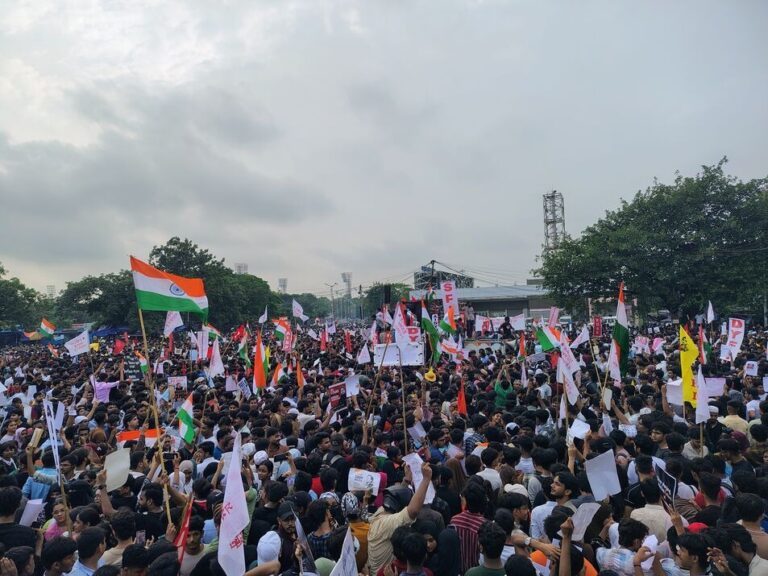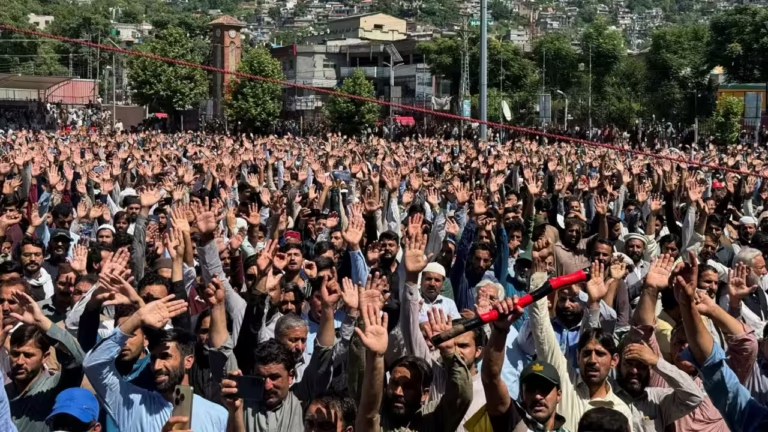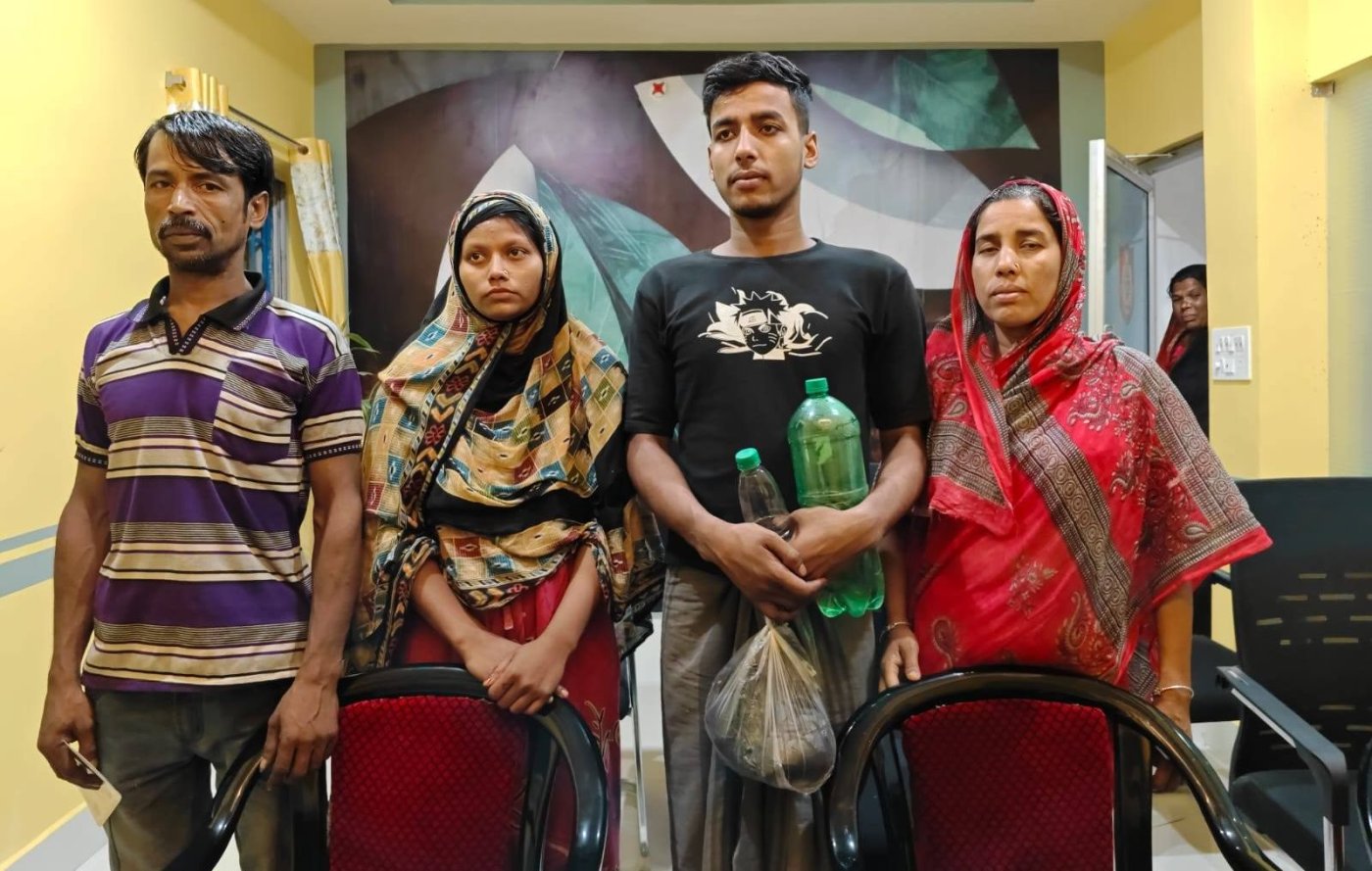
Fazer and Taslima Mandal with Fazer's parents at Raiganj police station of West Bengal’s Uttar Dinajpur district after the Border Security Force (BSF) brought them back from Bangladesh on 16 June. Picked up from a Mumbai suburb, the couple spent two days in the no-man’s land between the two countries’ borders after being forced by the BSF to cross over/ SAMIRUL ISLAM, FACEBOOK
West Bengal’s pushbacks, the Hindutva project, and the global machinery of expulsion
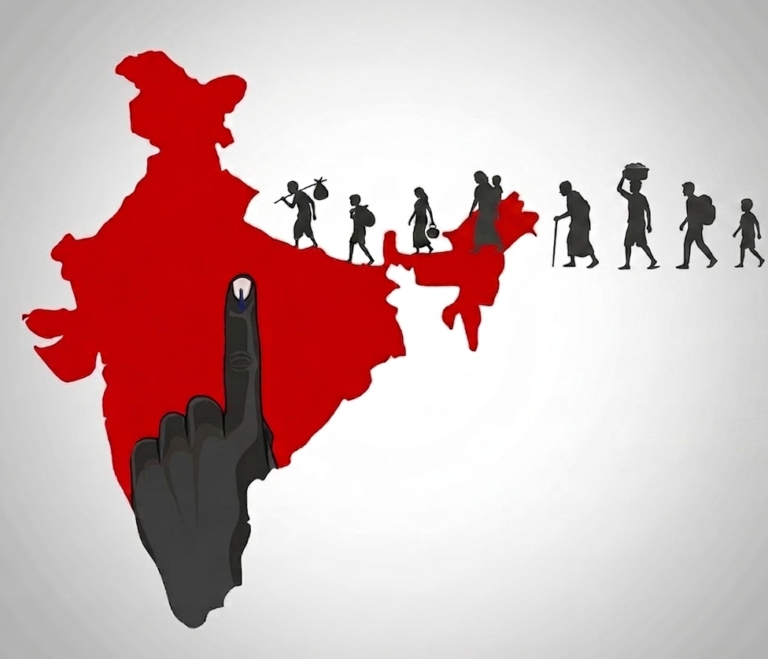
In the last week of May 2026, the road to the Bithari-Hakimpur checkpost in North 24 Parganas filled with people carrying packed bags. Men, women and children queued at the edge of the country, waiting for permission to leave it. They were not being marched out at gunpoint. Most were going of their ‘own accord’: a domestic worker from Khulna, a mason from Satkhira, a woman whose husband had begun telling her she was Bangladeshi and should go back. They had done the arithmetic of fear and concluded that crossing the border on their own terms was safer than waiting to be detained, processed and pushed. The scene had the orderly horror of a self-administered expulsion: the state had announced its intention, and people had pre-emptively obeyed.
This is what an “anti-infiltration drive” looks like on the ground three weeks after the Bharatiya Janata Party formed its first government in West Bengal. Chief Minister Suvendu Adhikari took office on 9 May 2026, and the machinery moved fast: holding centres in district after district, instructions to administrations to verify and detain, the security forces told to watch the stations and the border crossings. The campaign that immigration had been during the election, the BJP’s central promise to the Bengali electorate, became, within days, an administrative reality.
It would be a mistake to read this as a local law-and-order story, or even as a single state government’s overreach. The Bengal pushbacks are at once four things, and the article that does them justice must hold all four in view: they are the latest and most brazen node in a deportation machine that India has been building and intensifying for over at least two decades; they are the operational edge of an ideological project a century in the making; they are illegal, by the measure of India’s own Constitution and the international covenants it has signed; and they are the harvest of a “Bangladeshi” narrative that was manufactured not by the BJP alone but across the political and journalistic spectrum, fusing communal hatred with contempt for the Bengali, and for the poor. Read on that scale, the queue at Hakimpur becomes legible – and so does its kinship with a politics of expulsion now ascendant from Washington to Berlin.
The figure the net is built to catch
Begin with the people the drive actually sweeps up, because they expose what the official language conceals. The state speaks of “infiltrators” and “illegal immigrants,” categories that conjure a clean line between the citizen who belongs and the foreigner who does not. The line does not hold.
Hers was not an isolated slip. Across 2025, Bengali-speaking workers, hundreds in Odisha, dozens fleeing Gurugram, others held in Rajasthan and Maharashtra, were rounded up for no reason beyond a dialect that sounded foreign, many of them Indian citizens whose identity documents the police simply refused to accept.
That last fact is the tell. When language becomes evidence of foreignness, the category of “infiltrator” stops describing a legal status and begins describing a population. Every poor, Bengali-speaking, Muslim labourer becomes a suspect required to prove, on demand and often without papers, that they belong. The architecture guarantees error, because it has inverted the burden of proof. India’s Supreme Court ruled in December 2025 that foreign nationals enjoy almost no constitutional protection; the Bengal government has signalled that those it detains need not be taken before a court before being removed. The onus falls on the accused to demonstrate why they should not be pushed across a border, an impossible standard for an illiterate daily-wage earner, and a convenient one for a state that wants numbers. Human Rights Watch’s Asia director, Elaine Pearson, called the deportations illegal and warned that even detainees without documents must have legal representation, so that no citizen is wrongly expelled. The net is not malfunctioning when it catches citizens. Catching them is what a net of this design does.
This is not new – and that is the point
The temptation, watching Bengal, is to treat it as a rupture: the BJP finally in power in the last large state to resist it, the gloves off. But the drive that Adhikari’s government launched in May 2026 is not an innovation. It is the localisation of a national apparatus that has been expanding, and accelerating, since the BJP captured Delhi in 2014 – and whose foundations were laid earlier still.
Assam is the laboratory. There, the National Register of Citizens, updated under Supreme Court supervision and finalised in August 2019, excluded roughly 1.9 million people, throwing them into a Kafkaesque limbo of Foreigners Tribunals – quasi-judicial bodies notorious for arbitrary reasoning – and the older category of the “D-voter,” the doubtful voter stripped of the franchise on suspicion alone. Around this grew a network of detention centres, including the vast camp at Matia in Goalpara, where people adjudged foreign could be held indefinitely while the state worked out where to send them. The cruelty was not incidental; it was the proof of concept.
After 2014, and with rising momentum after the BJP’s second term began in 2019, the model went national. The Citizenship Amendment Act of 2019 and the threat of a countrywide NRC turned citizenship itself into a question every poor Indian might suddenly be made to answer. Round-ups of alleged “Bangladeshis” became a recurring spectacle in Delhi, in Gujarat’s Ahmedabad, in Rajasthan, in Maharashtra, almost always targeting Bengali-speaking Muslim labourers, almost always timed to the political calendar. A Union Home Ministry circular in May 2025 formalised the machinery, authorising states to detain and verify suspected illegal immigrants across state lines; within weeks Bengali workers were being held from Odisha to Haryana on the strength of their language alone. In the wake of the April 2025 Pahalgam attack, a nationwide crackdown saw thousands detained and many bundled across the border, several later established to be Indian citizens, some routed through Tripura and pushed into no-man’s land without a hearing.
Two features recur across this decade and matter for the argument. First, the escalation has been keyed to electoral advantage: the “infiltrator” is summoned most loudly when there is a vote to be won, and West Bengal – with its long border, its large Muslim minority, and its symbolic value as the citadel the Sangh could never breach – was always the prize. Second, the machine has consistently produced the very miscarriages that should have discredited it, and has been corrected, again and again, only by courts acting after the harm was done. A state that knows its method deports citizens, and persists, has told you that deporting citizens is a cost it is willing to pay. Bengal in 2026 is not the beginning of this story. It is its most confident chapter.
The ideological offensive: a genealogy of the intruder
None of this is improvised, because the figure of the intruder is not a policy invention. It is the load-bearing concept of an ideology the Rashtriya Swayamsevak Sangh has refined for the better part of a century.
The grammar begins with V. D. Savarkar, who in 1923 gave “Hindutva” its definition: a Hindu is one for whom India is both pitribhumi, fatherland, and punyabhumi, holy land. The formula is elegant and exclusionary by design. The Muslim and the Christian, whose holy lands lie in Arabia and Palestine, can never fully satisfy it; they are, structurally and permanently, partial outsiders in the nation Savarkar imagined. Belonging was redefined as a religious-civilisational test that some Indians could never pass.
M. S. Golwalkar, the Sangh’s longest-serving chief, turned that idea into a programme. His 1939 tract We, or Our Nationhood Defined laid out “five unities” of a nation – geography, race, religion, culture, language – and concluded that India was the homeland of the Hindus alone. At the height of Hitler’s rise, the book held up Nazi Germany’s purging of its Jewish population as an instance of “race pride at its highest” and called it a good lesson for India to learn and profit by. Minorities, Golwalkar argued, must either dissolve into the majority culture and claim no rights, or live wholly subordinated. It is fair to note that the RSS has at times disputed whether Golwalkar truly authored the book or merely adapted an older Marathi text, and his defenders cite his later moderation. But the continuity is hard to wish away: his 1966 Bunch of Thoughts names Muslims, Christians and Communists as the three “internal threats” to the nation, and that taxonomy, the enemy who lives among us, wearing the face of a neighbour, is precisely the one operating at the Hakimpur border.
From this lineage the present drive inherits its decisive move: the splitting of the migrant into two figures. There is the refugee, fleeing persecution, deserving of sanctuary; and there is the ghuspaithiya, the infiltrator, an internal enemy who has crept in to corrupt the body of the nation. The 2019 Citizenship Amendment Act gave this distinction the force of statute for the first time, fast-tracking citizenship for Hindus, Sikhs, Buddhists, Jains, Parsis and Christians from neighbouring countries while pointedly excluding Muslims. Paired with the NRC, it produced a machine with a religious test at its heart: prove your ancestry, and if you cannot, your faith decides whether you are a refugee to be embraced or a termite to be removed. That word, “termites”, is not invention; it is the Union Home Minister’s, used from the podium to describe Bengali-origin Muslims. Dehumanisation is not a by-product of the rhetoric. It is the engine. You do not deport neighbours; you exterminate vermin.
In Bengal the religious logic is barely veiled. The eviction, as reported, is aimed at Muslim migrants, with Hindus and others effectively shielded under the CAA framework. In a state where roughly 27 percent of the population is Muslim, a campaign that sorts the deportable from the protected by faith is not border management; it is a demographic message addressed to the Hindu electorate that delivered this government its first Bengal majority. This is the sense in which the pushbacks are an ideological offensive and not merely a policy. Their purpose is not principally to reduce a number no one can reliably state. It is to perform the nation’s boundaries – to stage, repeatedly and visibly, who belongs and who is permanently provisional – and so to summon into being the Hindu Rashtra that Savarkar and Golwalkar described, in which the Muslim is tolerated only as a guest, and only for as long as the host permits.
Against every norm of a civilised order
Strip away the ideology and a plainer fact remains: what is being done is illegal. Not merely cruel, not merely impolitic – unlawful, by the measure of India’s own Constitution, its statutes, and the international instruments to which it has bound itself.
Start at home. The Indian Constitution does not reserve all its protections for citizens. Article 14, the guarantee of equality before the law, and Article 21, the guarantee that no person shall be deprived of life or personal liberty except by procedure established by law, extend by their own terms to every person on Indian soil, citizen or foreigner. The Supreme Court has affirmed this repeatedly. What the executive leans on is the narrower Article 19(1)(e) – the right to reside and settle anywhere in India, which is confined to citizens – and the sweeping discretion of the Foreigners Act, 1946, a colonial-era statute that hands the government near-plenary power to expel. But even granting the state its power to remove genuine foreigners, the determination of who is a foreigner is itself a deprivation of liberty, and Article 21 demands that it follow a fair procedure: notice, a hearing, the chance to produce evidence, review by a court. A pre-dawn detention on the strength of an accent, followed by a push across the border before any tribunal has spoken, is the precise opposite of “procedure established by law.” That is why the Calcutta High Court and the Supreme Court have had to keep ordering the deportees back. Each such order is, in effect, a judicial finding that the state broke the law.
The international ledger is no kinder. It is true, and the government never tires of repeating it, that India has not acceded to the 1951 Refugee Convention or its 1967 Protocol, and has no domestic asylum law. But that is far from the whole of India’s obligations. India ratified the International Covenant on Civil and Political Rights in 1979; Article 9 forbids arbitrary arrest and detention, and Article 13 permits the expulsion of an alien only in pursuance of a decision reached in accordance with law, with a right to submit reasons against removal and to have the case reviewed. The Universal Declaration of Human Rights affirms the right to seek asylum. And the principle of non-refoulement, the bar on returning a person to a place where they face persecution or grave danger, has hardened into customary international law, regarded by many jurists as a peremptory norm from which no state may derogate. Indian courts have read it into Article 21 itself: in NHRC v. State of Arunachal Pradesh (1996) the Supreme Court blocked the eviction of Chakma refugees on exactly that ground, and the Gujarat High Court did likewise in Ktaer Abbas Habib Al Qutaifi v. Union of India (1999). The Constitution’s own Article 51(c) directs the state to foster respect for international law and treaty obligations. (The contrary pull is real and should be named: in Mohammad Salimullah v. Union of India (2021) the Supreme Court allowed Rohingya deportations to proceed, citing India’s non-signatory status and security concerns, a precedent the government now leans on.) But a government that pushes people across a border without a hearing is not exercising sovereignty within the law; it is violating its own Constitution and breaching covenants it freely signed.
This is worth stating without euphemism, because the official vocabulary is engineered to soften it. “Pushback,” “anti-infiltration drive,” “holding centre”, each phrase launders a practice that, named accurately, is the arbitrary detention and collective expulsion of human beings, some of them citizens, none of them tried. It offends not only Indian law and international covenant but the elementary norms of any civilised order: that the state must prove its case before it punishes, that families are not to be broken on suspicion, that a pregnant woman is not cargo to be moved across a frontier in the dark.
Who built the “Bangladeshi”? Media, Mamata, and class
If the ideology is the Sangh’s, the raw material it works with was not manufactured by the Sangh alone. The figure of the menacing “Bangladeshi”, the illegal who steals jobs, alters the demography, and votes in someone else’s name, was assembled over decades across the Bengali political and journalistic spectrum, and the BJP’s achievement has been to weaponise an anxiety others had already cultivated.
Consider Mamata Banerjee, now the BJP’s fiercest antagonist on this very issue. On 4 August 2005, as an opposition MP, she stormed the well of the Lok Sabha demanding a debate on Bangladeshi infiltration, declaring it had become a “disaster” and brandishing what she called the Bangladeshi and Indian voters’ lists; when the Speaker refused her motion, she flung papers and offered her resignation. The woman who in 2026 condemns the pushbacks once made the “infiltrator” her signature cause. Her later reversal, opposing the NRC, vowing that no detention centre would rise in Bengal “even if it costs my life”, was real, but it was argued largely on the terrain of Bengali ethnic identity and the defence of the language rather than a principled defence of the migrant, and it came only after the BJP had made the issue its own. The narrative, in other words, is bipartisan in its parentage; what changed was who stood to profit from it.
The press is part of this story too. The “Bangladeshi” did not enter the Bengali imagination as a neutral fact; it was narrated. The bhadralok daily Anandabazar Patrika, the flagship paper of the Bengali middle class for a century, and the wider vernacular media helped fix in respectable opinion the image of the East Bengali Muslim migrant as a source of disorder, demographic threat and criminality, an anxiety with deep roots in the partition-haunted, caste-and-class-inflected unease of the Calcutta bhadralok toward the poor, Muslim, often refugee population on its margins.
And here the argument turns on a paradox that exposes the whole project. The same machine that hunts “Bangladeshis” routinely brands Bengali-speaking Indian workers, in Delhi, in Gujarat, in Assam, as Bangladeshi on the strength of their language alone. The Bengali-speaking workers rounded up in Odisha and Gurugram for their dialect were not collateral damage; they reveal what the category was always about. “Bangladeshi” is not, in practice, a statement of nationality. It is a slur that fuses three hatreds: of the Muslim, of the Bengali, and of the poor. The drive is anti-Bengali even as it is conducted in Bengal, because to the Hindutva imagination the Bengali Muslim labourer is the suspect par excellence, and the Bengali language a marker of contamination, which is why Bengali migrants are profiled as foreign the moment they leave the state to work.
It is, finally, a war on the working class. Look at who is taken: ragpickers, masons, daily-wage labourers, street vendors, the migrant poor who cross state lines because their own districts cannot feed them. Their poverty is read as evidence of their foreignness; the absence of documents that the state itself failed to give them becomes proof of guilt. The drive does not inconvenience the propertied or the documented. It disciplines labour, displaces the precarious, and turns the most defenceless people in the country into a renewable political resource. The “Bangladeshi” is the point at which communalism, Bengali-phobia and class contempt converge, and that convergence, not any genuine count of undocumented migrants, is the true content of the policy.
The global grammar of expulsion
Here the Bengal story stops being only an Indian one. The manufactured intruder, the inverted burden of proof, the bureaucratic theatre of mass removal, the preference for the “voluntary” departure over the visible raid, these are now the common grammar of a transnational politics that runs on xenophobia and survives on it.
In the United States, Donald Trump’s second term has built the mass-deportation apparatus he campaigned on. By the enforcement peak of January 2026, during a Minneapolis operation styled “Metro Surge,” ICE was arresting well over a thousand people a day, more than triple the rate a year earlier, and removing tens of thousands a month directly from detention. The administration insists it targets “the worst of the worst,” yet the data is otherwise: more than a third of those deported from detention in 2025 had no criminal record at all. Washington has even borrowed the European far right’s preferred euphemism, with reporting of a planned State Department “Office of Remigration” and a Homeland Security app inviting immigrants to “remigrate”, to self-deport, just as the families at Hakimpur did. The mechanism differs; the choreography of pre-emptive flight is the same.
Europe has completed the same idea’s march from fringe to statute. “Remigration” began as the project of the Identitarian movement and its strategist Martin Sellner, a word freighted with the memory of Nazi-era deportations, dressed up to mean the orderly removal of non-white residents, citizens of migrant descent included. A secret 2023 gathering at Potsdam, exposed by the outlet Correctiv, saw figures linked to the Alternative for Germany discuss expelling millions; the revelation brought more than a million Germans into the streets, and did not stop the idea. AfD’s leadership embraced the term outright, and it now sits in the manifestos of the Austrian FPÖ, Spain’s Vox, Italy’s Lega, France’s Reconquête and others; there is an annual Remigration Summit, held this year on 30 May. The crucial development is that Europe no longer needs the far right in office for the far right’s programme to advance. In March 2026 the European Parliament endorsed a sweeping new return regime, expanding detention, enabling home raids, obliging states to “detect” undocumented people in workplaces, schools and hospitals, passed with cooperation between the centre-right and the AfD that breached the old cordon sanitaire. The EU’s Pact on Migration and Asylum took effect on 12 June 2026; Brussels is building “return hubs” in third countries on the model Giorgia Meloni pioneered with her detention centres in Albania, while Frontex, the border agency repeatedly accused of illegal pushbacks, has watched its budget swell toward €12 billion. As one European observer put it, the continent is quietly building its own ICE. What the far right could not win at the ballot box, it is winning in the legislative text.
The common engine
Lay the cases side by side and the shared machinery becomes visible. Each depends on manufacturing a permanent internal enemy, the infiltrator, the illegal, the un-remigrated, defined less by anything done than by who one is. Each inverts the burden of proof, so that belonging must be endlessly demonstrated and can be administratively revoked. Each outsources the violence to bureaucracy and to the victims themselves, preferring the self-deportation app and the pre-emptive flight because they are cheaper and photograph better. And each runs on xenophobia not as an occasional excess but as a renewable fuel – a politics that must keep producing the outsider in order to keep mobilising the insider.
Where India differs is in its candour. Europe wraps the religious logic in the neutral language of “return,” and the United States in the language of criminality. The CAA-NRC framework writes the religious test directly into law, naming the faith that may be welcomed and the faith that may not. In that sense the RSS-BJP project is not an exotic outlier to the Western trend but its most honest version – the place where the quiet premise of every deportation regime, that some human beings are more native than others, is finally said aloud.
The families at the Hakimpur border understood this in their bodies before any analyst could phrase it. They left because they had learned that in this order of things papers are not protection, courts arrive too late, and the safest response to a state that has decided you do not belong is to disappear before it acts. That lesson is now being taught, in different accents, on three continents at once. The question the Bengal pushbacks pose is not really about Bengal, or even about Bangladesh. It is whether citizenship is to remain a right one holds, or to become a status one must forever audition for – and which faith, language and poverty can quietly disqualify.
About the Author

Editorial Board Member of Alternative Viewpoint