On a cold Wednesday morning in June 1976, thousands of black schoolchildren walked out of their classrooms in Soweto, the sprawling township southwest of Johannesburg. They had been planning the march for days, in secret, and most of their parents knew nothing about it. By evening police bullets had killed a 12-year-old kid, Hector Pieterson, and smoke hung over the township. Something was lost that day that the apartheid state never regained. Its claim that Black resistance had been crushed for good was no longer believed by anyone, least of all its own ministers.
Fifty years on, the anniversary has been marked with speeches, murals and a public holiday. The harder question is what the children of Soweto actually got, and who cashed in on their victory. Race alone does not tell. Apartheid was a system for producing cheap Black labor and its demise was negotiated between a liberation movement and the capital that had grown rich on that labor. The students of 1976 destroyed the political legitimacy of the regime. Nine years later Western bankers destroyed its credit. The terms of settlement which followed were not written by the students who joined them or the workers who joined them.
Schooling for the labour market
The Union of South Africa, established in 1910, was a self-governing British dominion, ruled by and for a white population that comprised about one-fifth of the country. The Natives Land Act of 1913 restricted the African majority to reserves of about 7 per cent of the land. The Natives (Urban Areas) Act of 1923 allowed Africans into the cities only insofar as they were needed by white employers. The reserves supplied migrant labor to the gold mines and the pass laws controlled its flow. This was the economic basis upon which the National Party, after winning the whites-only election of 1948, built apartheid.
It used education as its main tool. In 1953, the Bantu Education Act took African education out of the hands of the missions and placed it under the state, linking it to the needs of the labor market. The Minister of Native Affairs, Hendrik Verwoerd, announced openly that there was no place for the African in the European community “above the level of certain forms of labour”. The doctrine was followed by funding. In 1975–76 the state spent R644 per white pupil per year, R189 per Indian pupil, R139 per Colored pupil and R42 per African pupil.
Organized opposition was smashed in the early 1960s. In March 1960 police in Sharpeville shot dead 69 people demonstrating against the pass laws. Within weeks the African National Congress (ANC) and the Pan Africanist Congress (PAC) were banned and by the mid 1960s their leaders were in prison, in exile or dead. The years that follow are often referred to as the “quiet decade”. Beneath, two forces were rising.
The first was Black Consciousness . In 1968-69, Black students, led by Steve Biko, broke away from the white-led National Union of South African Students and formed the South African Students’ Organization (SASO). The movement maintained that Black people had to free themselves from a sense of inferiority before they could free themselves politically. It was channeled into the high schools through the South African Students’ Movement (SASM) founded in 1972.
The second was the working-class. In early 1973, a wave of strikes swept Durban, with more than 100,000 African and Indian workers walking off the job demanding higher wages. The state had no quick solution. These strikes gave birth to the independent Black trade unions, which later formed the Federation of South African Trade Unions (FOSATU) in 1979, and the Congress of South African Trade Unions (COSATU) in 1985. It was the first time since Sharpeville that Black power had expressed itself collectively on the shop floor.
June 1976
Language was the spark. In 1974 the Department of Bantu Education decreed that arithmetic, mathematics and social studies be taught in Afrikaans in Black schools. Afrikaans was the language of the pass office and the police in Soweto. Most students couldn’t speak it, and many teachers couldn’t either. Punt Janson, the Deputy Minister of Bantu Education, said he had not asked African people about the decision and did not intend to.
Behind the question of language was a question of matter. In the early 1970s the state did expand secondary schooling in the townships, since industry needed a more skilled black workforce, but it did so cheaply. Enrollment shot up but classrooms, teachers and cash failed to keep pace. In 1976 Time reported that some 250 Soweto schools were running triple shifts. By 1976 pupils were being trained for semi-skilled work in an economy that was slowing sharply. Many of them could see the dead end ahead.
Inside the schools, resistance started. On 30 April 1976, pupils at Orlando West Junior Secondary refused to attend classes and the boycott spread to Phefeni and other schools. A SASM meeting on 13 June established an action committee, later to become the Soweto Students’ Representative Council (SSRC), and declared 16 June the day of a mass march.
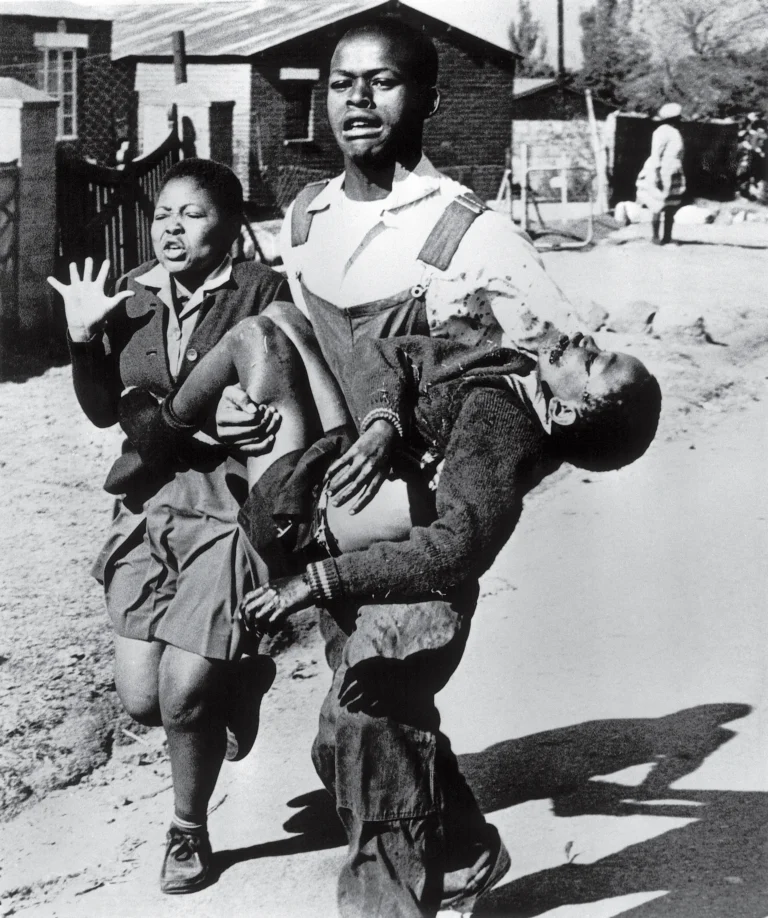
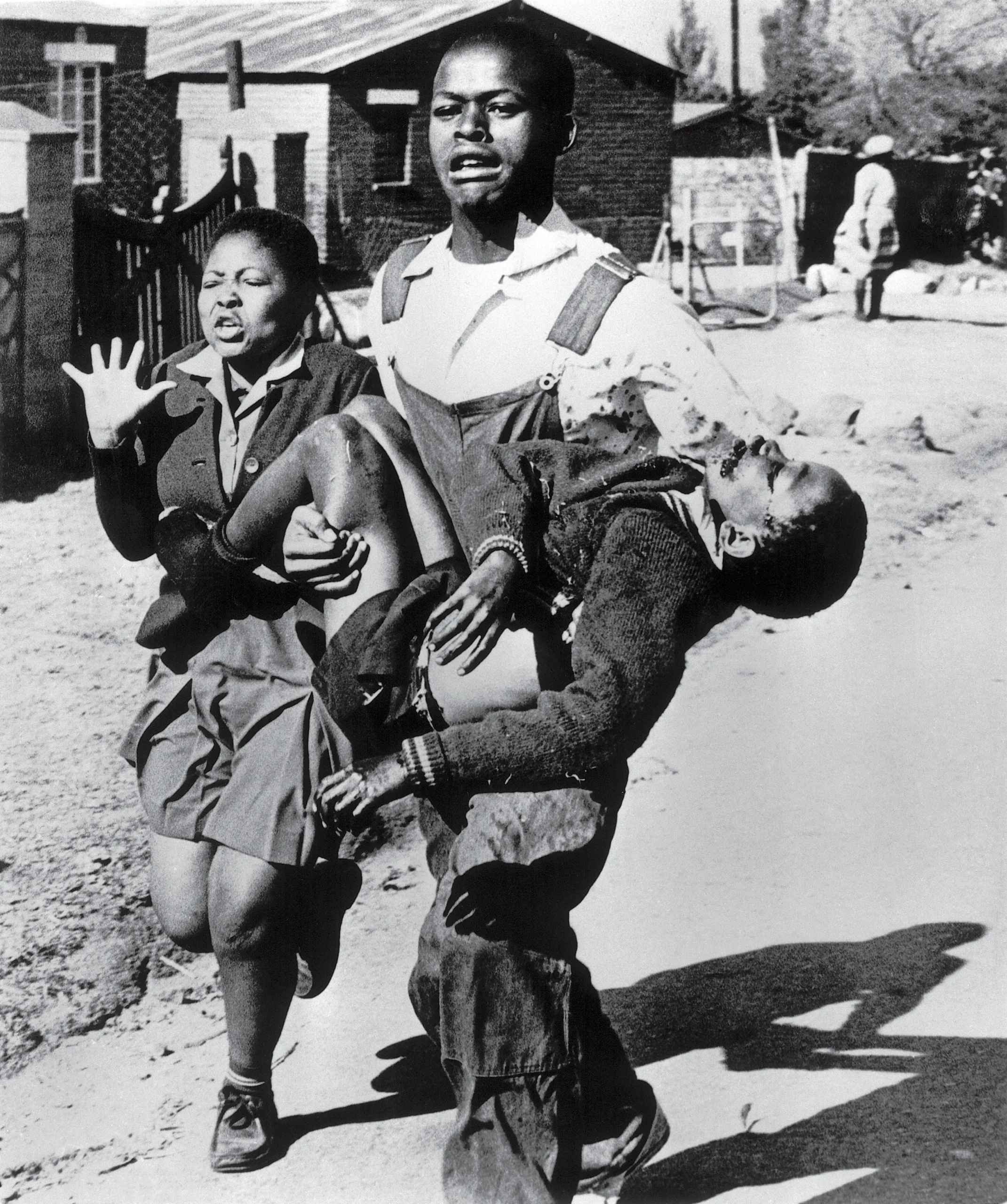
In the morning of 16 June columns of students left schools all over Soweto and headed for Orlando Stadium, at least 10,000 of them when they finally converged. They sang and held placards. “To hell with Afrikaans” read one. In Orlando West they were blocked by police on their way in. The next part is told in different ways. What is not in dispute is that police shot live ammunition into a crowd of children. Among the first shot was 15-year-old Hastings Ndlovu. Shortly afterward, Hector Pieterson was shot dead. Within days Sam Nzima’s photograph of Mbuyisa Makhubo carrying Hector’s body, with his sister Antoinette running alongside, went around the world. Seth Mazibuko, one of the march leaders, who was later jailed for seven years on Robben Island, recalled this year: “The police tear gas blew back on us and the students used stones to drive off the police dogs.
By afternoon Soweto was in full revolt. Students set fire to offices and vehicles of the West Rand Administration Board, which Pretoria had ordered to be self-sufficient, and the board’s beerhalls, whose profits from liquor sales largely supported the Bantustans. Melville Edelstein, a welfare official who had worked for years in Soweto, was beaten to death . The government deployed armored vehicles and helicopters. Prime Minister John Vorster said the violence had been planned and Police Minister Jimmy Kruger moved to ban gatherings held out of doors.
Within days the revolt spread to Alexandra, Kagiso, Tembisa and the East Rand, and by August to Cape Town and Port Elizabeth. Demands that began with Afrikaans became demands against apartheid as such. The government’s own Cillié Commission later counted 575 dead and 2,389 injured between 16 June 1976 and 28 February 1977, and found police responsible for 451 of the deaths. But activists have always thought the true toll to be higher.
When the students turned to the workers
The SSRC leaders soon realized that schoolchildren alone could not bring down the state. Between August and September 1976, they had three stay-aways, political strikes in which the workers of Soweto stayed home. On August 4 about 20 000 parents and students attempted to march on John Vorster Square, the police headquarters in Johannesburg, to demand the release of detained students. That day, at least 60 percent of the workforce in the township stayed away. On the first day of the second stayaway, 23-25 August, about three quarters of Johannesburg’s African workers were absent. “It was the biggest strike the city had seen since the early 1960s,” said Noor Nieftagodien, head of the History Workshop at the University of the Witwatersrand. The third, from 13th to 15th September, was the most successful of all. One student pamphlet crowed that the regime and the factory owners had lost their profits The students had made the state and the employers into one enemy.
The state responded by dividing the class it feared. The single-sex hostels, where migrant workers lived cut off from township life, and on contracts that left no room to lose wages, ignored the August call largely. Police and members of the Urban Bantu Council organized hostel men to act as strike-breakers and Inkatha leader Mangosuthu Buthelezi called for vigilante groups to guard property. On 24 August hostel dwellers attacked Orlando West and Meadowlands residents killing several people. This was a mini-rehearsal for the hostel violence that the apartheid state would sponsor on a much larger scale in the early 1990s.
This chapter is not usually found in official celebrations. It showed how far the revolt could go when it got into the workplace, and how deliberately the state worked to divide settled township workers from migrants. In Year of Fire, Year of Ash (1979), Baruch Hirson, a Trotskyist historian who was a political prisoner for nine years, focused on the student-worker relationship in his account of the revolt. The ANC’s later 1976 version left it far less room.
From the uprising to the debt crisis
By 1977 repression had smashed the SSRC. Its leaders were arrested, killed or fled into exile. Steve Biko died in police custody in September 1977, and the Black Consciousness organizations were banned a month later. Thousands of youngsters crossed the borders. Most joined the ANC, which, unlike the Black Consciousness Movement, had the infrastructure, the weapons, and the international backing to absorb them. The ANC set up the Solomon Mahlangu Freedom College (SOMAFCO) at Mazimbu, near Morogoro, in Tanzania in 1978. It was named after an Umkhonto we Sizwe fighter of the 1976 generation who was hanged in 1979. Historian Yasmina Martin’s research details how the exiles used Tanzania’s socialist idea of self-reliance to build an alternative to the Bantu Education they had fled.
Within the country the 1976 generation entered the factories, the new unions and the civic organizations. In 1983 the regime attempted to further divide the oppressed with a tricameral constitution which gave Colored and Indian South Africans separate houses of Parliament and left Africans with nothing but the homelands. The response of more than 500 organizations was the United Democratic Front (UDF). COSATU came later in 1985. By the mid-decade the townships were ungovernable. In July 1985 a state of emergency was declared, which was extended nationwide in June 1986, and under which over 30,000 people were detained, according to South African History Online.
It was debt that finally cornered the regime. Through the late 1970s and early 1980s, South Africa borrowed heavily from Western banks, and increasingly on short terms. By 1985, its foreign debt had reached $24 billion, and much of it was due within a year. In late July 1985 Chase Manhattan declined to roll over its short-term loans to South African borrowers. Anthony Sampson’s account shows that its chairman, Willard Butcher, was concerned about the bank’s exposure after the Latin American debt crisis. His decision was not based on the moral case against apartheid. Other American and European banks followed suit. State President P.W. Botha ruled out any serious reform in his “Rubicon” speech delivered in Durban on 15 August. The rand dropped. On 1 September the government suspended the stock exchange and the foreign-exchange market and placed a standstill on repayment of most of the country’s foreign debt. It is still the only default in South African history.
The standstill did what ten years of protest hadn’t. It convinced the leading sections of South African capital that apartheid was bad for business. 13 September 1985: Anglo American chairman Gavin Relly heads up a delegation to meet exiled ANC leadership at Mfuwe in Zambia. From then on the question was never just the vote. Big business wanted to know if a majority government would let the property, the mines and the banks alone. Some $13 billion of the debt remained frozen and was repaid in installments under an agreement signed in 1987 with the creditor banks. The last payment on the 1985 debt was made by a democratic government on 15 August 2001.
Sanctions piled on the pressure. In 1986, the US Congress overrode a veto by Ronald Reagan to pass the Comprehensive Anti-Apartheid Act, which prohibited new investment and loans, and other governments followed suit. Inflation was still in double figures and the Angolan war was bleeding the budget.
The negotiated settlement
Botha suffered a stroke in 1989 and was replaced by F.W. de Klerk. On 2 February 1990 de Klerk legalized the ANC, the PAC and the South African Communist Party (SACP) . Twenty-seven years and nine days later, Nelson Mandela walked out of jail. Negotiations continued from 1990 to 1993, through state-backed violence in the hostels and townships of the Witwatersrand and Natal which killed thousands and through the assassination in April 1993 of Chris Hani, general secretary of the SACP. On 27 April 1994, South Africa went to the polls and Mandela became its first black president.
Political power shifted to another. Economic power did not. In the interim constitution, the ANC agreed to the protection of private property and an independent Reserve Bank, and Mandela asked apartheid-era governor Chris Stals to stay on for another five years. In December 1993, months before the election, the Transitional Executive Council agreed to a $850 million loan from the International Monetary Fund (IMF). The economist Sampie Terreblanche saw its letter of intent as a first draft of the policies the ANC adopted in 1996. The new government inherited the debt of the regime too. Jubilee South Africa, established in 1998, estimated the apartheid debt at R86.7 billion in 1993 and demanded it be written off as odious debt, borrowed by an illegitimate regime to oppress the people now being asked to pay it. Its slogan was “Won’t pay apartheid twice!”. The government paid, however. Brian Ashley, who was then national organizer of the campaign, argues that the sheer size of the debt helped convince wavering ANC leaders that there was no option but austerity.
The government replaced the redistributive platform on which it had campaigned, the Reconstruction and Development Program (RDP), with Growth, Employment and Redistribution (GEAR) in 1996. GEAR was structural adjustment without the IMF: cuts in the deficit, privatization, trade liberalization and wage restraint. Black Economic Empowerment then handed over shares and board seats to a small, politically connected Black elite, but left the ownership structure unchanged. The story is in Cyril Ramaphosa’s career. In 1974 and again in 1976 he was jailed, this time for 11 months and then for six months, as a student activist and later founded the National Union of Mineworkers. Police killed 34 striking platinum miners at Marikana in 2012 and he was a director and shareholder of Lonmin. He is now President of the Republic.
What remains owed
The students of 1976 wanted a decent education, and the end of a system designed to keep them down. They got the franchise in 1994. The economic demand that propels their march remains unsatisfied. Statistics South Africa said two in three South Africans, 66.7 per cent in 2023, lived below the upper-bound poverty line of R2,635 per person per month. The official jobless rate was 33.7 percent in the third quarter of 2026, and 44 percent when discouraged job seekers are counted. It was 47.3 per cent for those aged 15 to 34 and over 60 per cent for 15 to 24s earlier this year. The country’s Gini coefficient, 0.63 at the World Bank’s last measure, is among the highest in the world, and the World Inequality Report 2026 found that the richest 10 per cent own 86 per cent of wealth. Poverty remains overwhelmingly black and concentrated in the former homelands and townships.
For the anniversary, the Associated Press interviewed Young South Africans who identified the same problems: unemployment, poverty, crime and addiction. “Many young people are forced into crime because of poverty,” a 19-year-old visitor to the Hector Pieterson Memorial told the agency. In May 2024, the ANC’s vote share dropped to 40.2 per cent and it now governs in coalition with the Democratic Alliance (DA), the party of big business.
Memory and the Left
The memory of 1976 has been a contested one since 1994. Nieftagodien argues that the de-politicisation of the anniversary is a result of Youth Day concerts and celebrations. Lucy Kernick has demonstrated in a post on the SOAS History Blog, how the ANC incorporated the uprising into its own official history, turning the students into heroes and martyrs of an ANC-led story, rather than political actors in their own right. In fact most of them were black consciousness activists.
The students who started #RhodesMustFall and #FeesMustFall in 2015 explicitly evoked 1976. They also repeated its biggest move. Their anti-outsourcing campaign brought together students and cleaners, gardeners and security guards on their campuses, and several universities rehired those workers on their own payrolls. Both generations, separated by thirty-nine years, saw that a student revolt is most powerful when it links up with the workers.
The lessons for the left, here, go far beyond South Africa. In the past four years, Sri Lanka, Bangladesh and Nepal have been rocked by student-led protests. Soweto shows that such a revolt can break a regime’s legitimacy, while maintaining its economic order. The ANC won the state in 1994 without challenging the property relations of apartheid, and then paid apartheid’s debts out of the budgets that should have rebuilt black schools. Four years after the settlement and after the decisions were made that demand for cancelation came. A Left that wants to honor the children of Soweto must put ownership, debt and the alliance with workers on the table at the beginning of the struggle when the outcome is still open.
[ Sources: Statistics South Africa, Quarterly Labour Force Survey Q1–Q3 2026 and Poverty Trends in South Africa 2006–2023 (2025); South African History Online; Truth and Reconciliation Commission Report, vol. 3; Noor Nieftagodien, “The Soweto Uprising: forging student–worker unity”, Amandla!, 2022; Lucy Kernick, SOAS History Blog, 2021; Yasmina Martin, History Workshop, 2025; John Summa, Multinational Monitor, September 1988; Ben Fine and Vishnu Padayachee, Review of African Political Economy, 2019; Brian Ashley, “Apartheid South Africa as a Case Study for Cancellation of Illegitimate Debt” (CETIM, 2003); World Bank Poverty and Equity Brief, South Africa; World Inequality Report 2026; TIME, 28 June 1976; Associated Press, 15–16 June 2026.]
About the Author


Editorial Board Member of Alternative Viewpoint