Yet another El Niño, after the strong event of 2023–24, has taken hold of the Pacific Ocean – and this time it may emerge as a historically powerful one. Satellite data through the spring tracked a vast pulse of unusually warm water making its way across the Pacific, and on 11 June 2026 the United States National Oceanic and Atmospheric Administration (NOAA) issued its El Niño advisory: the warm phase of the El Niño–Southern Oscillation is officially underway, with conditions expected to strengthen through the Northern Hemisphere winter of 2026–27.
The early consequences are already visible at both ends of the ocean.
Peru has spent the first months of the year reeling from torrential rains, river floods and landslides layered over an unprecedented coastal heatwave. By mid-March, at least 68 people had been killed and close to two hundred thousand affected, with the toll still climbing; in late February the government declared a state of emergency as more than 700 districts were placed under emergency measures, and in Arequipa an air force helicopter evacuating flood victims crashed, killing all fifteen aboard, six of them teenagers and one a three-year-old child. Peru’s own El Niño monitoring commission warns the coastal El Niño pattern could persist through November. And the disaster has once again laid bare the character of the Peruvian state: after decades of warnings, flood defences and drainage remain unbuilt, prevention funds authorised after the 2017 catastrophe were left to gather dust through a decade of presidential turnover and corruption scandals, and working-class and migrant families remain settled along the riverbanks the state never protected. The rains are natural; the deaths are made by a ruling oligarchy that has proven itself unable and unwilling to protect the Peruvian toiling masses.
On the other side of the ocean, India recorded one of the driest Junes since record-keeping began in 1901 – the fifth-driest, by the India Meteorological Department’s count, with 99.5 mm of rain against a normal of 165.3 mm, a deficit of nearly 40 per cent. Of the country’s 36 meteorological subdivisions, 24 recorded deficient rainfall. Madhya Pradesh, the heart of the monsoon core zone, ran a 58 per cent deficit during the month; Maharashtra 85 per cent; Gujarat 84 per cent. Not a single low-pressure system formed over the region in June – the IMD attributes the collapse in rainfall activity in part to the developing El Niño, and notes that the Indian Ocean Dipole, sitting in a neutral phase, could do nothing to compensate. A deficient June is not unusual in itself. It assumes an entirely different significance in a year when the world’s forecasting agencies are converging on the prospect of a super El Niño.
El Niño
El Niño and La Niña are opposite phases of a global ocean-atmosphere phenomenon. El Niño is the warm stage of a natural climate cycle in the tropical Pacific called the El Niño–Southern Oscillation (ENSO). It typically occurs every two to seven years and lasts nine to twelve months, altering ocean temperatures and disrupting wind and rainfall patterns across the tropics. Because the Pacific is the world’s largest ocean, these shifts trigger climatic impacts across the globe.
Normally, trade winds blow steadily from east to west along the equator, pushing sun-warmed surface water toward the western Pacific, near Indonesia and Australia. This westward flow allows cold, nutrient-rich water from the deep ocean to rise to the surface along the coast of South America, the upwelling that sustains some of the most productive fisheries on Earth.
An El Niño event breaks this pattern. The trade winds weaken or even reverse. The warm surface waters normally confined to the western Pacific slosh back eastward and pile up along the coasts of South America. The upwelling of cold, nutrient-rich water is suppressed, coastal marine ecosystems collapse, and the effects extend far beyond the Pacific. Warmer sea surface temperatures reorganise atmospheric circulation, including the jet streams that steer storms across the continents. Depending on its intensity, an El Niño can produce weather extremes of drought and deluge and elevated temperatures over much of the planet: heightened drought risk across South and Southeast Asia, northeastern South America, Australia and southern Africa, with destructive excess rainfall elsewhere. In either case, the normal patterns on which agriculture and daily life depend are thrown into disorder.
Super El Niño
Each El Niño is unique in its evolution and impacts, but some are especially intense. These are the super El Niños, extreme versions of the same event, occurring when Pacific temperatures in the key monitoring region rise roughly 2 degrees Celsius or more above the long-term average. They amplify weather extremes across the globe far beyond what ordinary episodes produce.
Only three events since 1950 have reached that intensity: 1982–83, 1997–98 and 2015–16, each peaking at around 2.4 to 2.5 degrees above average. The forecasts now suggest 2026–27 may join them. NOAA puts the probability of a very strong El Niño this coming winter, one that would rank among the largest events in the record going back to 1950, at 63 per cent. In the mid-June multi-model forecast compiled by Columbia University’s International Research Institute for Climate and Society, thirteen of twenty-four models project a very strong event at the season’s peak. The US Geophysical Fluid Dynamics Laboratory reports that every member of its thirty-member forecast ensemble now produces a peak strength at least competitive with the strongest events of the past century; the signature, in its words, of a historically strong event already underway. The World Meteorological Organization’s Secretary-General, Celeste Saulo, has warned that the strengthening event will intensify the chances of drought and heavy rainfall, and raise the risk of heatwaves both on land and in the oceans; Columbia University atmospheric scientist Michael Tippett puts it more bluntly: depending on the model, the forecasts are now “close to unprecedented.”
UN Secretary-General António Guterres warned as early as 2023 that El Niño conditions would “pour fuel on the fire of a warming world”; and that the impacts of a warming climate would hit harder, travel farther, and cross borders with devastating speed. Three years on, that warning describes the present.
How this El Niño was born
This El Niño did not arrive unannounced. Through 2024 and 2025, unusually strong trade winds had piled up a pool of warm water in the western Pacific deeper and hotter than anything previously measured. By late 2025, the ocean buoys strung across the equatorial Pacific began recording small pulses of heat escaping eastward, the fingerprint of weakening trade winds.
Then, in the first half of April 2026, a rare alignment occurred. Amid a powerful westerly wind burst along the equator, three tropical cyclones straddled it simultaneously: Maila and Vaianu in the South Pacific, and Super Typhoon Sinlaku in the north, the strongest storm on Earth so far this year, which struck the Mariana Islands on 14 April as a Category 4 storm with sustained winds near 240 kilometres per hour. Because storms south of the equator spin clockwise and storms north of it spin anti-clockwise, the equator-facing flank of each cyclone pushed in the same direction, against the trade winds, and the storms and the wind burst reinforced one another, briefly reversing the normal flow and releasing an avalanche of warm water that had been held back in the western Pacific.
Through April and May, this vast pulse : a downwelling Kelvin wave whose subsurface warm anomaly some analysts rated the strongest on record, at 6 to 7 degrees Celsius above normal – slid eastward across the ocean, depressing the thermocline off South America and shutting down the cold upwelling. Temperatures in the Niño 3.4 monitoring region climbed steadily: the anomaly stood at +0.48 degrees over March–May, reached +0.94 in May, and by the week of 17 June had hit +1.7 degrees. On 11 June, NOAA declared the planet had tipped into an El Niño state. The system has shown no sign of slowing since.
Global heating and El Niño amplify each other
Many factors shape the weather of any particular year, but the accelerating heating that the scientific literature labels “anthropogenic” – as though humanity in the abstract, rather than fossil capital, had done the burning – is unambiguous, and the consequent rise in ocean temperatures is well documented. The term deserves a correction the science itself supports: this heating is capitalogenic. Roughly a hundred fossil fuel corporations account for some 70 per cent of industrial emissions since 1988; the richest tenth of humanity for around half of all current emissions; the Global North for the overwhelming share of the historical excess. It was not the anthropos that fired the boilers. This El Niño is arriving on a planet hotter than at any point in the instrumental record, drawing on an ocean charged with excess energy accumulated over two centuries of fossil capitalism. Scientists warn that the combination could push the planet into another phase of record-breaking global temperature – likely carrying the global average temporarily past the 1.5 degree threshold of the Paris Agreement – with everything that follows from it. Some researchers suggest that as the planet warms, super El Niños will become more frequent, threatening a self-reinforcing feedback that accelerates warming further.
Europe has just demonstrated what the baseline already looks like – before the El Niño adds its heat on top. In the last week of June, a Saharan heat dome pushed temperatures across the continent past 40 degrees, setting national records in Germany and Poland and giving France its hottest day ever measured. A preliminary rapid analysis by climate scientist Christopher Callahan of Indiana University estimates 20,390 heat-related deaths across Europe between 22 and 28 June – around 5,200 in France, 4,500 in Germany, 3,200 in Spain, 2,700 in Italy. The estimate is a modelled one, not yet peer-reviewed; the official excess-mortality counts, which always lag, have already confirmed 2,025 excess deaths in France alone – the country’s worst heat mortality since 2003. The WHO’s Director-General called heat a “silent killer” and noted that Europe is the fastest-warming continent on Earth, heating at twice the global average.
Two findings from this body of work deserve particular attention in India. First, heat kills quietly – through cardiac, renal and respiratory stress, not spectacle – and days above 40 degrees raise weekly mortality rates by more than 6 per cent compared with mild days. Second, and more ominously: Callahan’s peer-reviewed research in Nature Climate Change has shown that mass heat mortality at these scales is “not substantially reduced by climate adaptation currently observed across Europe” – there are hard limits to how much adaptation can achieve as extreme temperatures keep rising. Europe invested two decades in cooling centres and early-warning systems after the 2003 catastrophe. Twenty thousand people may still have died in a single week. Adaptation is necessary. It is not sufficient. Only ending the heating itself is.
What history tells us
The strongest El Niño in the instrumental record remains that of 1877–78 – an event Mike Davis, in Late Victorian Holocausts, places at the centre of what he called arguably the worst environmental disaster ever to befall humanity. Disrupted monsoon circulation produced persistent, severe droughts and sporadic floods across India, China, Brazil and Africa through 1876–78, 1896–97 and 1899–1900, and the resulting waves of famine are estimated to have killed between 30 and 60 million people, while hundreds of millions more endured hunger, social upheaval and political unrest.
India was hit the hardest. Consecutive monsoon failures triggered the Great Famine of 1876–78, which affected more than 58 million people across southern and central India. And the mass starvation was not a natural event: the British colonial administration prioritised grain exports over the lives of the Indian population, and continued exporting even as millions starved. Davis records that during the famine of 1899–1900, Berar province exported tens of thousands of bales of cotton and nearly three-quarters of a million bushels of grain in the very year that 143,000 of its people died directly of starvation – a year in which life expectancy at birth in the province fell below ten years. Colonial policy converted drought into holocaust. India never fully recovered from the scars of that era.
The pattern has repeated, in gentler but recognisable form, ever since. Between 1951 and 2022, around 60 per cent of El Niño years brought below-average rainfall to India. Of the 21 El Niño years since 1950, 15 coincided with drought conditions, and 10 of India’s 15 major droughts in that period were associated with El Niño. During strong or moderate events, the probability of below-normal rainfall approaches 70 per cent.
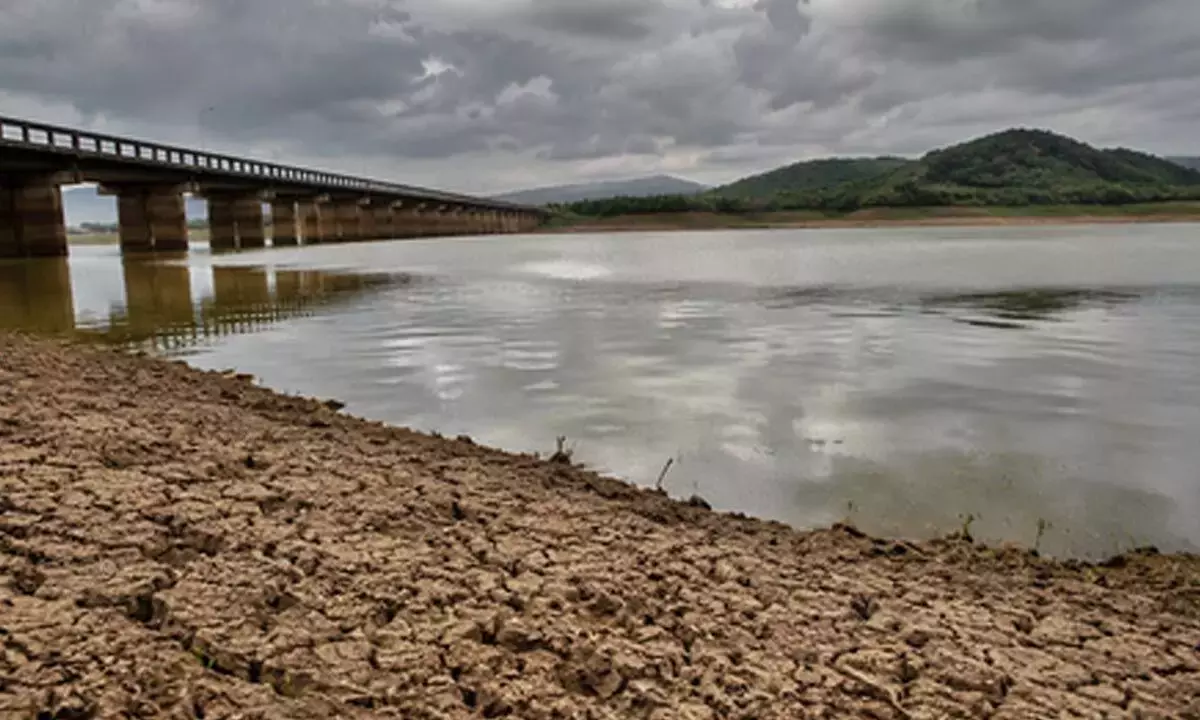
And the last super El Niño showed what a deficit percentage means on the ground. By the summer of 2016, after a third consecutive failed monsoon, the dams of Marathwada had fallen to single digits of live storage. A special water train, the Jaldoot Express, began running 343 kilometres from Miraj to Latur on 11 April 2016 – ten tanker wagons at first, then fifty – delivering some 24 crore litres of drinking water by the end of July to a region whose need dwarfed it. Section 144, the colonial-era prohibition on assembly, was imposed around water distribution points to prevent riots at the tap – the first time it had ever been invoked for a drought – and villages resisting the diversion of their reservoirs to Latur watched tankers move under police protection. And while a region rationed drinking water, the state hosted IPL cricket matches whose pitches were to consume an estimated six million litres – until, in response to public fury and a citizens’ petition, the Bombay High Court condemned the “criminal wastage” and ordered every match after 30 April out of Maharashtra, final included. A drought, it turned out, is not merely an absence of water. It is a struggle over the water that remains – and that struggle is settled by class.
The historical record also shows that not every El Niño year produces a failed monsoon. Other factors, above all the Indian Ocean Dipole, can counterbalance its influence: in 1997–98, a strong positive dipole largely shielded India from a super El Niño that devastated much of the rest of the tropics. This year, the dipole was neutral through June – absent precisely when the monsoon’s first act collapsed. Forecast models suggest a positive dipole may yet develop in the latter half of the season; whether it arrives in time, and with sufficient strength, is an open question on which a great deal now rides. And in any case the seasonal total is not the only thing that matters. Delayed onset, prolonged breaks and erratic distribution – all characteristic of El Niño years – can destroy a crop even in a season whose arithmetic ends up looking merely “below normal.”
India vulnerable
A weak monsoon triggered by the developing super El Niño poses one of the gravest risks to India, because the southwest monsoon is not merely a weather event. It is a key driver of the economy. The monsoon delivers nearly 70 per cent of India’s annual rainfall; nearly two-thirds of cultivated land is rain-dependent; roughly 60 per cent of farmers depend entirely on monsoon rains for the kharif season. Agriculture contributes about 18 per cent of GDP and provides livelihoods to nearly half the population – and it remains structurally dependent on the monsoon, as much as it was in colonial times. The country is no longer under colonial rule. The vulnerability of its agriculture is structurally unchanged.
El Niño attacks the monsoon at every stage. The monsoon winds lose their driving strength; the rain system stalls and advances late; and even after onset, El Niño induces abnormally prolonged monsoon breaks – weeks with little or no rain that bake the topsoil dry. Deficient rains lower soil moisture and threaten yields of rice, pulses, oilseeds, sugarcane, coarse cereals, soyabean and cotton. Nor does the timing offer comfort: El Niño events typically build strength as the season progresses, so that August and September – when the standing kharif crop is most vulnerable, just before harvest – frequently see the sharpest deficits. The IMD has already forecast a season at just 90 per cent of the long period average, with a 60 per cent chance of an outright deficient monsoon. Nor is the danger confined to kharif: the rabi crop now produces almost as much as kharif, and the same El Niño conditions that starve the monsoon can bring the unseasonal rain and heatwaves that destroy wheat, rapeseed and onions in the winter fields. In that case, existing food security challenges could sharply worsen.
The rural transmission chain from failed rain to human catastrophe is well mapped. When the rains fail, the farmer makes the only rational choice available: he borrows to dig the borewell deeper and keep the crop alive one more season. When the second harvest also fails, the loan defaults. Crop insurance under the Pradhan Mantri Fasal Bima Yojana covers roughly a third of the country’s cropped area – even after what the government celebrates as record enrolment in 2024–25; the majority of the peasantry absorbs the loss as private debt. Marathwada alone recorded over 1,100 farmer suicides in 2015, with 339 more across Marathwada and Vidarbha in just the first three months of 2016; Maharashtra’s toll that year – 3,661 – was the state’s highest in fourteen years. Debt, shame, and heat that destroys sleep – these are the ingredients of that statistic, and a super El Niño assembles them all at once.
This year, imperialist war converges directly with the climate shock. When US-Israeli strikes on Iran closed the Strait of Hormuz at the end of February, roughly a third of the world’s seaborne fertilizer trade was choked off – daily transits through the strait collapsed by over 95 per cent within weeks. The Gulf states account for some 43 per cent of seaborne urea exports, and unlike the 2022 crisis, cargo trapped behind this chokepoint cannot be rerouted. Urea prices rose above 850 dollars a tonne by April – an 80 per cent jump in two months, the highest since 2022 – and the World Bank projects them nearly 60 per cent higher across 2026 even as an uneasy April ceasefire allows a slow, partial reopening. Iran halted ammonia production; Qatar’s damaged facilities stopped producing urea altogether; and India, one of the world’s largest fertilizer importers and heavily dependent on Gulf supplies, was simultaneously forced to curtail its own urea and ammonia production for want of Gulf gas. The timing could hardly be crueller: fertilizer demand for the kharif season peaks in exactly the months the El Niño is strangling the monsoon. The Indian peasant is squeezed from both ends at once – deficient rains cutting yields, war-inflated input prices cutting margins – while food inflation, already stoked by oil prices that briefly crossed 120 dollars a barrel, bears down on the working-class consumer. Imperialist war and climate breakdown are not parallel catastrophes; they are joint products of the same order, and they are converging on the same people.
The contradiction extends into the power system. El Niño years slash hydropower generation just as air-conditioning demand drives the grid to record peaks – and the coal plants that fill the gap need river water for cooling, in a year when the rivers run low, forcing states to arbitrate between the reservoir water farmers need for food and power plants need for electricity. The air conditioner itself is a small emblem of the whole arrangement: it cools the propertied household while dumping its exhaust heat onto the street, where the delivery rider, the construction worker and the vendor have no choice but to labour. Heat stress already costs India hundreds of billions of potential working hours a year, and the ILO projects the country will lose the equivalent of 34 million full-time jobs to it – more than any nation on earth. The heaviest load falls on rural women, some 80 per cent of whom work in agriculture: as the water table falls, their paid farm hours shrink while their unpaid hours fetching water lengthen.
Water security is threatened across the board. India is already severely water-stressed, its groundwater levels already alarming, and this El Niño will strain the management of water for drinking, irrigation and industry across large parts of the country, potentially affecting hundreds of millions who depend on rainfall for agriculture and daily use.
The health consequences follow the same class gradient. Heatwaves and rising humidity are deadly for outdoor workers and the elderly; warm nights above 30 degrees deny the body its overnight recovery, and cardiac and renal stress accumulates. The toll is already registering: Andhra Pradesh alone logged around 325 suspected heatstroke cases between 1 March and 19 May, before the summer’s peak. Extreme heat widens the range of vector-borne diseases; drought pushes rural populations toward contaminated water sources, and dengue, cholera, typhoid and diarrhoeal disease spike. Air pollution remains a year-round burden. All of this presses on an underfunded public health system – while food inflation and rural distress compound the mental and physical health risks of the most vulnerable. Communities that were already struggling will be pushed beyond their limits.
What the state is doing
It would be inaccurate to say the government is doing nothing. After NOAA’s declaration of 11 June, the agriculture ministry went into visible motion: 315 vulnerable districts identified with ICAR, of which 111 with irrigation coverage below 25 per cent are classed high-priority, concentrated across Madhya Pradesh, Maharashtra, Gujarat, Uttar Pradesh, Rajasthan, Karnataka, Bihar, Jharkhand, Telangana, Andhra Pradesh and Odisha. A national El Niño Monitoring Cell and a Crop Weather Watch Group have been established; advisories are to flow through 731 Krishi Vigyan Kendras; fodder-transport plans are being prepared; the Home Minister has chaired review meetings on agriculture, water and power; and the agriculture minister has set a kharif foodgrain target of 176 million tonnes while assuring farmers there is “no need for fear.”
But look closer, and the response indicts itself.
The district contingency plans now being hurriedly “updated” had sat unrevised for a decade – through the super El Niño of 2015–16 that emptied Marathwada’s dams, and through the drought year of 2023. Only after NOAA declared the event underway did the ministry rush to overhaul them, placing 150 to 200 districts on priority watch. That is not preparedness; it is the definition of governance by crisis management.
At the very review meetings convened to prepare for deficient rain, the minister pressed for expanded acreage under cotton – a water-hungry cash crop – under a failing sky. This is the same official logic that feeds the ethanol programme: the state itself marches the peasant toward the borewell and the moneylender.
The ministry assures the country that supplies of urea and DAP are “sufficient” for the season. What the assurance conceals is the price of that sufficiency: with the Gulf’s urea trade strangled and India importing roughly 90 per cent of its fertilizer raw materials, every tonne now costs more to procure and more to subsidise. The fertilizer subsidy bill – already around 50 billion dollars a year, exceeding the entire budget of the agriculture ministry – is set to climb further, a fiscal burden that will be recovered, as always, from spending on the poor. The danger has shifted from outright shortage to the cost of guaranteeing supply – and to the question of who ultimately pays it.
And the centrepiece of “financial protection” is the expansion of a crop insurance scheme that, even at record enrolment, covers roughly a third of the cropped area – the very gap through which crop failure is converted into private debt, and debt into the suicide statistics.
Above the entire apparatus hangs a legal absurdity that measures the state’s seriousness better than any press release: heat is still not a notified disaster under the Disaster Management Act of 2005. Floods, cyclones and earthquakes unlock statutory relief funds; the hazard that kills quietly, by the thousands, in the country that dominates the world’s heat rankings, unlocks nothing. Two decades of deepening heatwaves have not moved the government to amend a two-decade-old law – an omission that leaves heat deaths uncounted in any systematic way and heat relief a matter of administrative discretion rather than legal right.
Meanwhile the Central Water Commission’s own data shows reservoir storage falling from 71 billion cubic metres (38.7 per cent of capacity) on 30 April to 63 billion cubic metres (34.5 per cent) by mid-May – roughly 8 billion cubic metres lost in two weeks, heading into a predicted deficient monsoon.
What would serious preparation look like? A budget line for resilience on a multi-year horizon. Risk maps for heat, groundwater, agriculture, infrastructure and energy for every district and block. Heat-health early-warning systems that reach the outdoor workforce, not just the newspapers. Protection of farmers through late-sowing and drought-tolerant seed varieties, water conservation and micro-irrigation, and the restoration of the natural water bodies that once carried villages through failed monsoons. Early warning is crisis management; a climate-resilient India requires proactive, structural measures – and none of it can be achieved by administration alone, without civil society and the mass of citizens. The government’s actual response contains fragments of this list. What it lacks is the thing that would make the fragments cohere: a state whose own project were not deepening the very vulnerabilities it now scrambles to manage.
Climate denialism
Which raises the billion-dollar question: how can a government led by a prime minister who does not believe in climate change be an ally in the fight against extreme weather?
It must not be forgotten that Prime Minister Modi has denied climate change for years. Recall his answer to schoolchildren in 2014: “Climate has not changed. We have changed. Our habits have changed. Our habits have gotten spoiled. Due to that, we have destroyed our entire environment.” Or his musing, in an interview with The Hindu: “Climate change? Is this terminology correct? … They say this time the weather is colder. And, people’s ability to bear the cold becomes less.”
This view is nourished by a stream of misleading climate-denial commentary, including the wishful claim that India is somehow spared from global heating. The trick depends on the choice of dataset: in maps of year-to-year annual temperature trends, India can appear to be warming less than other regions, or even cooling in patches. Examine the record season by season – the pre-monsoon heat, the failing winters – and the crisis is undeniable. On 19 May this year, India monopolised the entire global list of the hundred hottest cities, with Delhi entering the ranking in 99th place; three days later, all fifty of the world’s hottest cities – and 97 of the hottest hundred – were still inside India, with Balangir in Odisha touching 48 degrees.
This is not the moment for futile debates with deniers over whether India will be spared. A country that intends to survive extreme weather cannot afford to misjudge either natural climate variability itself or its exacerbation by global heating – in every season.
Authoritarian extractivism
But the problem runs deeper than denial, and deeper than the familiar institutional markers of India’s authoritarian slide – the weakened courts, the captured media, the police impunity, the shrinking civic space. Those markers illuminate how coercive power is consolidated. They do not tell the whole story. For fascism does not express itself only in nationalist rhetoric, the persecution of minorities and the hollowing of democracy; it expresses itself in how it materially transforms land, water, forest and energy. And here lies the deepest indictment: the same state that must now manage a super El Niño has spent a decade manufacturing the very vulnerabilities the El Niño will exploit – draining the aquifers, felling the forests, and fragmenting the social solidarity on which disaster survival depends.
India under the BJP has intensified a system of authoritarian extractivism that dispossesses marginalised communities behind a rhetoric of Hindu civilisational ascent. The far right adds an identity grammar that transforms technical projects into moral imperatives: development becomes proof of civilisational destiny; dissent becomes disloyalty not merely to the state but to the Hindu nation; and specific groups – Adivasis who resist, Muslims labelled “outsiders” on contested land – are marked as impediments to national destiny. This identity-centred justification expands the moral licence for coercive extraction. And so everything that serves corporate interests – deforestation, legal and illegal mining, land grabbing, limitless water extraction, water-intensive monoculture, eviction by bulldozer – proceeds unchecked.
Consider the forests. According to global analyses of the 2015–2020 period, India lost approximately 668,400 hectares of forest cover – the second-largest total loss in the world, behind only Brazil – and topped the global chart for the biggest increase in deforestation compared with the 1990s. In 2025 alone the country lost roughly 140,000 hectares of natural forest, releasing some 63 million tonnes of carbon. Forests fall to coal mines, highways and mega-projects like Great Nicobar; the northeastern states of Assam, Mizoram and Arunachal Pradesh have borne some of the heaviest losses.
Consider the water. India ranks thirteenth among the most extremely water-stressed countries. Over 600 million Indians face high to extreme water stress. The country placed 120th of 122 countries on a global water quality index; some two lakh people die annually for want of safe water. Twenty-one cities, including Bengaluru, Chennai, Hyderabad and Delhi, have been identified as potential “day zero” cities, and 12 per cent of the population already faces recurring day-zero conditions. India extracts a quarter of the world’s groundwater – more than any other nation – consuming almost 60 per cent of its non-renewable groundwater every year, with some states extracting over 150 per cent of their natural recharge.
Against this backdrop, the government’s ethanol-blending programme is deliberately deepening the crisis. Since April this year, every litre of petrol dispensed in India contains up to 20 per cent ethanol – a target originally set for 2030 and pushed forward – and for years the Modi government has aggressively scaled up production in full knowledge of its water cost. A single litre of ethanol from rice carries a water footprint above 10,000 litres; from maize, about 4,670 litres; from sugarcane, around 3,630 – and its manufacture generates 8 to 15 litres of toxic effluent (vinasse) per litre produced, poisoning soil and village wells where untreated. Much of this production is concentrated in regions already facing severe water shortage, such as Maharashtra and Uttar Pradesh. And the food-versus-fuel arithmetic is explicit: the government allocated 52 lakh tonnes of rice for ethanol in 2024–25, is targeting 90 lakh tonnes in 2025–26, and plans to fund the diversion partly by cutting the share of broken rice in the public distribution system from 25 per cent to 10 – grain taken from the plates of the poor and burned in petrol tanks. Rising blending targets lock in further extraction, monoculture, biodiversity loss and food-security risk.
And now a new claimant on the water has arrived: the data centre. India’s digital ambitions are growing at breakneck speed – capacity reached 1.5 gigawatts by the end of 2025, and Deloitte projects 8 to 10 gigawatts by 2030, a six-fold expansion sweetened by a Union Budget tax holiday for foreign operators running until 2047. Everyone speaks of the electricity that powers the internet; almost no one speaks of the water. By the Council on Energy, Environment and Water’s estimate, a typical 100 MW hyperscale data centre consumes around 20 lakh litres of water every day for cooling; India’s data centres drew nearly 150 billion litres in 2024–25, projected to rise to around 358 billion litres by 2030 – and more than 65 per cent of existing capacity sits in Mumbai, Chennai, Hyderabad, Bengaluru and Noida, cities already under water stress. Karnataka’s own IT minister told the state assembly that every megawatt of data centre capacity requires roughly 2.5 crore litres of water a year. There is even a direct El Niño multiplier: most Indian facilities use evaporative cooling, which consumes more water precisely as temperatures rise – and El Niño years are heatwave years. In an already water-scarce country, the data-centre boom is intensifying a fundamental, physical resource crisis – in the name of a digital future.
This is what it means to say the state is manufacturing the disaster it claims to manage. The El Niño will not strike a resilient country weakened by bad luck. It will strike a country whose aquifers have been mined for fuel blending, whose forests have been cleared for capital, and whose reserves – hydrological, fiscal, social – have been systematically spent.
Conclusion
Climate disasters are not equal-opportunity events. Marginalised groups and the toiling masses carry the highest burden of climate risk: they are the most dependent on rain-fed agriculture, hold the smallest plots, and have the least access to credit, relief and climate-resilient infrastructure. In India, social discrimination guarantees that Dalits, Adivasis, minorities and the low-income working class – the people least responsible for the crisis – will absorb its heaviest blows.
And the RSS’s politics of hatred and “othering” has prepared the ground for the crisis to metastasise. Indian villages and urban neighbourhoods historically survived crop failures through cross-community cooperation – shared tanks, shared labour, shared grain. Polarisation destroys precisely this social capital. In a communally divided polity, emergency relief, water distribution and subsidies run a high risk of flowing along political and identity lines, leaving the most vulnerable entirely exposed; and severe scarcity – a failed water supply, soaring food prices – becomes raw material for bad actors to convert desperation into communal conflict rather than collective survival. A fragmented society under a communal and opaque administration will not distribute the burdens of a super El Niño equitably. It will multiply them.
Minimising the catastrophe therefore requires more than meteorology. It requires climate policy deliberately fused with social justice: relief and procurement systems – FCI grain operations, MGNREGS employment guarantees – depoliticised and operated universally, without communal bias; State Action Plans on Climate Change that actively incorporate tribal welfare and minority development rather than structurally excluding them; the restoration of traditional village water bodies and support for climate-resilient cropping – millets, pulses – that allows communities to adapt below the level of polarised macro-politics; and legal frameworks for climate justice that ordinary people can actually invoke.
None of this is on offer from the present dispensation. The ruling classes across the world, riding the global upsurge of the far right, remain fixed on indiscriminate extractivism, perpetual war for profit, greenwash, and the ruthless suppression of the working class. They have done nothing to arrest global heating, and they are unwilling and unprepared to face the catastrophe now gathering in the Pacific. India is no exception. The El Niño of 1877 met a colonial state that exported grain past starving villages. The El Niño of 2016 met a neoliberal state that watered cricket pitches while Latur queued at the tap. The El Niño of 2026 arrives to meet a communal-corporate state that has spent a decade selling the ground from under its own people. The storm is natural. What it finds upon landfall is not.
About the Author


Debajit Chanda
Editorial Board Member of Alternative Viewpoint.