The World Bank Rediscovers the State in East Asia and the Pacific – but Not the Monopolies That Own the Digital Economy It Tells the Region to Join
Few ideas have been rehabilitated as quickly, or as quietly, as industrial policy. For most of the late twentieth century, governments across the Global South were told that development turned on getting prices right, liberalising trade, privatising public enterprises and integrating into world markets. Industrial policy, selective intervention, planning, strategic support for chosen sectors, was cast as an invitation to inefficiency and capture. East Asia’s own history embarrassed that story, but never quite displaced it. The region was admired and then set aside as a special case, too particular to generalise; an exercise in what Robert Wade memorably called the Bank’s “art of paradigm maintenance”.
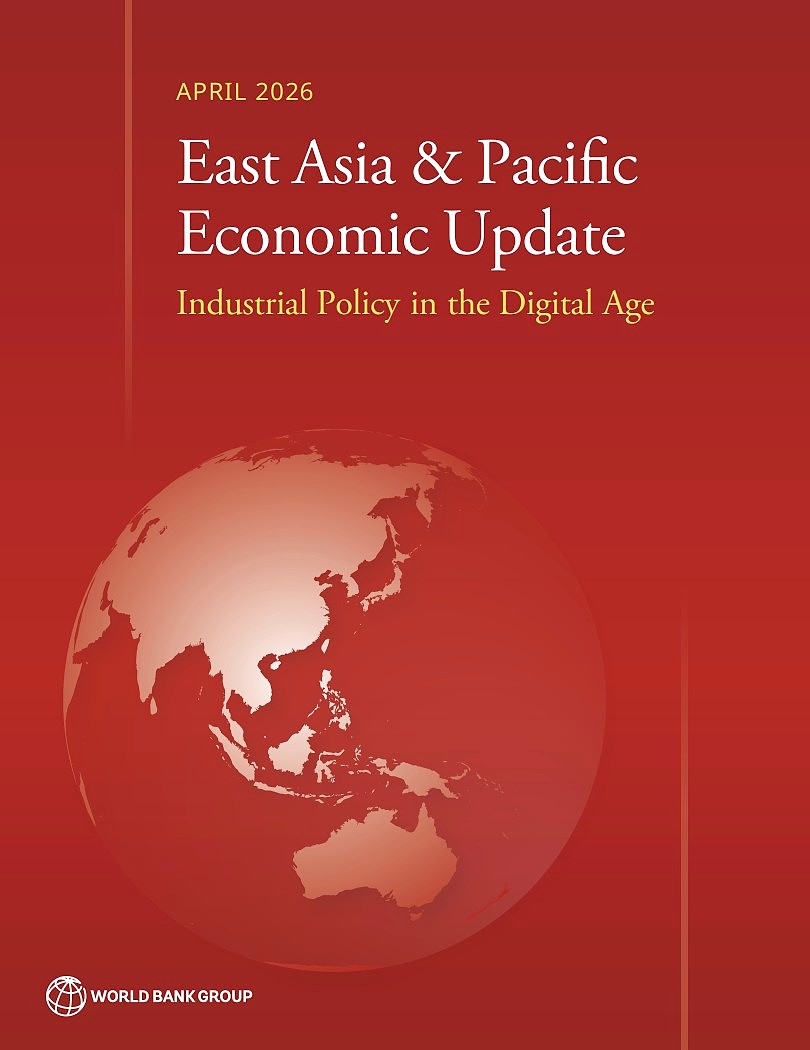
The World Bank’s East Asia and Pacific Economic Update 2026: Industrial Policy in the Digital Age is the sound of that orthodoxy conceding. An institution that spent decades warning against directing production now argues that industrial policy has become indispensable to structural transformation. Governments, it says, must build productive capabilities, invest in digital infrastructure, coordinate innovation and steer technological upgrading if the region is to keep growing in an age of artificial intelligence, geopolitical fragmentation and climate disruption.
The report deserves close reading all the same, not because the institution has had a change of heart, but because the manoeuvre is executed with skill, and skill of this kind is informative: what an institution concedes maps what it fears, and what it withholds maps what it protects. The Bank’s economists are able, and the historical shifts they describe are real; what the institution does with their work is another matter, and it is the matter of this essay. Read through capability, productivity and institutional quality, the obstacles to development become things a country lacks and must build. The ownership of technology, the structure of finance, the distribution of what productivity produces, the weight of debt – the relations, in short, rather than the attributes – stay outside the frame. That framing is not an oversight awaiting correction in the next edition. It is, as we shall see, the design: the report widens what the state may do precisely so as to leave untouched the world within which it must do it.
Why Industrial Policy Came Back
Whether industrial policy can work was never really the open question. The evidence that states can direct investment, discipline firms and force the pace of transformation has been on the table since Amsden and Wade wrote it up three decades ago, and the Bank managed to look past it then. So the puzzle is one of timing, not proof. Nothing in the economics changed to produce this conversion; what changed is the world, and the Bank’s place in it – and on the world, at least, the report is genuinely perceptive.
The conditions of industrialisation have shifted under everyone’s feet. For decades, a recognisable ladder existed: enter labour-intensive manufacturing on the strength of cheap labour, attract export-oriented investment, join global production networks, and climb gradually into more sophisticated activities. Japan, then South Korea and Taiwan, then coastal China appeared to confirm the sequence. That ladder is now being pulled up. Robotics, automation and artificial intelligence are eroding the advantage of abundant low-cost labour. Value is migrating from assembly toward software, semiconductor design, cloud computing, research and intellectual property. Manufacturing remains indispensable, but it has become more capital-intensive, more knowledge-intensive, and more deeply fused with digital infrastructure controlled from a handful of centres.
Three further shifts compound the technological one. Geopolitical rivalry has made trade inseparable from national security: decisions about chips, critical minerals and telecommunications are now strategic before they are commercial. Climate change has moved from an external environmental cost to a determinant of industrial strategy itself; a source of new “green” value chains and, for much of the region, of existential danger. And demographic divergence pulls the region in opposite directions, with Japan, South Korea and China ageing while others still absorb young workforces.
There is also the matter of the Bank’s own standing. Borrowing governments in this region can now go to Chinese policy banks, the AIIB or a widening circle of regional lenders – with the BRICS New Development Bank beckoning at the edge of the frame, as Indonesia’s accession talks show – and the intellectual monopoly the Bank once held over “what development require” has eroded along with the financial one. A doctrine nobody is obliged to buy has to be updated. Seen from that angle, the report is a self-portrait as much as a prescription: an institution revising its catechism for a world in which its old certainties have thinned and the costs of three decades of market-led globalisation have become too visible to wave away. Industrial policy returns not because history repeated itself, but because history changed.
This much the report registers accurately, an institution watching its franchise erode has every incentive to read the weather well. The difficulty begins with what it does with the reading.
The Domestication
Set beside the caricature of the “minimal state” the report’s ambitions look expansive. It insists that markets alone no longer generate technological upgrading, that innovation and learning require deliberate public action, that education, digital infrastructure, research institutions, logistics and regulatory quality are all productive assets rather than mere social spending. It organises this into a framework built, in the Bank’s own terms, on providing public goods and addressing market failures, supplemented by carefully bounded targeted intervention. And it folds under the single heading of “industrial policy” a range of activities – competition policy, customs administration, standards, financial regulation – that an earlier generation would have filed under “governance reform.”
But look at the container into which industrial policy has been decanted. The report takes, in its own words, a “broad view” and builds the framework on three pillars: providing foundational public goods, addressing “policy failures,” and addressing market failures. The middle pillar is the tell – it turns out to mean removing barriers to competition and to trade, which is to say deregulation and liberalisation, now relabelled as industrial policy. The other two, public goods and market failures, are the two most orthodox justifications for state action in the entire liberal repertoire, the very grounds on which even a market-fundamentalist economist concedes a role for government. To rebuild industrial policy on these foundations is not to break with the market paradigm; it is to reaffirm it, and then to grant the state exactly as much room as market-failure logic allows and no more. It is worth marking what that first pillar quietly installs: by classing “basic human capital” as a public good the market under-provides, the report assigns the state the cost of producing a skilled workforce while leaving the return on that skill to private hands; a public-cost, private-benefit arrangement to which we return below. The report is candid about the limit. Intervention must be selective, transparent, evaluated, and equipped with credible exit; public support should “strengthen markets rather than replace them.” Across the Bank’s parallel 2026 updates the same boundary is drawn even more plainly: in the Europe and Central Asia edition, industrial policy is to be used sparingly, not as the main engine of development. The embrace is real; it simply comes pre-fitted with its own restraints.
The report’s account of why East Asian intervention succeeded gives the game away. Targeted support in Korea, Malaysia and Vietnam worked, the Bank explains, because those states had first improved their “foundations” – infrastructure, education, regulatory institutions – and liberalised trade and investment. The developmental achievement is thus retold as a story about market-conforming fundamentals, with the disciplining, directive, often coercive core of those states; the directed credit, the export discipline enforced against private capital, the subordination of finance to industrial goals, quietly filtered out. What remains is a developmental state stripped of everything that made it developmental: a coordinator, a convener, a builder of “capabilities,” a corrector of market failures. The state gets its job back, but the job description has been rewritten by the market’s HR department.
On Korea in particular, the Bank’s account deserves to be called what it is: false – not a simplification of the record but an inversion of it. South Korea did not first build market-friendly “foundations,” liberalise trade and investment, and then add a measure of well-designed targeted support. It industrialised under a US-backed military dictatorship that did nearly everything the Bank’s framework proscribes: a radical land reform that expropriated the old landowning class; a quarter-century of import substitution behind high protection, out of which export capacity was then gradually built , the second impossible without the first; state ownership of the banks and dirigiste planning of credit; strict control of prices, foreign exchange and capital movements; systematic disregard of foreign intellectual property; and the violent repression of labour. The “foundations” the Bank now credits – the schools, the infrastructure, the administrative capacity – were not preconditions of this dirigisme but its products, financed in part by the American grants that Cold War geopolitics supplied. And the Bank knows this history at first hand, having lived it: it lent to Park Chung Hee’s dictatorship from 1961 to 1979 even as Seoul refused the Bank’s development model point by point. Liberalisation arrived at the end of the story, not the beginning – pressed on a mature industrial economy in the 1990s and completed by the IMF’s structural adjustment after the 1997 crisis, which dismantled much of the machinery that had produced the “miracle.” Éric Toussaint reconstructed this record in detail long ago; the report’s Korea is that history told with the ending moved to the front.

Indonesia completes the demonstration from the other side, because there the Bank did write the prescription, and it was followed. Where Seoul refused the Bank’s model and industrialised, Jakarta embraced the Bank for three decades: from the late 1960s the institution made Suharto’s dictatorship, born of the massacres of 1965, one of its largest clients and most advertised success stories, financing the regime generously even as its own internal documents recorded the scale of the corruption – a textbook case of intervention, in Toussaint’s phrase. The experiment ended in 1997, and the crisis that ended it was not weather either. The capital-account liberalisation that the Bank, the Fund and the US Treasury had pressed on the region in the 1990s – against the grain of the very arrangements that had produced the growth – invited in the flood of short-term money whose reversal detonated the crisis, the sequence Wade and Veneroso anatomised at the time as the work of the Wall Street–Treasury–IMF complex. The same institutions then administered the cure: an adjustment that dismantled Korea’s developmental machinery, opened Indonesia’s assets to foreign acquisition at fire-sale prices, and converted a liquidity panic into a social catastrophe measured in tens of millions pushed into poverty. This is the record behind the report’s serene talk of “foundations.” Where the Bank’s counsel was resisted, it now claims the credit; where it was followed, the results are not in the report.
The Philippines supplies the written proof. There the Bank’s relationship with dictatorship survives in the institution’s own hand. Lending to Manila, modest since 1958, was scaled up by McNamara for frankly strategic reasons – the American bases made the country too important to leave loosely tied – and when Marcos declared martial law in 1972, one year before Pinochet seized Chile through a military coup supported by the World Bank and the IMF and organized with the assistance of the CIA, as Toussaint puts it. The same objectives, the same overlords and the same backing, the Bank’s answer was to multiply its commitments. Its officials’ irritation with the Philippine legislature for obstructing policy reform is preserved in the Bank’s own commissioned histories; the dictatorship dissolved the obstruction, and the money followed. When thousands of pages of internal documents leaked in the early 1980s – published by Walden Bello and his colleagues as Development Debacle – they showed an institution that knew precisely what it was financing and financed it because of, not despite, what it was. By the dictatorship’s fall in 1986 the debt had swollen from some six hundred million dollars to twenty-six billion, a great part of it looted; the Bank’s response to the 1983 collapse had been bailout loans on the usual conditions. No court would accept ignorance as this defendant’s plea. The record sits in the defendant’s own archive.

And when the report itself touches 1997, the erasure moves onto the page. Its one sustained engagement with the crisis comes inside a case study of Korean semiconductors, and there the catastrophe appears as the model’s own fault: aggressive capital mobilisation, the reader is told, had exposed firms to financial vulnerability through redundant investment and high debt-to-equity ratios, so the crisis arrived as a critical inflection point necessitating fundamental restructuring – whose outcome the report commends as market-compatible. Every load-bearing fact is absent from this account. The high debt ratios were not a pathology but the architecture of the model itself — bank-based finance under state coordination, intermediating the region’s enormous household savings, and perfectly stable for three decades behind capital controls. It was the liberalisation demanded from outside that converted structure into fragility; the panic that followed was the fragility cashing out; and the restructuring the report praises was dictated by creditors in the middle of that panic, on terms no solvent government would have accepted. The word necessitating is doing the ideological work of a whole library: it converts an assault into a diagnosis. An institution that helped set the fire returns a generation later to admire the survivors’ renovation — and cites the rebuilt house as proof that its opinions about architecture were sound all along.
This is the manoeuvre the whole report performs, and it is worth naming precisely, because it is subtler than hypocrisy and more deliberate than timidity. It is a conception – and a conception is how strategy presents itself when it needs to be believed by its own authors. Development is recast as the accumulation of capability; productive capability in firms, human capital in workers, institutional capability in governments; and the language of comparative advantage recedes before a dynamic vocabulary of learning and upgrading. That is a genuine advance over static allocation models. But capability, precisely because it does so much analytical work, is also where the report’s horizon ends. It explains, with real sophistication, how economies learn. It says almost nothing about how power is owned.
The Evidence for Caution, Read to the End
That charge must still deal with the report’s evidence, because the caution here is not free-floating doctrine; it comes with numbers attached, some of them the report’s own, and numbers are answered, not waved away.
The strongest of it concerns China. Drawing on tax-administration data, the Bank’s researchers find that Chinese industrial-policy support is substantial, on the order of 2.2 to 2.4 percent of value added in their sample, and that its two main instruments pull in opposite directions. Tax incentives correlate with rising productivity, employment and exports: a 10-percentage-point increase is associated with a 6 percent gain in labour productivity. Direct subsidies correlate with the reverse; an equivalent increase is associated with a 3 percent decline, alongside weaker exports and lower R&D, consistent with earlier findings on listed Chinese firms. The report supplies its own explanation, which is worth quoting as the Bank’s rather than adopting as ours: subsidies flow disproportionately to inefficient firms that preserve employment at the expense of productive investment – the firms, that is, with the strongest claim on the state’s protection. The correlation is real; the gloss deserves a second look. In the Bank’s ledger, a subsidy that keeps workers in their jobs without raising measured productivity is failure by definition. The possibility that the Chinese state was purchasing something else with that money, employment, social stability, the survival of communities through wrenching restructuring, is legible to the report only as distortion. One need not defend the instrument to notice the accounting: some of what the report scores as capture may in fact be distribution, and the productivity ledger has no column for it. The cross-country evidence points the same way, targeted support correlates with better firm outcomes in G-20 economies but not in other developing ones, suggesting institutional depth is a precondition rather than an ornament, and subsidised credit raises capital intensity while reducing employment in both groups. None of this is invented. A region that is intervening on this scale, with instruments this blunt, has genuine reason to ask what its money is buying; and a critic who waves the findings away is conceding the empirical ground for no reason.
But sit with the evidence a moment longer than the report does, and it starts to testify against its own conclusion. What the Chinese data actually show is not that intervention fails but that the choice and governance of the instrument decides everything – the same state, in the same economy, getting strong results from one tool and poor results from another. That is an argument about the political conditions under which discipline can be imposed on capital, not an argument for retreating to public goods and market-failure repair. And the Bank’s scepticism remains strictly one-eyed. It audits the state’s instruments down to the percentage point; it runs no equivalent audit on concentrated private power. It can quantify what a subsidy does to a firm’s productivity; it does not ask what a dozen firms owning the world’s computing infrastructure does to everyone else’s. The same institution that demands a credible exit clause from every public programme treats the monopolistic structure of the digital economy as part of the natural landscape. The empiricism is real. It is simply pointed in one direction, and the direction is not neutral.
There is a further asymmetry in the ledger itself, and it concerns what gets counted as a subsidy in the first place. Private capital is subsidised continuously, on a scale that dwarfs any industrial-policy budget line; it simply receives its transfers through channels the Bank’s accounting does not register. Publicly funded research is appropriated privately: the technologies at the core of the digital economy the report celebrates, from the internet to the foundations of machine learning, were built on decades of state-financed science, and today’s frontier models are trained on data the public created – a point Mariana Mazzucato documented at length for Silicon Valley more than a decade ago. Patents and intellectual property are state-granted monopoly rents, enforced at public expense. The workforce arrives pre-trained at public cost, as we have seen. Infrastructure is supplied below cost; losses are socialised in every crisis through bailouts and implicit guarantees; and the environmental bill is left unpaid, which is a transfer like any other. None of this appears in the report’s audit, and the omission is not an oversight but a definition: in the Bank’s frame, a “subsidy” is a state expenditure that distorts an otherwise neutral market, so transfers that flow to capital through property rights, externalities and the ordinary operation of public provision are invisible by construction. What the state gives is called a subsidy and audited to the decimal point. What capital takes is called the market, and never audited at all.
The Commanding Heights Are Owned Elsewhere
The report assumes that countries can climb toward higher-value activity by investing in knowledge, technology and institutional competence. Apparently, this is true. But contemporary technological competition is organised around assets whose ownership is exceptionally concentrated, and building capability does not, by itself, change who owns them.
Artificial intelligence is the clearest case, and the report supplies the statistic that undoes its own optimism. Developing frontier AI requires not just skilled workers and research institutes but vast computational resources, proprietary datasets, advanced semiconductor architectures and cloud infrastructure; assets held by a remarkably small number of corporations in a remarkably small number of countries. The Bank’s own data show how far the region sits from that frontier: only about 13 to 17 percent of multinational subsidiaries in China and Thailand use AI, against 37 percent in the United States, and adoption is heavily concentrated among the multinationals, with domestic firms lagging well behind. That gap is not a skills deficit waiting to be trained away. It is the visible surface of an ownership structure. The subsidiaries in question are, precisely, subsidiaries; nodes in networks whose core technologies, standards and returns are controlled elsewhere.
The same pattern runs through semiconductor design, advanced lithography, operating systems, cloud services and the digital platforms on which everything else increasingly rests. Capability develops, when it develops, inside markets that are themselves radically unequal; enclosed by intellectual property, gated by proprietary standards, and dominated by incumbents with the scale to keep the gate. This is what the report cannot say in its own vocabulary: that for much of the region the binding constraint is not insufficient capability but subordinate position. Vietnam may upgrade its manufacturing and remain dependent on foreign-owned technology. Malaysia may lay world-class digital infrastructure and never own the platforms that run on it. The Philippines may expand its digital-services exports while remaining lodged in value chains whose architecture is decided in California or Shenzhen; an export-of-labour model whose foundations were laid under the same Marcos regime the Bank was then financing. . The report itself concedes that regional growth has been driven by capital accumulation rather than productivity improvements, and that workers are leaving low-productivity agriculture not for high-productivity manufacturing but for low-productivity services. That is not the profile of an economy climbing a ladder. It is the profile of one running hard to stay in place on someone else’s machine.
Capability, in other words, is a necessary condition for transformation. It is nowhere near a sufficient one, and the difference between the two is the whole terrain of power the report declines to enter.
Capability Cannot Be Financed on Command
If ownership is the report’s first blind spot, finance is its second, and the two are joined at the root, because owning technology and funding its pursuit are the same problem seen twice. The Bank asks governments to invest, simultaneously and for the long haul, in research, education, digital infrastructure, green technology, logistics and institutional capacity. It says remarkably little about where the money is to come from.
East Asia’s own history makes that silence conspicuous, because the region’s industrialisation was, before it was anything else, a financial feat. Japan’s post-war ascent rested on close coordination between the state and the banks; a system so instructive that the definitive study of it, examining precisely its relevance for developing economies, was sponsored by the World Bank itself, which has since misplaced its own findings. South Korea’s ran on directed credit and disciplined lenders; and, beneath the credit system, on something the banking literature can obscure. The original fund of accumulation was extracted from the peasantry itself: the land reform that broke the old landowning class also placed the agrarian surplus in the state’s hands, through administered prices and compulsory deliveries, and the state reinvested it in industry. The mechanism has a name from another tradition, it is what Preobrazhensky, in the Soviet debates of the 1920s, called primitive socialist accumulation, the transfer of the countryside’s surplus to finance industrialisation, executed here, in history’s dry joke, not by a workers’ state but by an anticommunist dictatorship. China’s technological rise has been inseparable from state-owned banks and development finance operating at a scale no private market would have supplied. In each case the decisive instrument was not a capable bureaucracy alone but finance placed under public command; banks owned outright or disciplined by the state, credit converted into an instrument of planning. And the point must be stated the right way round, because it is easily inverted into a fable about virtuous, far-sighted financiers. The “patience” of these systems was not a quality finance discovered in itself; no private financial system left to its own devices funds losses for years or carries the horizons frontier innovation demands, left to itself, finance is precisely the short-term, extractive force these states had to break. The patience was imposed from outside, by states strong enough to make lenders serve accumulation rather than the other way round. Nor did these systems die of natural causes: Korea’s machinery of public-command finance was scrapped under the post-1997 adjustment – banks recapitalised and sold, foreign entry mandated, directed credit abolished – which gives the report’s silence about finance its sharpest edge. The institution now asking, implicitly, where the region’s patient investment is to come from helped dismantle the mechanism that used to supply it. Treat finance, as the report does, as a neutral input rather than a structure of power, and the whole capability agenda floats free of its own foundation.
Within the region those foundations diverge violently, and a single framework flattens the difference. Japan carries vast public debt, financed at home. China commands its own banking system. But several Southeast Asian economies operate on far narrower margins, and the Pacific Island states – projected to grow at about 2.8 percent – lean on concessional finance and, in several cases, sit under the shadow of external debt distress. For them the ceiling on industrial policy is set less by the competence of officials than by debt service, creditor conditionality and the swings of international capital; and the report treats that ceiling as a technical given rather than a produced outcome. It is a produced outcome. The institution now urging these governments to invest helped write the rules of financial opening under which their fiscal room narrowed, and the debts consuming their revenue are serviced on conditions they did not choose. The region’s own textbook case sits in Manila: the Bataan nuclear plant, contracted under Marcos from Westinghouse with a reported eighty-million-dollar payoff to a regime crony, built beside a fault line at the foot of a volcano, never productive of a single watt of electricity, and serviced by Filipino taxpayers until 2007. Marcos also left the creditors a gift that outlived him: Presidential Decree 1177, still in force, which appropriates debt service automatically, before the legislature allocates a peso to schools or clinics. Fiscal space, in the Philippines, is not a metaphor and not a market outcome; it is a statute, written by a dictatorship for its lenders. This is the ground the debt-justice movement has worked for decades: the argument that much of the South’s sovereign debt is illegitimate or odious in origin and that its legitimacy belongs before a public reckoning – a citizen debt audit – rather than sitting on the books as an immovable charge. A capability agenda mute on all of this asks indebted states to invest their way toward autonomy while the interest bill forecloses it in advance.
The Worker as Input
The report reconstructs labour as tellingly as it reconstructs the state. Workers are everywhere in it: as skills, as training, as adaptability, as human capital to be raised toward the frontier. The digital transition really does demand new forms of education, and up to a point the emphasis is fair. But it captures only one face of labour. Workers are not merely stores of capability; they are agents whose wages, conditions, organisation and bargaining power help decide the direction development takes and who collects its proceeds.
East Asia’s own industrialisation was made as much by the discipline and struggle of labour as by schooling and technological learning; by unions built and broken, by the vast feminised workforces of the export zones, by internal and cross-border migration, by contests over how the fruits of rising productivity would be split. None of that was incidental to the developmental state; it was part of how the developmental state worked. In the report it is nearly invisible. And the omission bites hardest exactly where the report is most modern: on artificial intelligence. The Bank asks how workers can be equipped to complement the new machines. It does not ask how a technology that lets a firm produce more with fewer hands shifts the balance of power between those who own the machines and those who work beside them. Capability can explain how a worker becomes more productive. It has nothing to say about who ends up owning the productivity – which, for a workforce rather than a spreadsheet, is the question that matters.
There is a further edge to this, and it runs to the core of what “capability building” quietly asks of the state. When the report files “basic human capital” under foundational public goods, it assigns the cost of producing a skilled workforce to the public budget while leaving the return on that skill to be collected privately. The economic justification is a market-failure story – firms underinvest in training because a trained worker may leave for a rival, so the benefit “spills over” – but notice what the story concedes. It admits the gain is appropriable by capital at large; its remedy is simply to move the bill to the state while the appropriation continues undisturbed. The spillover is not closed, only socialised. And where the technologies those workers are trained to operate are owned abroad, the arrangement is starker still: the state finances the manufacture of labour optimised for platforms whose rents accrue elsewhere; cost carried at home, value realised in the accounts of firms headquartered somewhere else. Only about a tenth of the region’s jobs, the report notes, involve tasks positioned to benefit from AI; its answer is mass public reskilling toward the rest. None of this is an argument against public education, which is a good in its own right. It is an argument against dressing a transfer from public budgets to private balance sheets in the neutral language of capability.
Climate: Opportunity for Some, Survival for Others
Nowhere are the report’s method and its limit more visible than on climate. The report does refuse the old separation between environmental and industrial policy: green technology, renewable energy, critical minerals and resilient infrastructure appear as components of future competitiveness rather than as external obligations. The advance on its predecessors is real; and it lasts exactly one step.
But climate enters the report overwhelmingly as an opportunity; a new frontier of upgrading, a set of green value chains to be joined. Its deeper political economy is left aside, and for much of the region climate change is not an industrial opportunity at all. It is an existential condition. Indonesia’s bid to build a battery industry on its nickel reserves generates ecological pressures – extraction, energy-intensive processing, displacement – that the report notes and then files under “challenges to be managed,” rather than treating them as questions that might reshape the model itself. Vietnam faces mounting salinisation and disruption in the Mekong Delta. The Philippines absorbs recurrent typhoons that repeatedly wreck infrastructure and harvest. And for Kiribati, Tuvalu and the Marshall Islands the developmental question is not how to raise manufacturing productivity but how to sustain social existence under rising seas. Their inclusion in a single regional framework alongside China and Japan is a quiet reminder of how much violence the aggregate does to the parts.
These realities raise questions the capability frame cannot hold. Who finances adaptation? Who bears the cost of each successive disaster? Can a heavily indebted state invest simultaneously in industrial upgrading, ecological resilience and social protection? Climate policy cannot be separated from development finance; development finance cannot be separated from debt; debt cannot be separated from the organisation of the international economy. Industrial policy, followed honestly to its end, becomes inseparable from a question of global justice, which is exactly the point at which the report stops.
Capability as Depoliticisation
Stand back from the particular silences – ownership, finance, debt, labour, ecological survival – and one pattern resolves behind them all. In each case a question about power has been rewritten as a question about capacity. Technological subordination becomes a skills gap. Technological monopoly becomes a frontier, as if the firms that own the far side were terrain and not landlords. Underdevelopment becomes a shortfall of capability. Fiscal strangulation becomes weak institutions. Each rewriting turns a relation – between those who own the technology and those who license it, between creditor and debtor, between core and periphery – into a property of the individual country, something it lacks and must acquire. And a property, unlike a relation, accuses no one. That is the quiet work the report performs: it moves the obstacles to development out of the structure of the world economy and into the capacities of each nation, where they can be addressed without anyone being held responsible.
This is why the report should be read neither as the conversion its admirers announce nor as mere confusion, but as strategy. An institution does not survive eight decades at the centre of the world’s financial order by ignoring its critics; it survives by managing them; conceding what costs nothing, absorbing the vocabulary of opposition in order to disarm it, performing “self-criticism” as a technique of self-preservation. Wade named the method three decades ago: the art of paradigm maintenance. This report is its second, more sophisticated iteration. The Bank concedes that markets fail, concedes that the state matters, concedes even that industrial policy can work, and each concession is calibrated to leave untouched the interests the institution actually serves: the creditors whose claims it enforces, the capital whose access to the South it guarantees, the technological monopolies whose property is secured by the trade and intellectual-property rules it has spent decades championing. Competitiveness, export growth, value-chain integration and private-led investment remain the load-bearing assumptions not out of intellectual habit but because they are the programme of those interests. The state is invited back to build the conditions under which markets work; it is not licensed to change who the markets work for. Industrial policy is embraced in the version that makes markets function and refused in the version that might make them function for someone else. What looks like a homecoming for the developmental state is closer to its taxidermy: the posture kept, the life removed – and the taxidermist works on commission.
A Longer Lease, or the Building?
The significance of the report, then, is not what its admirers claim for it, and the credit does not belong to its authors. Structural transformation is back at the centre of economic analysis; industrial policy is again respectable; the state has recovered a strategic role in development thinking. But none of this was given by the Bank – all of it was taken from it. These are positions the institution defended for four decades and lost: to the failure of its own prescriptions, to China’s refusal of them, to the crises that discredited them and the movements that fought them. What the report records is not an intellectual advance but a retreat under pressure, conducted in good order and dressed up as leadership. That is its chief significance. It is the minutes of a defeat, drafted by the defeated party, in language chosen to make the defeat survivable; and read this way, even its concessions are informative, for an institution registers exactly as much reality as it can no longer suppress.
But the concession stops precisely where it would begin to cost the Bank something. The obstacle this report cannot look at directly is the one most specific to its own moment: the ownership of the technologies it urges the region to master. Frontier computing, advanced chips, cloud infrastructure, foundation models and the data that feeds them are held by a few firms headquartered in a few states, and enclosed behind intellectual property built to keep them there. Against that concentration, a strategy of building national capability is necessary but structurally insufficient; a way of climbing faster inside a hierarchy whose upper rungs are owned, not merely occupied. Vietnam can deepen its manufacturing and still rent its core technology. Indonesia can turn its nickel into batteries and still depend on cell chemistry and machinery designed elsewhere. The Pacific states can build every institution the report recommends and still face seas that do not consult development plans. Capability travels only as far as the ownership structure permits.
East Asia and the Pacific are no longer simply the world’s workshop; they have become the arena in which the future relation between technology, ownership, ecology and development is being fought out. Industrial policy has returned to that arena not as a settled blueprint but as contested ground, and the live question is not whether states will act but on whose behalf; whether their action ends by servicing a global order of concentrated technological and financial power, or by beginning to prise it open. The report, bound by what it is and who wrote it, treats that order as the fixed backdrop against which development happens. The wager of any serious alternative is that the backdrop is exactly what has to move. That contest will be settled not in the pages of an economic update but in the politics of the states, movements and workers the report addresses, and, increasingly, in whether they are willing to challenge who owns the commanding heights rather than merely to petition for a longer lease.
There is nothing natural or permanent about who owns them. The monopolies that look immovable today were assembled within living memory, on foundations of public science, public data and public labour; and what was built by collective effort can be contested, redistributed, held in common. The region’s own history is the standing proof. A part of the world once written off as a periphery of cheap hands refused the place the world economy had assigned it, and did so not by waiting for permission from the institutions now claiming to guide it but by taking the direction of its own development into its own hands. The terrain has changed, and the essay has not pretended otherwise: the enclosures now are of code, computation and knowledge rather than of land and looms, and no manufacturing ladder waits conveniently to be climbed. But an enclosure is a political fact before it is a technical one, and political facts are made by some people and can be unmade by others. The report offers the region a better-appointed cell and calls it progress. The wager worth making – the one the report cannot make and the region can – is that the walls are political, and political walls have been pulled down before.
About the Author

Editorial Board Member of Alternative Viewpoint