On 22 November, forty-four hours after its scheduled close, the 31st Conference of the Parties (COP31) to the UN Framework Convention on Climate Change (UNFCCC) ended in Antalya without agreeing a final declaration. Darragh O’Brien, Ireland’s climate minister speaking for the European Union (EU), told the final plenary that the bloc couldn’t endorse a text that left out fossil fuels. According to ABC News in Australia, it was the longest UN climate summit on record. It was also the first since Copenhagen in 2009 to end without a deal. O’Brien said the talks had been “hijacked by some oil states”.
A few days earlier, more than seven thousand people had marched through Antalya in the rain, declaring the summit had nothing to offer them. The final plenary has proved them right.
For three decades, the COP has been the place for the governments and corporations whose actions are primarily responsible for the climate crisis to pretend to engage in resolving it. Even though the Antalya summit ended up in a failure, it followed the script strictly. Russia and Saudi Arabia were willing to sign a text that set a gigatonne target for carbon capture but omitted any reference to coal, oil or gas. This lends credibility to critics who argue that COP works as a greenwashing operation by design, and this collapsed summit has followed the same path.
The failed text
On 16 November, the presidency issued the first draft of the final declaration, the Antalya Pact. It called for “the urgent phase out of fossil fuels in energy systems”. CNN reports that later drafts dropped every mention of fossil fuels, despite opposition from over 100 countries. The final draft only obliquely referenced the 2023 Dubai decision. Murat Kurum, Turkey’s environment minister and COP31 president, gave negotiators about three hours to object before it went to plenary. Australia’s climate minister and president of the negotiations Chris Bowen said afterward that he would have been happy with the transition language, but parties wouldn’t support it.
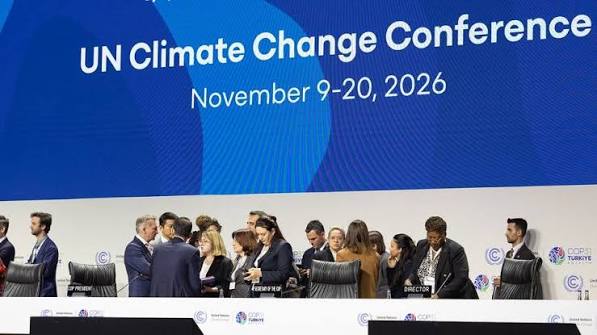
What the text did say is instructive. It set an ambition to scale up carbon capture, utilization and storage (CCUS) to gigatonne levels by 2035. It also aimed to raise electricity’s share of final energy use to 35% from about 23% now, reported Down To Earth. The electrification target had been untied from Dubai’s goals of tripling renewable capacity and doubling efficiency gains by 2030. The text said warming will exceed 1.5°C in the years ahead. It estimated developing countries’ climate finance needs at $455-584 billion a year to 2030. It also estimated adaptation needs at about $305 billion a year to 2035. It did not require anyone to pay any of it.
Russia and Saudi Arabia supported the exclusion of fossil fuels. Moscow could not accept any mention at all on fossil fuels, Russian delegate Sergei Kononuchenko told Reuters. Among those rejecting the text were the EU, UK, Norway, Panama and the Marshall Islands. Philip Davis, prime minister of the Bahamas, said Antalya had drained the small island states of their plans and patience. These talks had continued for three decades. Climate Action Network International (CAN), the global coalition of climate NGOs, also urged governments to reject the text, calling carbon capture and carbon dioxide removal dangerous distractions.
A few choices survived the collapse. Parties extended the Just Transition Work Program for three years and deferred the design of a just transition mechanism to COP32 in Addis Ababa. They also took decisions on the Adaptation Fund, transparency and carbon markets.
Thirty-one summits, rising emissions
The first COP was held in Berlin in 1995. Isak Stoddard and some twenty co-authors reviewed global carbon dioxide emissions in 2021. They found emissions stood 60% above their 1990 level, and a bit over half of all the CO2 humanity has ever emitted has entered the atmosphere since 1990. Greenhouse gas emissions have gone up about 10% since the Paris Agreement alone.
The figures of this year were announced in Antalya. The Global Carbon Project has forecast a 0.4% decline in fossil emissions to 38.2 billion tons in 2026, largely because of the oil shock from the war on Iran. Total CO2 including deforestation and land use hits record 43.3 billion tons. At that rate, the remaining budget for 1.5 °C would be exhausted in less than four years.
UNEP’s Emissions Gap Report said the window of opportunity to avoid overshoot in limiting warming to 1.5°C closed three weeks before the summit. Current policies are consistent with a 2.8 °C pathway this century. Meeting all national pledges in full would deliver a 2.6°C outcome, with the new pledges filed since last year making little difference to that projection. The Paris Agreement’s main tool for cutting emissions is national pledges, and according to UNEP’s numbers, they’ve changed the outcome.
Polluters as hosts
Nothing was more evident than President Erdoğan announcing two new oilfields in the Gabar mountains. They hold an estimated 135 million barrels, announced on the first day of the summit. A month ago, a presidential decree authorized the state oil company TPAO to look for urgent land acquisition across Antalya and the Mediterranean coast. Turkey’s climate goal allows for national emissions to rise until 2038. New coal plants are planned at Çanakkale and Afşin-Elbistan, and the government’s official list of green investments includes gas and nuclear power.
The summit’s corporate sponsors come from the same coal and mining interests. The “sustainable transformation partner” is Cengiz Holding, which last June announced the expansion of its Cenal coal plant. Limak Holding, which cut down Akbelen Forest to expand a coal mine, held a Blue Zone event on rapid decarbonization. In a country that Turkish environmentalists told NPR imports more European plastic waste than any other – and much of it is burned or dumped – a government flagship Zero Waste campaign is under way.
Turkey is not an exception. Earlier, the UAE put the head of its national oil company in the chair of COP28 and planned to use the summit to sign oil deals. Azerbaijan’s COP29 chief executive was filmed brokering gas agreements. Brazil auctioned 172 oil and gas blocks five months before Belém.
Hosting is a matter of prestige for the government and, in Ankara’s case, money. The Green European Journal said the government views ESG funds, green loans and summit income as a buffer against macroeconomic pressure ahead of the 2028 presidential election. Meanwhile, authorities charge local activists opposing mining and power plants with criminal offenses, detain them and fine them, as Human Rights Watch documented in the lead-up to the summit.
Polluters in the room
On 13 November, the Kick Big Polluters Out (KBPO) coalition published the count of its provisional participant list: 103 corporations and trade associations with a track record of blocking climate policy. Of these, 60 are from the fossil fuel industry. The biggest delegation, with 29 members, is from the International Emissions Trading Association, the carbon market lobby that the oil and mining majors set up to keep climate policy cheap. BNP Paribas sent 22, HSBC 19, ExxonMobil 13 and Amazon 12.
30 of the 100 banks that are the largest lenders to fossil fuels are registered. Between 2021 and 2025, they provided the industry with more than $2.2 trillion in financing, nearly 40% of all such bank financing worldwide. There are six times more delegations than Nepal and eight times more than the Philippines.
Most attended on guest passes given by governments to outsiders not part of their official negotiating teams. Forty-five are guests of the Turkish host and 31 are members of official negotiating delegations. BlackRock was part of the French delegation. Italy sent 50 representatives from the fossil fuel sector, versus 12 last year.
The pattern is continuing for a decade. At COP27, the coalition counted 636 fossil fuel lobbyists. At COP28, it counted a record 2,456. The coalition counted 1,773 at COP29 and 1,602 at COP30. That equals one in every 25 people in Belem. In total, 5,350 lobbyists from 859 organizations attended four summits.
Among them, 90 corporations produced 57% of the world’s oil and gas last year. After 31 UNFCCC conferences, no conflict-of-interest rule exists, unlike the rule adopted by the WHO’s tobacco convention. The lobby’s principal aim is omission. A Transparency International study interviewing negotiators finds that lobbyists exert influence chiefly through state delegations.
Their usual result is inaction: negotiators block wording and leave decisions unfulfilled. No COP decision mentioned fossil fuels until Glasgow in 2021. Dubai’s 2023 formula was to “move away” from them. Over 80 countries backed the roadmap, but the final text from Belém struck it out and omitted fossil fuels.
Antalya’s final draft also did the same on fossil fuels and set a gigatonne target for carbon capture, a technology the oil industry has long touted. CAN pointed out hundreds of lobbyists for carbon capture technology at the summit. Addressing leaders in Antalya, UN Secretary-General António Guterres was blunt. “The dinosaurs did not have a lobby,” he said.
Markets as the method
The lobby isn’t proposing a plan to phase out fossil fuels, it’s proposing schemes that allow polluters to continue polluting. Since Kyoto, the regime’s preferred instrument has been the tradable carbon credit. The rules for Article 6 of the Paris Agreement were finalized in Baku, making it a trade between countries. A rich country funds a project in a poorer country, for example, planting trees or building a solar farm. The project is supposed to save carbon. That carbon then contributes to the rich country’s target, keeping its emissions intact. Thus, a rich country can pay for cuts in a poor one and take the credit for it.
Some governments already build their climate plans around buying credits. Singapore expects its emissions to grow until 2028 while scaling up purchases of Article 6 credits. A 2023 paper in One Earth by Danny Cullenward and colleagues concluded that offsets as they exist are incompatible with the Paris Agreement. The World Rainforest Movement’s verdict on REDD+, the forest-credit scheme, after almost twenty years is total ineffectiveness at stopping deforestation.
Each summit launches a new program of the same type. Belém started the Tropical Forests Forever Facility, a $125 billion fund that invests in global markets and uses the returns to pay forest countries. Survival International said that this money would depend on the same companies that destroy tropical forests for its income. The Antalya draft set a gigatonne target for carbon capture by 2035, and the presidency’s top priority was a pledge on electrification backed by 180 corporations, including Volvo, Uber, IKEA and Siemens.
Each scheme turns an obligation to stop emitting into a license or, more precisely, a right to keep emitting, which someone poorer sells. Forests and farmland in the South become permission for the North to keep burning oil, gas, and coal. That’s why Indigenous delegations at COP25 and COP26 called Article 6 carbon colonialism. In Papua, the environmental group WALHI reports that the same companies want its land for fossil fuel projects, large food plantations, and carbon offsets, all at the same time.
Corporate advertising in the pavilions is a much smaller part of the greenwashing. Most of it appears in the Paris Agreement’s own rules on carbon markets and offsets. In Antalya, governments couldn’t agree on how to name fossil fuels. However, they still adopted fresh decisions on carbon markets.
Finance as debt
There is money promised to the South for putting up with all this. The Baku deal of 2024 promised all these. Developed countries are meant to lead the way in raising at least $300 billion annually by 2035. This target forms part of a broader, non-binding goal of $1.3 trillion from all sources. We’ve got to read the language carefully. “Mobilizing” includes loans and private investment, and “all sources” includes private money. So the whole sum might come as debt, not a single dollar free.
According to Oxfam and CARE’s Climate Finance Shadow Report 2025, two-thirds of public climate finance in 2021-22 took the form of loans. Most loans were non-concessional. Developing countries received some $62 billion in climate loans in 2022. They are expected to return more than $88 billion to the lenders. For every five dollars received, seven are returned. Of the total, 19.5% went to the least developed countries and 2.9% to small island states. Developing country debt is $3.3 trillion.
Antalya went the same way. On the opening day, African nations requested time on the agenda to discuss tripling cash for adaptation, but the hosts said no. Vulnerable countries wanted at least $120 billion a year by 2035. The earlier draft had repeated the ambition of tripling adaptation finance without a baseline or number. It had also established an Antalya–Addis Ababa Road Map to keep discussing it until COP32. The Adaptation Fund has received $50 million from rich countries, according to the ACT Alliance. There were no new commitments to the loss and damage fund.
The fund for loss and damage created at COP28 has received around $600 million. Guterres told the leaders’ summit that the nine largest oil companies “pocketed $95 billion in profits” in the last quarter alone, adding: “That is what these companies made in about 14 hours.” Five Western majors booked $56.3 billion in the third quarter on war-inflated prices.
When a government does act, those same companies can sue the government. Fossil fuel companies have won at least $443 billion from states in investor-state arbitration, and have been awarded $86 billion, which is nearly 70% of all such awards. Trade and investment treaties incorporate the right to sue. The COP has no power to change any of these.
Climate finance on these terms is like a new line of credit. The countries that did the least to cause the warming now have to take on debt to deal with its effects. Organizations like CADTM has been arguing for a long time that the North has an ecological debt to the South. In practice the South continues to pay.
Why the COP cannot deliver
These results are produced by three aspects of the COP system, independent of the chair. The first is consensus. All decisions require the approval of all members, giving each petrostate a veto. From the opening session, the Arab Group in Antalya rejected any reference to Brazil’s roadmap on fossil fuels, while Russia and Saudi Arabia resisted a text without fossil fuels to the very end. The closest the regime gets to admitting there is a problem is in its failed draft that suggested dialogs in 2027 and 2028 about how to make the consensus system work better.
The second is volunteering. Paris replaces binding targets of Kyoto with each state pledging its own. Yet a government that fails to hit its target, as one withering assessment of Belém pointed out, suffers no legal sanction. It costs almost no political price in practice either. The Paris Agreement’s Article 15 explicitly requires the compliance committee to be non-punitive.
Third, the COP has no authority over the sources of emissions. Stefan Aykut and Amy Dahan, scholars of climate governance, call this the schism of reality. The talks are about climate change as a matter of counting emissions. Decisions on energy, trade, finance and investment are taken elsewhere, by bodies such as the WTO and the IMF, which have the power to enforce their rules. Energy was a almost forbidden word in the process for twenty years. In their recent work the authors argue the gap has migrated into a fiction of orderly decarbonization, repeated at each COP as an incantation.
In a review of nine fields of research, Stoddard found that the common denominator of thirty years of failure is power. Fossil capital, i.e., the oil, gas and coal companies and the banks and funds that finance them; have reserves, pipelines and power plants that are only worth anything if their fuel is burned. States compete for the investment and tax revenue of that capital. Some states are that capital because the state controls the national oil company, such as Saudi Arabia. It cannot take those assets away from its own members without all of these states agreeing a meeting. It can convert the crisis into promises, and then convert the promises into markets, making the crisis appear manageable.
The defenders of the process have a point. The COP is the one site where Tuvalu and Nepal sit as formal equals of China and the EU, and the loss and damage fund exists because small states fought for thirty years in that room. Australian ABC News reported that many developing countries reluctantly supported the final text in Antalya because they thought consensus mattered more than the text’s content. Harjeet Singh, founding director of the Satat Sampada Climate Foundation, took the opposite view, saying: “No deal is better than a deal that locks in failure.” The Pan African Climate Justice Alliance (PACJA) said much the same.
The walkout by the EU deserves as much scrutiny as the veto by the oil states. The bloc rejected a text without fossil fuel language, but campaigners in Antalya accused it of stalling stronger commitments on adaptation finance and a just transition, Nepali paper People’s Review said. Developed countries as a group were accused by CAN of blocking progress on finance. French climate politics researcher Édouard Morena said the EU and Australia were hypocritical to campaign for a fossil fuel roadmap after Belém. Their own hydrocarbon production was still rising. Australia headed up negotiations this year. It is also one of the world’s largest coal and gas exporters.
Reformers want majority voting, conflict of interest rules and criteria for hosts. And these are worth fighting for. Exclusion of polluters above all. But a cleaner negotiation over voluntary pledges and tradable credits would not bring ownership of the energy system into the room. Nor would it bring financing into the room.

The challenge for us
The forces that could change the mandate were out on the street on 14 November. The People’s Climate Summit organized the march. It is a platform created by groups excluded from the official process, along with trade unions and rights groups. It connects local struggles in Akbelen, İkizdere, Perşembe with labor and human rights struggles. “Their voices are never heard at the COP, and new power stations and coal mines are still being opened,” Halime Saman of the platform told AFP.
The same split was seen in Belém a year ago. The Cúpula dos Povos concluded with a declaration that blamed capitalism for the crisis, rejected offsets and financialised forest funds and called for demilitarization and reparations for extractivism. The official conference a few kilometers away couldn’t be arsed to type the words fossil fuels.
Honestly speaking, we need to stop judging climate politics by whether a summit text includes or excludes fossil fuels. Rather, we must demand a binding cut-off date to end coal, oil, and gas extraction. We must enforce it on the companies and banks that sent lobbyists to Antalya, starting with the thirty banks that put $2.2 trillion into fossil fuels in five years. We must push for public and community energy ownership because the companies that own it have shown us what they will do with it.
We should also raise voices for grants and reparations instead of loans and the cancellation of the debts that climate loans have exacerbated. The demand for an ecological debt owed by the Global North should be central to our advocacy efforts. Governments should leave investment treaties that allow fossil companies to sue them for $443 billion. Indigenous and peasant land rights are a better forest protection than any credit, and we should defend them as climate policy.
None of these demands will be won by consensus with Saudi Arabia in a hall sponsored by a coal company. Where demands like these have been won, movements have imposed them on national governments, from the communities that stopped pipelines to the campaigns of debtors that won cancellations. So the trick for the Left between now and Addis Ababa is to build those movements in our countries and use every COP to expose the people who sponsor it.
About the Author

Editorial Board Member of Alternative Viewpoint