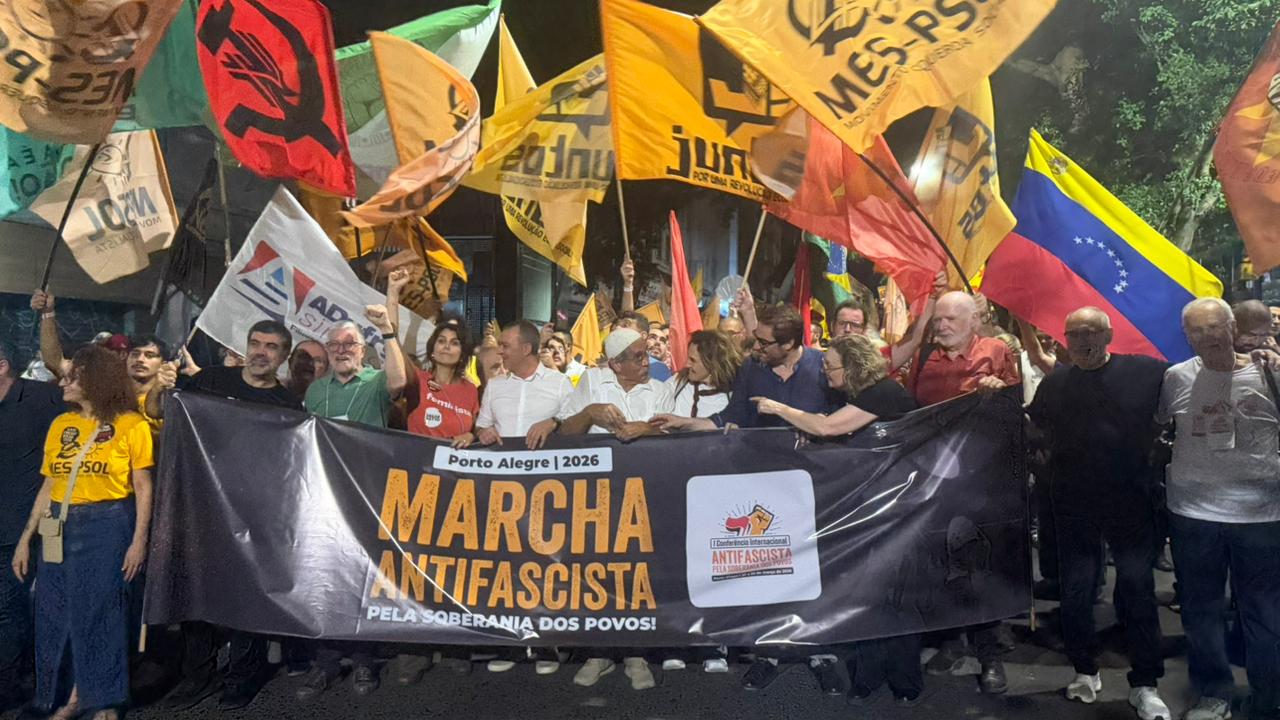
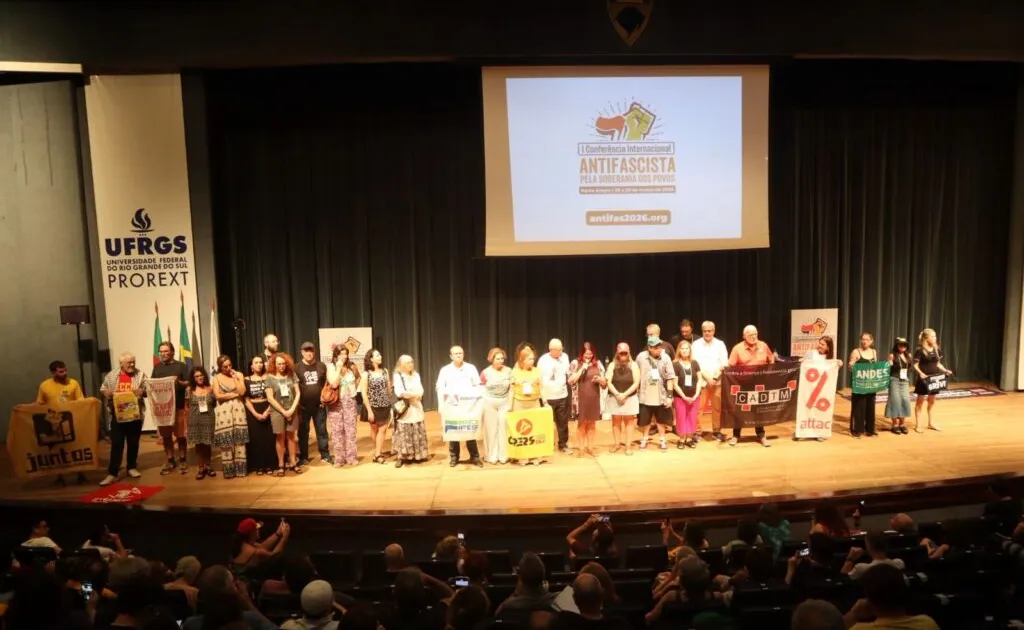
In this interview with Gabriella Lima, Sushovan Dhar takes stock of the first International Anti-Fascist Conference, which took place in Porto Alegre (Brazil) from 26 to 29 March. He discusses the progress, limitations, and challenges involved in building a united anti-fascist and anti-imperialist front at the international level, as well as the prospects of organising a regional conference in Asia in 2027.
Sushovan Dhar is a member of the Committee for the Abolition of Illegitimate Debt (CADTM) from India, which played a leading role in organising the Porto Alegre conference and its international links. Interview by Gabriella Lima.
Gabriella Lima: What is the context of this international anti-fascist conference, and what significance does it hold within the current political climate?
Sushovan Dhar: It is important to note the political moment in which the conference is taking place. We are in a particularly dangerous and unstable period on a global scale. Indeed, we are simultaneously witnessing the rise of the far right, the return of imperialist wars, and a global offensive against social and democratic rights. Today, we see authoritarian and far-right forces developing everywhere. One needs only to think of Trump and Trumpism in the United States, Milei in Argentina, Modi in India, Netanyahu in Israel, and the rise of the far right in Europe, but also authoritarian regimes in various parts of the world, including Russia and China.
So these dynamics are not isolated; they are deeply linked to the crisis of capitalism, the worsening of social inequalities, and increased militarisation. At the same time, we are also witnessing an obvious resurgence of conflicts between major powers. Thus, the war in Ukraine, the genocide in Palestine, the attack on Iran, the escalation in the Middle East, and the growing tensions in Asia all show that we are entering a period marked by instability and confrontation between blocs.
In this context, the Porto Alegre conference was a very significant attempt to rebuild an internationalist response. Since the decline of the World Social Forum, there has been a lack of space for international political coordination. This conference thus aimed to reignite a dynamic with an obvious objective: to rebuild an anti-fascist and anti-imperialist front on an international scale. I believe this objective is what gives this conference its political significance. It was not merely an event but a first step towards rebuilding international coordination in the face of the rise of the far right and conflicts.
G.L.: The conference organisers started from the understanding that unity in action was necessary to combat the rise of fascism and the return of large-scale inter-imperialist wars. Can you tell us about this united framework and how it was built? What conclusions do you draw regarding our ability to build a broad anti-fascist front at the international level?
S.D.: It should be noted that, from the outset, we understood quite clearly that, in the face of the global rise of the far right, no organization can act alone. So we had to build broad unity, even with significant political differences. The process brought together a wide variety of actors—social movements, political organisations, trade unions, feminist movements, international networks, and peasant organisations from different traditions on the left. It was this diversity that was our strength, but it also created tensions within the conference. It is important to understand that unity was not built on political homogeneity but by focusing on convergence in action.
This is important because, within an anti-fascist front, the aim is not to have a common line on everything but to build common ground in the face of a threat that affects us all. But this unity has also revealed the contradictions within the international left, which is currently quite fragmented. Certain forces still have a ‘campist’ view of anti-imperialism and downplay certain authoritarian regimes, such as Russia or China, for the sole reason that they are ‘in conflict’ with Western powers. Such unity has given rise to significant debates. But I think this is also a positive aspect, because building an international anti-fascist front necessarily involves political discussions and serious debates. Overall, the conference demonstrated a genuine desire to rebuild international coordination, even if the process still requires development. This presents a challenge!
G.L.: We’ll come back to these differences of approach regarding anti-imperialism. Could you say a few words about your assessment of this event and outline the key points from the final declaration adopted in Porto Alegre?
S.D.: The conference was a major success: there was broad participation from delegations across several continents and a powerful militant dynamic. What was particularly important was that the conference helped forge links between organisations and movements that hadn’t necessarily worked together before. It also provided an opportunity for open discussion of major strategic issues such as the rise of the far right, wars, the question of anti-imperialism, the debt issue, social and feminist struggles, and so on. The final declaration reflects this broad convergence. It highlights the struggle against the far right, solidarity with Palestine, opposition to imperialist wars, the defence of social and democratic rights, and also – very importantly – the need to strengthen international solidarity.
But at the same time, as Eric Toussaint also emphasised in his assessment of the conference, this convergence took place amid certain political ambiguities, which are important to acknowledge because building a sustainable dynamic requires clarifying these differences. In short, I would say that the conference represented an important step, but that it marks a starting point rather than a finishing line.
G.L.: To return to its limitations, within the international left, some felt that this conference lent credence to the idea that it was essentially only Western imperialist powers that served as a base of support for the various far-right movements around the world. Can you tell us a little more about how this debate unfolded within the organising committee, with those who opposed referring to Vladimir Putin’s Russia as one of the imperialist powers that must be fought, even though Russia has been waging one of the most brutal imperialist wars for over four years in Ukraine and openly supports far-right forces internationally?
S.D.: One of the most important debates at the conference naturally centred on the question of Russia, the war in Ukraine and, more broadly, how to define anti-imperialism today. Some of the forces present rightly highlighted the role of Western imperialist powers, notably the United States and NATO. But at the same time, some of these forces refused—or hesitated—to characterise Russia as an imperialist power or to clearly denounce the aggression against Ukraine that has been raging for over four years. This debate is fundamental, because it touches on the very credibility of an international anti-fascist and anti-imperialist project. If we adopt a selective view of anti-imperialism, we risk falling into a ‘campist’ logic, which fails to mention certain authoritarian regimes simply because they are in conflict with Western powers.
Yet Putin’s Russia has for several years been waging a brutal war of invasion against Ukraine, resulting in massive destruction, the repression of democratic movements, and an aggressive policy throughout the region and even against any opposition within its own country. Furthermore, the Russian regime maintains links with various far-right forces on an international scale. It was emphasised during the conference that overlooking this issue was one of its political limitations. This shows that there are still significant differences within the highly fragmented international left regarding how to conceive of anti-imperialism in a multipolar world. So for us, the position must be very clear: anti-imperialism cannot be selective; it must oppose all imperialist powers, whatever they may be. Otherwise, we weaken our internationalist perspective.
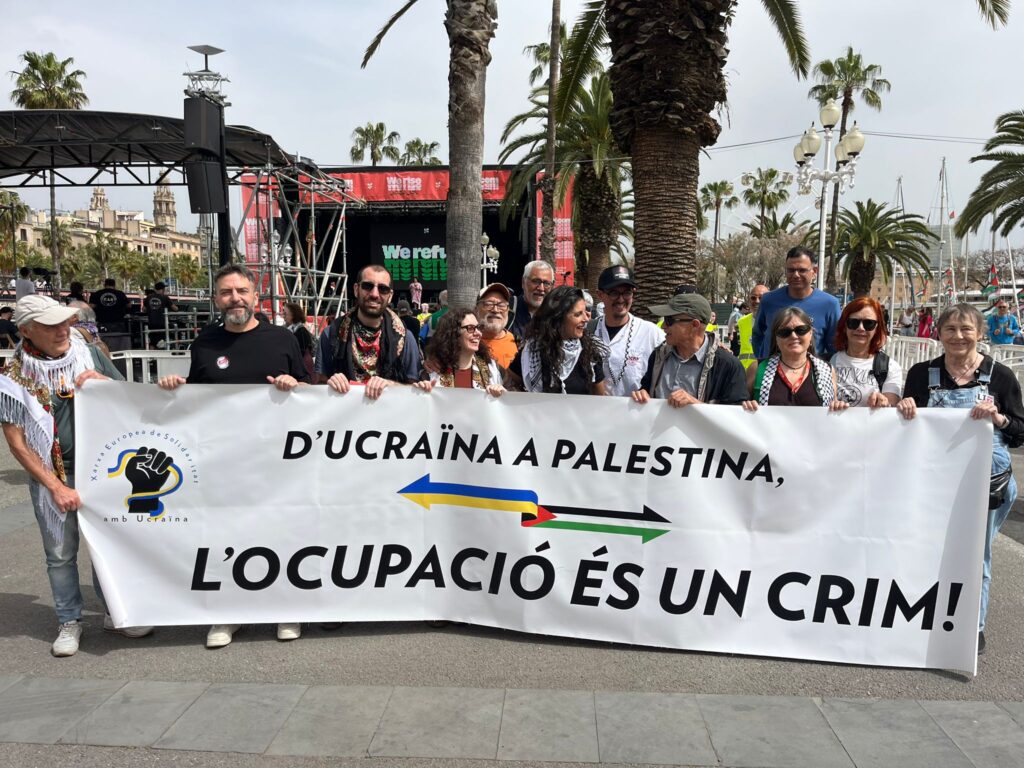
G.L.: Could you also comment on the efforts made by activists from the Fourth International Organization to highlight solidarity with the Ukrainian people and denounce Russian imperialism during the conference?
S.D.: Activists from Fourth International and its affiliated organisations played a major role in organising this conference and defending an independent internationalist position. It was essential to do so. Several speeches affirmed our solidarity with the Ukrainian people whilst also opposing NATO and global militarisation. This independent position rejects both any alignment with Western powers and any complacency toward Russian imperialism. This stance is essential for rebuilding a credible internationalism.
Discussions were also held to highlight the struggles of Ukrainian social movements and trade unions and feminist organisations, as well as the democratic opposition in Russia. The daughter of Boris Kargalitsky, imprisoned for his criticism of Putin’s regime, was present, reminding everyone that internationalist solidarity must be built with peoples, not with states. These contributions obviously did not resolve all differences, but they opened up an important debate and put forward an independent internationalist position within the conference.
G.L.: How can we explain that a representative of the Islamic Republic of Iran, responsible for the bloodiest repression in that country for over 40 years, was invited and actively participated in this conference? Should 21st-century anti-imperialism and the struggle against far-right regimes worldwide clearly oppose turning a blind eye to authoritarian regimes simply because they conflict with Western imperialisms?
S.D. That is indeed a critical question. The representative from Iran was on the same panel as me, and his presence represented a notable limitation of the conference. It rightly provoked significant criticism both from those present and from comrades internationally. The Iranian regime is notorious for its extremely brutal repression of social movements, trade unions, women, and minorities. The ‘Women, Life, Freedom’ movement has vividly illustrated the extent of popular opposition to this authoritarian regime. In this context, the participation of a representative connected to this regime at our conference raises a serious political issue.
Anti-imperialism cannot justify ignoring authoritarian regimes solely because they oppose Western powers. This issue was discussed during the conference and reflects a persistent tension within the international left: on one side there is a “campist” vision that prioritises opposition to the United States, and on the other an independent internationalist perspective that advocates solidarity with the people. So for us, the position must be clear: anti-imperialism must be an anti-imperialism of the peoples, not of states.
G.L.: Let’s return to the challenges related to the aftermath of this conference. We’ve seen that, despite its undeniable scale, importance, and success, there is still progress to be made in expanding this anti-fascist front to include trade unions, with whom we hope for greater engagement in the future. The same is also true for feminist and LGBTQIA+ movements, which should play a more significant role going forward, given that they are directly targeted by the far right. What challenges now lie ahead of expanding this conference, and how can we move from an international conference or several regional conferences to the establishment of an organization that links grassroots movements on an international scale?
S.D.: Despite its success, the conference showed that the international anti-fascist front still needs to be built. A first challenge concerns trade union participation. The rise of the far right is deeply linked to the social crisis, the precariousness of work, and the weakening of the workers’ movement. It is therefore essential that trade unions play a more central role in building the anti-fascist front. A second challenge concerns feminist and LGBTQIA+ movements, as these movements are now directly targeted by far-right forces in several countries, even in India.
Therefore, greater participation by these movements in building an anti-fascist front is indispensable. A third challenge is organisational in nature. How do we transition from a conference to a sustainable organization? This is an important question, which involves building regional networks, launching joint campaigns, and creating regular spaces for coordination. Thus, the prospect of organising regional conferences is an important step in this process. We discussed the possibility of organising a conference in Argentina, but we will also need to establish concrete links between grassroots movements. This is important for broadening the anti-fascist front.
G.L.: Can you tell us about the major mobilizations that have taken place recently in India and what this context opens up in terms of organization and international connections?
S.D.: In India, as you know, we are facing a very strong surge from the far right. The Modi government has been in power for twelve years. It combines religious nationalism, political authoritarianism, and a very aggressive neoliberal policy. But there are also significant resistance movements, such as the farmers’ movement, which has mobilized millions of people for over a year. There are also student, labor, and feminist struggles, as well as mobilizations against authoritarian policies. On February 27, a general strike mobilized 300 million people, undoubtedly one of the largest social movements in the country’s history. These mobilizations show that the far right is not invincible. They also open up opportunities to strengthen international ties. My participation in the Porto Alegre conference is part of this effort to build a militant and sustainable internationalism.
G.L.: Building an anti-fascist and anti-imperialist united front of this kind in South Asia also raises the question of our relationship to BRICS+. Could you tell us a little about BRICS+ from the Indian perspective and the internationalist line we should defend on this issue with a view to a regional unity conference?
S.D.: The issue of BRICS+ is central today because it gives rise to many illusions in certain parts of the international left, particularly in Latin America, Brazil, the United States, and also in Europe. We often see BRICS+ presented as a progressive alternative to Western hegemony. But in my view, this interpretation is highly problematic. BRICS+ is not building an anti-imperialist bloc; that much is clear. It is an alliance among capitalist powers seeking to strengthen their position in a capitalist world undergoing restructuring. The BRICS+ countries have their own economic, geopolitical, and strategic interests—which, incidentally, differ greatly from one another—that do not align with those of the people, workers, the oppressed, and the exploited.
From an Indian perspective, this is particularly clear. The Modi government uses BRICS+ to strengthen India’s geopolitical role, attract investment, secure access to resources, and attempt to bolster its position vis-à-vis China. But such progress is not accompanied by a progressive policy—quite the contrary. The rise in authoritarianism, attacks on minorities, and an assault on social rights characterise Modi’s India. And the same contradiction exists in the other BRICS+ countries, such as China, which is developing a global power policy with its own economic and strategic interests, or Russia, which is pursuing an aggressive imperialist policy, particularly in Ukraine. The expansion of BRICS+ to include countries like Saudi Arabia or the United Arab Emirates further reinforces the conservative and authoritarian nature of this alliance.
As critical analyses have pointed out, the BRICS+ represent more the emergence of multipolar capitalism than a progressive alternative. The multipolarity of capitalist powers does not necessarily mean a more just world. On the contrary, it can lead to more rivalries and conflicts. Therefore, for an international antifascist front, our position must be clear: we must not fall into the logic of allying with one bloc against another. Our internationalism must remain independent of state powers. What does this mean? First, refusing to align with Western powers. Second, I also reject any illusions about the BRICS+. Third, defending the independence of popular movements and building solidarity among workers and social movements. This is an essential strategic orientation. If the international anti-fascist movement harbours illusions about BRICS+, it risks repeating the mistakes of the past, when anti-imperialism turned into support for authoritarian regimes. On the contrary, we must rebuild a people’s internationalism based on solidarity among social, democratic, and anti-fascist struggles on a global scale.
G.L.: What are the prospects for organising a conference in Asia? Can you tell us about the representation of Asian organisations in Porto Alegre and the challenges involved in organising an event on a regional scale in 2027?
S.D.: Asian representation at the Porto Alegre conference, though still relatively limited, was nonetheless an important and promising development. Delegations from India, Pakistan, the Philippines, and other Asian countries were present, which helped open a discussion on building an anti-fascist movement in this vast region. That said, this participation fell short of its true potential. Asia is today one of the regions where authoritarian and nationalist tendencies are particularly strong. One might think of India with Hindu nationalism, the Philippines with the consolidation of authoritarian dynamics, the rise of militarism in several countries, or the repression of social movements in various regions.
Furthermore, Asia is also at the centre of inter-imperialist rivalries, particularly between the United States and China, as well as significant tensions involving India and Pakistan, an ongoing war between Pakistan and Afghanistan, and conflicts in Southeast Asia. This situation therefore underscores the need to build anti-fascist and anti-imperialist coordination in the region. But there are also specific challenges: Asia’s political, linguistic, and cultural diversity makes it more difficult to build a common space, and severe repression in several countries limits opportunities for open organising. Finally, social movements are often fragmented and face vastly different national contexts.
Nevertheless despite these difficulties, the goal of organising a regional anti-fascist conference in Asia is extremely important. We discussed the possibility of holding a conference in the Philippines, perhaps in 2027, which would also serve as an Asian regional conference. In my view, such a conference would help strengthen ties between social movements, share experiences in the struggle against the far right, and build stronger international solidarity. It is also important to highlight our gathering in Istanbul in July, on the occasion of the anti-NATO summit. So, it is important to mobilise for all of these goals, and in this sense, Porto Alegre must be seen as a starting point for developing regional dynamics, including in Asia.
The interview originally appeared in French on Marx 21 website.
About the Author

Editorial Board Member of Alternative Viewpoint

Gabriella Lima
is an activist based at Lausanne.