The first year of Donald Trump’s return to the US presidency has accelerated an ongoing transformation: the disintegration of US-led neoliberal globalisation. From the 1990s through the post-2008 period, global capitalism was organised through a structured hierarchy, with US financial dominance, global value chains, and multilateral institutions that secured the conditions for capital accumulation. That architecture is now visibly fraying.
What is emerging is often described as ‘multipolarity’, as if a more balanced order were taking shape. But this language obscures the central dynamic: not the disappearance of hierarchy, but its reorganisation under intensified inter-imperial rivalry. Trade, finance and technology are no longer governed primarily by the imperatives of market integration. They are increasingly subordinated to strategic competition, evident in export controls on advanced technologies and efforts to restructure supply chains. The shift is not from globalisation to fragmentation but from relatively open circuits of accumulation to more managed, politicised interdependence.
Trump’s second term should be understood in this light—as an accelerant rather than a rupture. The turn toward protectionism, supply chain restructuring, and economic nationalism predates his return, rooted in the long crisis of profitability and the strategic challenge posed by China’s rise. What has changed is the explicitness with which major powers are now willing to weaponise interdependence and redraw the terms of global integration.
In this context, the question is not simply which state will dominate the emerging order but how different states operate within it. It is here that countries such as India assume a particular significance: not as alternative centres of power, but as actors navigating—and seeking advantage within—the fractures of a recomposing global hierarchy.
Why India Matters Now
India’s growing centrality in global economic and geopolitical debates is not simply a function of its size but of its place in this order. With a large domestic market, a substantial workforce, and an expanding digital and infrastructural base, India emerges as a potential site for the partial reorganisation of global value chains, reflected in the rapid expansion of electronics assembly and Apple’s shift of part of its iPhone production to India. The search for alternatives to China has elevated India’s profile, but meaningful relocation of production remains limited.
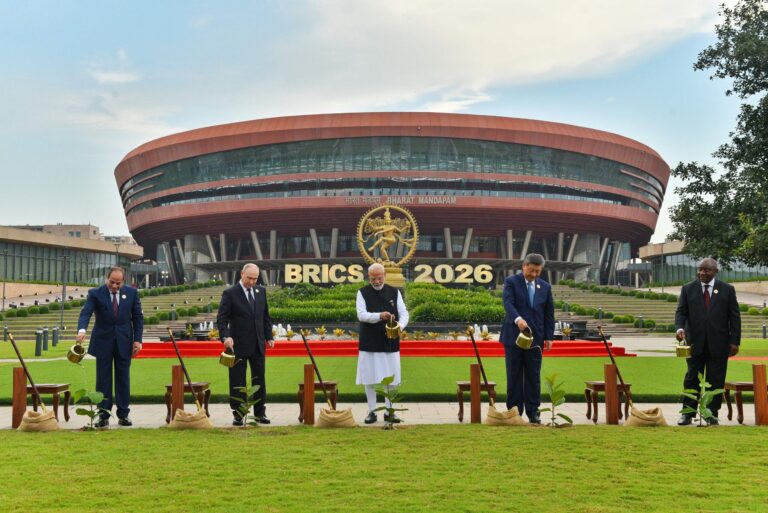
At the same time, India occupies a distinctive geopolitical space. It is neither integrated into Western alliance structures nor aligned with China. Its participation in groups like the QUAD and BRICS is a condition of its relevance, not a contradiction.
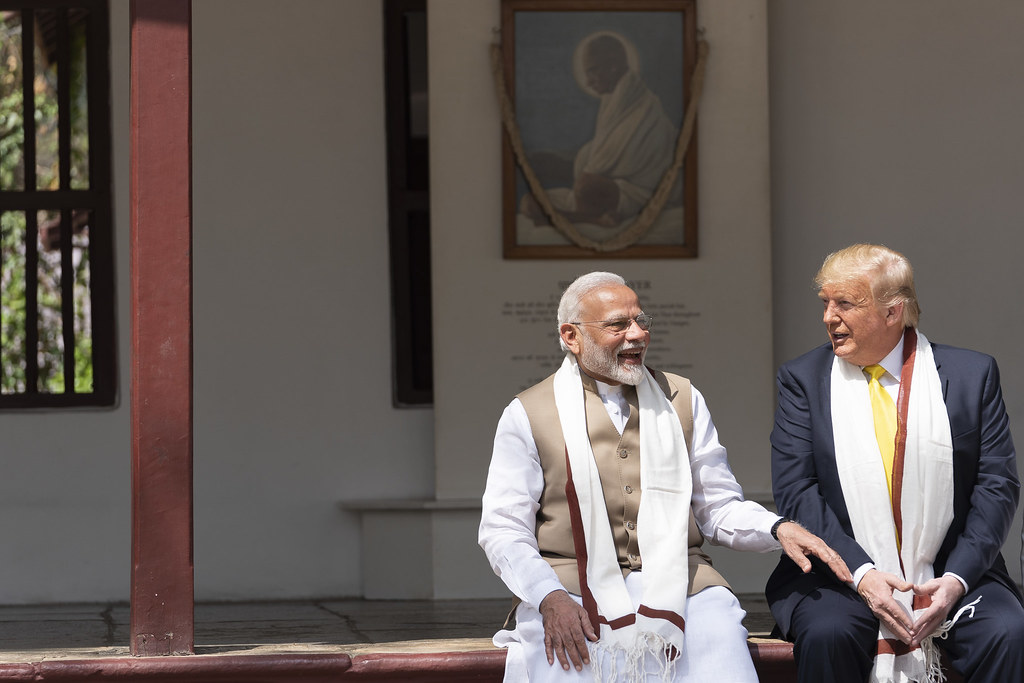
This duality—economically attractive to global capital and politically mobile across geopolitical divides—has made India an increasingly important interlocutor. It is courted by the United States and its allies, while simultaneously maintaining ties with Russia and projecting itself as a voice of the Global South. In moments of systemic transition, such positions become more important.
Yet it would be misleading to read this prominence as evidence of an impending transition to Indian hegemony, or even to a stable multipolar equilibrium in which India emerges as one pole among others. India’s importance lies less in reordering the system than in how it operates within it. It is not simply rising; it is positioning itself within the constraints and opportunities produced by an increasingly fractured global order.
India as a Hinge State
India’s current role is best understood not through “non-alignment” or alliance formation, but as that of a hinge state. India today moves across blocs, unlike the non-aligned posture of the Cold War, which sought to maintain distance from them. However, it refrains from making binding alliance commitments. This reflects an effort to extract material and strategic gains from a context in which major powers are competing to secure partners, markets, and influence.
Following the war in Ukraine, India sharply increased its imports of discounted Russian oil, with Russia becoming its largest supplier in 2023, much of it refined and re-exported to Western markets as petroleum products, even as Western sanctions sought to isolate Moscow. These purchases also helped stabilise domestic energy prices and supported economic growth. Simultaneously, India deepened its strategic partnership with the United States through the QUAD—an Indo-Pacific strategic grouping—while broader Western security initiatives such as AUKUS have taken shape alongside it. It has expanded defence cooperation and positioned itself as a critical node in efforts to reconfigure supply chains away from China. What appears as inconsistency is strategy. India leverages geopolitical tensions without fully committing to any single camp.
This hinge function extends beyond energy and security. India actively courts investment, promoting itself as an alternative manufacturing destination through state-led initiatives such as production-linked incentive schemes. At the same time, it continues to participate in BRICS, endorsing projects even as its integration into US-led capital circuits deepens. The coexistence of these orientations is not transitional but constitutive of its current role.
To describe India as a hinge state is to recognise a specific mode of insertion into the global order—one that relies on movement between centres of power and the capacity to translate systemic fragmentation into strategic advantage.
The Limits of Autonomy
The language of ‘strategic autonomy’—India’s claim to act independently of competing blocs—overstates the freedom implied by its hinge position. Its capacity to manoeuvre is real, but exercised within structural constraints. The hinge can pivot—but only within the frame that holds it. This room for manoeuvre is also subject to pressure, as the United States increasingly links strategic partnership to expectations around trade, technology, and sanctions compliance.
India’s growth remains tied to global circuits of capital, technology and demand. Its appeal as an alternative manufacturing hub rests on low labour costs and state-led incentives; its industrial base remains uneven, with strength in areas such as pharmaceuticals and services but gaps in advanced manufacturing, and its integration into global value chains depends on imported components, foreign investment, and external markets. Efforts to attract supply chain relocation, whether in electronics, pharmaceuticals or semiconductors, yield partial gains but fall short of a structural transformation.
Ambitions of digital sovereignty coexist with reliance on external capital and infrastructure. Partnerships with US firms and alignment with Western technology ecosystems have enabled expansion in sectors such as digital services and telecommunications but also reinforce asymmetric dependencies in areas such as advanced manufacturing, chip design and critical technologies. This is not autonomy but negotiated insertion.
Sustained growth rates of around 6–7% coexist with persistent inequality, agrarian distress, and a labour regime characterised by informality and precarity, with over 80% of employment remaining informalised. Much of India’s comparative advantage in global production continues to depend on the reproduction of low-cost labour under conditions of limited social protection. The uneven distribution of the benefits of its geopolitical positioning raises the question of whether “national” strategic gains translate into broader social advancement.
Finally, India’s expanding international role is accompanied by the consolidation of political power domestically, with increasing centralisation and repression of dissent. These shifts underpin India’s capacity to present stability to global capital and act decisively in geopolitical negotiations. Autonomy at the level of the state can thus coexist with deepening asymmetries within society.
Implications for the Global South
India’s trajectory as a hinge state raises broader questions about the possibilities facing the Global South. Its ability to navigate between competing blocs, extract concessions, and maintain a degree of strategic flexibility may appear, at first glance, as a model for other postcolonial states seeking to avoid subordination within any single bloc. Yet such a reading risks mistaking a structurally specific position for a generalisable strategy.
India’s ability to act as a hinge is closely tied to its size. Few states possess the strategic location that allows India to be simultaneously courted by multiple centres of power. For smaller and more economically vulnerable countries, the fragmentation of the global order is more likely to narrow the space for manoeuvre—pushing them toward selective alignment or dependent integration.
This may deepen differentiation within the Global South. While some states are able to leverage inter-imperial rivalry to secure investment, technology transfers, or diplomatic concessions, others face intensified pressures to conform to the strategic and economic priorities of dominant powers.
The fragmentation of globalisation does not automatically translate into greater autonomy for the Global South; it may instead produce more complex and differentiated forms of dependency, mediated through regional powers and hinge states.
Conclusion
India’s emergence as a hinge state does not herald the arrival of a new, stable multipolar order. It reveals the character of the transition underway. What is taking shape is not the displacement of hierarchy, but its reconfiguration through intensified rivalry, selective decoupling, and uneven forms of interdependence. States like India matter less for transcending the system than for how they operate within its fractures.
The hinge can move. But it does not determine the door.
The original Spanish version of this article was published in Espacio Público
About the Author

Editorial Board Member of Alternative Viewpoint